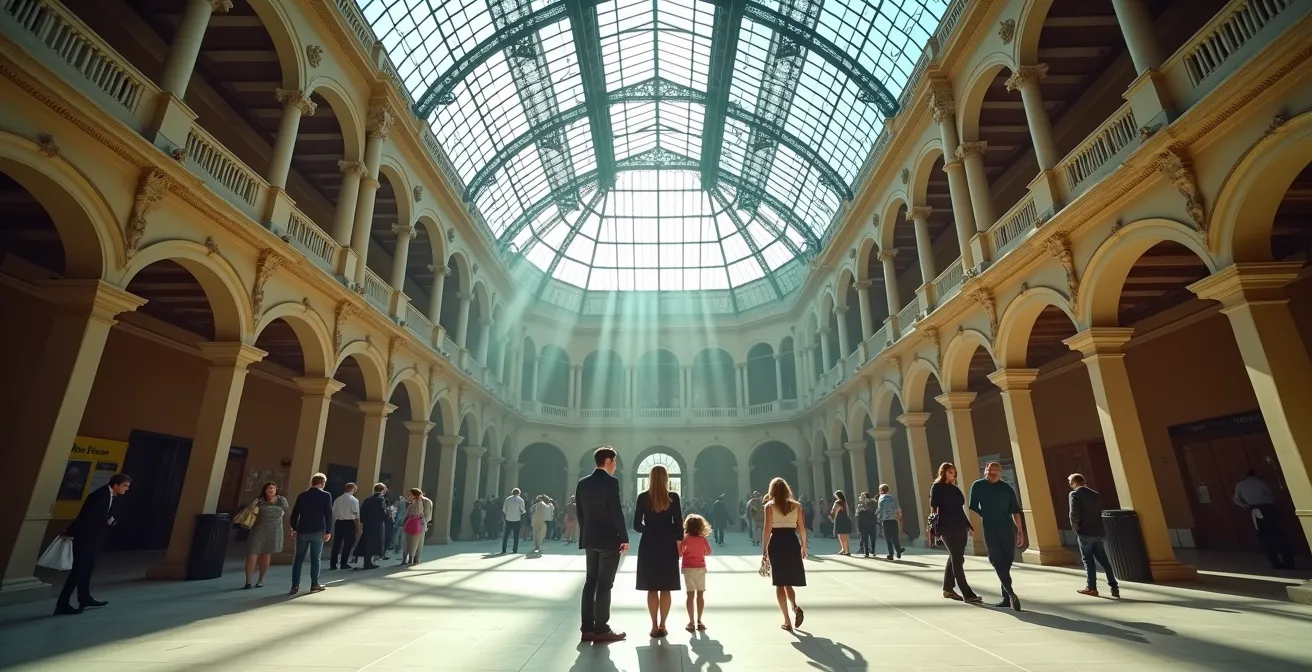
The key to enjoying the ballet for the first time isn’t knowing the art, but mastering the practicalities of the experience.
- Your outfit is less important than your comfort; jeans are perfectly acceptable, but “smart casual” is a safe and common choice.
- Choosing the right performance (story-driven vs. abstract) and seat (overview vs. close-up) will completely transform your evening.
Recommendation: For a fantastic first visit, choose a classic narrative ballet like *Swan Lake* and opt for a seat in the Amphitheatre for a spectacular, affordable view.
You’re holding a ticket to the Royal Opera House. The gold crest gleams under the light, a promise of world-class artistry, sweeping music, and breathtaking performance. But alongside the excitement, a knot of anxiety might be tightening in your stomach. What do I wear? Will I feel out of place? What if I don’t understand the story? These are the questions that can turn a magical night out into a stressful ordeal, reinforcing the myth that ballet is an exclusive club with a secret handshake.
Most guides will tell you to “read the synopsis” or wear “something smart.” This advice, while well-meaning, misses the point entirely. The real barrier for a newcomer isn’t the art on the stage; it’s the unwritten rules of the experience itself. The fear of committing a faux pas is often greater than the fear of being bored by the performance. This is where the elitism of the art form truly lies—not in its complexity, but in its perceived inaccessibility.
But what if the secret wasn’t about trying to fit in, but about crafting an evening that works for you? This guide is your experience blueprint. We will strip away the myths and give you the practical, non-jargony information you need to walk into one of the world’s greatest theatres with the confidence of a seasoned regular. We’ll focus on the things you can control—your clothes, your seat, your pre-show pint—so you can relax and let the art on stage do its work. We’ll even explore how the principles of an amazing cultural night out extend beyond the ballet to other iconic London experiences.
This article breaks down everything a first-timer needs to know to conquer the Royal Opera House experience. From decoding the dress code to finding the best seats for your budget and discovering which ballet style will captivate you, this summary will guide you through the essentials of a perfect night.
Summary: A Beginner’s Guide to The Royal Ballet: How to Feel Like a Regular on Your First Visit
- Can You Wear Jeans to the Royal Opera House?
- Swan Lake or Woolf Works: Which Style Suits a Beginner?
- Stalls or Amphitheatre: Where Can You See the Footwork Best?
- Champagne Bar or BYO Sandwich: Avoiding the £15 Glass of Wine
- Birmingham Royal Ballet vs The Royal: Is the Quality Different?
- Why Working with Clay Reduces Anxiety Faster Than Scrolling?
- Standing Downstairs or High Up: Where is the Acoustic Sweet Spot?
- How to ‘Prom’ at the Royal Albert Hall for £8?
Can You Wear Jeans to the Royal Opera House?
Let’s get the biggest fear out of the way first: there is no formal dress code. In fact, for 100% of performances at the Royal Opera House, you are encouraged to wear whatever makes you feel comfortable. The days of mandatory black-tie are long gone, replaced by a wonderfully democratic mix of styles. You are as likely to see someone in a glittering ballgown as you are someone in a hoodie and trainers, especially at a mid-week show or matinee.
The best approach is what’s often called “smart casual.” This isn’t a rule, but a helpful guideline. Think of what you might wear to a nice restaurant or a sophisticated bar. For many, this means dark jeans with a smart top or blazer, a dress, or a shirt and chinos. Comfort is key, especially as you’ll be seated for a few hours. The one area to pay attention to is your shoes—while trainers are common, something a little smarter can help you feel more in the spirit of the occasion.
Ultimately, what people wear often depends on the occasion and where they are sitting. An opening night gala will naturally see more formal wear, while a Saturday matinee is much more relaxed. People in the pricier Stalls seats might dress up more than those in the high-up Amphitheatre. But nobody is checking, and nobody is judging. The focus is on the stage, not the audience.
Your Pre-Ballet Outfit Checklist: 5 Steps to Confidence
- Review Your Ticket: Is it a weekday evening, a weekend matinee, or a special gala? Adjust your outfit’s formality accordingly, with matinees being the most casual.
- Prioritise Comfort: Select an outfit you can sit in for three hours. Consider comfortable shoes and fabrics that aren’t restrictive.
- Assess Your “Smart Casual” Items: Inventory your wardrobe for reliable pieces like dark wash jeans, a clean blazer, a simple dress, or smart knitwear. These are the building blocks of a perfect ballet outfit.
- Check the Weather, Not the Rules: Your biggest concern should be a coat for the journey home, not whether your top is formal enough. The cloakroom is free and efficient.
- Final Check: Do you feel good in it? The best outfit is one that lets you forget what you’re wearing and lose yourself in the performance.
Swan Lake or Woolf Works: Which Style Suits a Beginner?
Your first ballet shouldn’t be a gamble. Choosing the right performance is the single most important decision you’ll make. Broadly, ballets fall into two categories: narrative (they tell a clear story) and abstract (they are about movement, music, and emotion). For most beginners, a classic narrative ballet is a much safer and more engaging entry point. You’ll have characters to follow, a plot to invest in, and often, familiar fairy-tale themes.
In contrast, contemporary or neoclassical works, like Wayne McGregor’s *Woolf Works*, can be visually stunning but are often abstract and thematically complex. They focus on pushing the boundaries of movement and can be more challenging to connect with if you’re not used to interpreting dance. While these are incredible artistic experiences, they might be better saved for your second or third visit, once you have a feel for the art form.
The following table, based on common ballet classifications, breaks down the main styles to help you choose. For a first-timer, anything in the “Classical” or “Romantic” category is a fantastic bet.
| Ballet Style | Best For Beginners Who… | Example Productions | What to Expect |
|---|---|---|---|
| Classical (19th century Russian) | Love traditional stories and fairy tales | Swan Lake, Nutcracker, Sleeping Beauty | Grand sets, tutus, familiar music |
| Romantic (Early 19th century) | Enjoy supernatural and folklore themes | Giselle, La Sylphide | Ethereal, magical qualities |
| Neoclassical (Mid-20th century) | Appreciate pure dance without complex plots | Ashton’s Concerto, Balanchine works | Focus on technique, simple costumes |
| Contemporary | Prefer modern, experimental works | Woolf Works, McGregor pieces | Floorwork, athletic innovation, abstract themes |
To help visualise these differences, consider the choreographic language itself. A classical piece by Marius Petipa (*Swan Lake*) is defined by elegant lines, symmetry, and ethereal grace. A neoclassical work by Frederick Ashton might be faster and more musically intricate. A contemporary piece by Wayne McGregor will feel athletic, hyper-flexible, and intensely modern.
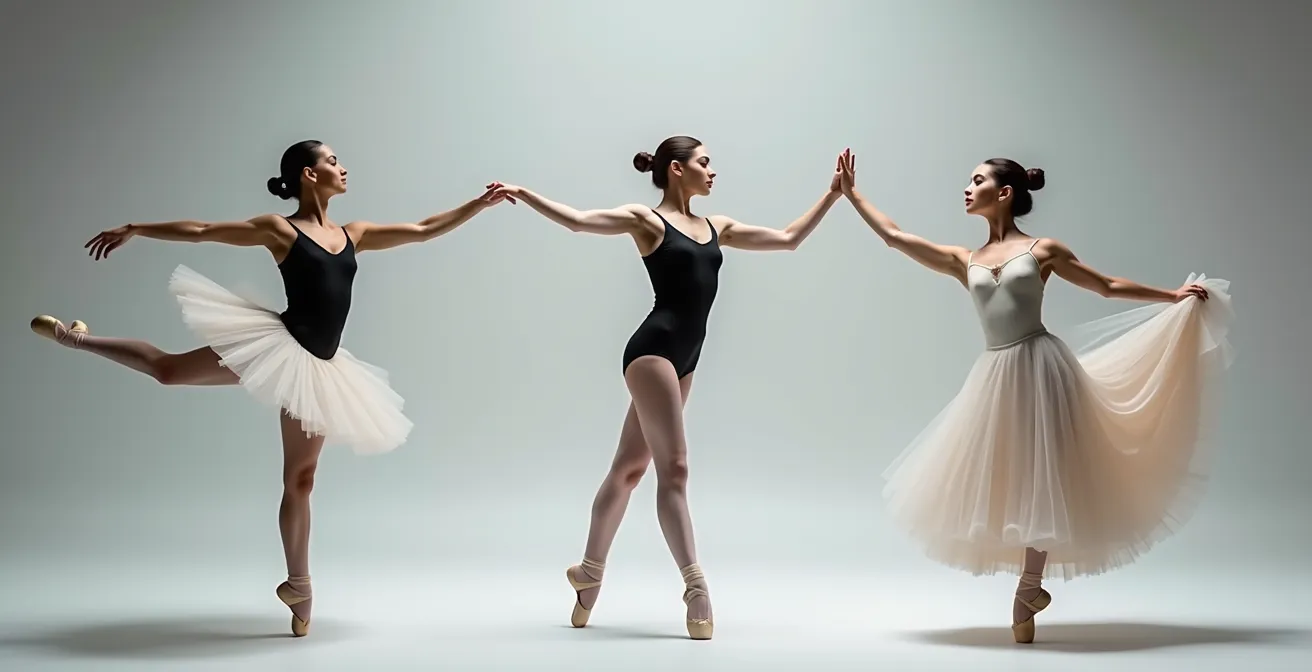
As the image suggests, each style has its own distinct physical vocabulary. The classical arabesque is upright and poised; the neoclassical form is clean and sharp; the contemporary pose is fluid and grounded. Starting with a ballet where the story is clear allows you to appreciate the beauty of the classical vocabulary without the pressure of deciphering an abstract concept. It’s the perfect foundation for a lifelong appreciation.
Stalls or Amphitheatre: Where Can You See the Footwork Best?
There is no single “best” seat in the Royal Opera House; there is only the best seat for what you want to see. Your choice of seating is about defining your viewing geometry. Are you there to see the intricate footwork and facial expressions of the principal dancers, or are you there to appreciate the sweeping, symmetrical patterns of the entire company? The answer will determine where you should sit.
For an up-close, intimate experience where you can see every muscle and emotion, the front rows of the Stalls (the ground floor) or the front of the Donald Gordon Grand Tier are unparalleled. You’ll feel the energy coming off the stage and see the acting in detail. The trade-off is that you might lose the sense of the overall stage picture and the geometric shapes created by the corps de ballet (the ensemble).
For a spectacular overview, nothing beats the Amphitheatre. Perched at the very top of the house, these seats—often the most affordable—give you a breathtaking, bird’s-eye view. From here, you can fully appreciate the choreographer’s patterns and the grand scale of the production. While you won’t see the dancers’ faces clearly, you will see the ballet as a magnificent living painting. This is often the best choice for a first-timer on a budget.
Case Study: The Hidden Value of Restricted View Seats
The Royal Opera House is refreshingly honest about its seating, clearly marking “restricted view” tickets. While many visitors avoid them, they can offer exceptional value and unique perspectives. An official overview on the ROH website details that some restrictions are minor, like a safety rail at eye-level or a pillar blocking a small part of the stage. However, these seats often provide surprising benefits. A side seat in the Amphitheatre might offer a perfect, close-up view of a soloist during a key variation at the edge of the stage. Standing places, while a challenge for a full three-act ballet, provide an authentic, historic experience for a fraction of the price and often have surprisingly clear sightlines.
Champagne Bar or BYO Sandwich: Avoiding the £15 Glass of Wine
The glamour of the Royal Opera House can feel synonymous with expensive champagne and tiny, pricey tubs of ice cream. But a night at the ballet doesn’t have to break the bank. With a little planning, you can craft an experience that is both magical and affordable, allowing you to focus your budget on the ticket itself. This is a key part of stripping away the elitism: you are in complete control of your spending.
First, know that you have time. According to the venue, all Royal Opera House bars and restaurants open to ticket holders 90 minutes before the performance begins. This gives you ample time to find your way, soak in the atmosphere, and have a drink without a last-minute rush. One of the best money-saving tips is to pre-order your interval drinks online when you book your ticket. This not only saves you from queuing but often comes with small discounts.
For those on a tighter budget, the options are even better. You are allowed to bring a bottle of water into the auditorium, saving you £3-4 right away. And while you can’t bring a full picnic, the area around Covent Garden is packed with fantastic, historic pubs and charming wine bars. A pre-show pint at The Lamb & Flag or a glass of wine in Neal’s Yard is far more atmospheric—and affordable—than the crowded crush bars inside. This high/low culture mix is the modern Londoner’s secret to enjoying the arts.

If you do want the in-house experience without the high prices, the rooftop terrace offers stunning views over Covent Garden Piazza. It’s a beautiful place to enjoy a drink, and you can access it with any ticket. The feeling of looking out over the twinkling lights of the market, drink in hand, is part of the magic of the evening, and it doesn’t have to cost a fortune.
Birmingham Royal Ballet vs The Royal: Is the Quality Different?
For newcomers, it’s easy to assume that “The Royal Ballet” is the only company that matters in the UK. While it is the nation’s flagship, the ballet scene in England is incredibly rich and varied, with several world-class companies offering different styles and experiences. In fact, research shows that 4.3% of adults in England attended the ballet in a recent year, a testament to its broad appeal beyond just London’s premier venue. The question isn’t about one company being “better,” but which is the right fit for you.
The key players alongside The Royal Ballet are the English National Ballet (ENB) and Birmingham Royal Ballet (BRB). While both are based outside the Royal Opera House, they tour extensively, including to London (the ENB’s home is the London Coliseum). The “quality” of the dancers is exceptionally high across all three; they all attract top international talent. The real difference lies in their mission, funding, and repertoire focus.
The Royal Ballet has the largest grant and stages both grand classics and cutting-edge new works. The ENB is known for being more daring and accessible with bold reinterpretations of classics. Birmingham Royal Ballet, sister company to The Royal Ballet, has a strong focus on touring the regions and is celebrated for its warm, engaging approach to narrative ballets.
| Company | Home Venue | Mission | 2025/26 Arts Council Funding | Repertoire Focus |
|---|---|---|---|---|
| The Royal Ballet | Royal Opera House | National/International flagship | Part of £24.96m ROH grant | Classic & contemporary premieres |
| English National Ballet | London Coliseum | More daring, accessible | £6.91m (3.3% decrease from 2018) | Bold reinterpretations |
| Birmingham Royal Ballet | Birmingham Hippodrome | Regional touring focus | £3.28m (1.8% increase) | Narrative ballets, warmer approach |
As this comparison of UK ballet statistics illustrates, each company has a unique identity. For a beginner, seeing a production by Birmingham Royal Ballet might be a wonderfully accessible and story-focused introduction to the art form, even if it’s not at the iconic Covent Garden venue. Don’t limit your options; explore what’s on tour near you.
Why Working with Clay Reduces Anxiety Faster Than Scrolling?
The deep focus required to follow a ballet—the ‘flow state’ of losing yourself in the music and movement—has powerful parallels in other mindful activities. While watching is a receptive act, engaging in a creative, tactile process can be even more effective at calming a racing mind. One of the most potent examples of this is working with clay, an activity that combats anxiety far more effectively than the passive consumption of a social media feed.
The primary reason is haptic feedback. The simple act of touching and shaping the clay engages your senses in a direct, grounding way. Your mind is forced to concentrate on the physical sensations—the coolness, the texture, the resistance—pulling your attention away from abstract worries and into the present moment. This is the essence of mindfulness. Scrolling, by contrast, bombards the brain with disjointed information and social comparison, often increasing feelings of inadequacy and anxiety.
Working with clay also induces a flow state, a term coined by psychologist Mihaly Csikszentmihalyi. It’s that feeling of being completely absorbed in an activity, where time seems to disappear. The challenge of centring the clay on the wheel or methodically coiling a pot requires just enough skill and concentration to occupy your full cognitive bandwidth, leaving no room for anxious thoughts. Finally, unlike the ephemeral nature of a digital feed, pottery results in a tangible object. This sense of accomplishment, of creating something real and lasting, provides a profound boost to self-esteem and a welcome antidote to the fleeting, often negative, validation of online ‘likes’.
Standing Downstairs or High Up: Where is the Acoustic Sweet Spot?
Just as we’ve explored the ‘visual sweet spot’ for watching the patterns of a ballet, other performing arts venues have their own optimal positions, particularly when it comes to sound. In a world-class concert hall, the architecture is an instrument in itself, designed to carry, blend, and clarify sound. But where you place yourself in that space dramatically changes what you hear. Finding the acoustic sweet spot is a quest for music lovers, whether you’re standing for £8 or sitting in a £200 seat.
Basic physics dictates much of the experience. Sound, especially higher frequencies, travels in relatively straight lines, while lower frequencies are less directional. Sound also reflects off surfaces. Being too close to a side wall can cause distracting echoes, while sitting under a deep balcony overhang can create a ‘dead’ sound, as the reverberant energy of the main hall is blocked.
Generally, the best place for sonic clarity and balance is in a central position, some distance back from the stage. Standing in the central arena of a venue like the Royal Albert Hall provides a direct, powerful, and immediate sound. You are getting the music straight from the source. However, standing or sitting high up in the gallery or circle offers a completely different, and often richer, experience. Here, you hear the blended sound: the direct sound from the orchestra mixed with the thousands of reflections from the hall’s ceiling and walls. This creates a warmer, more immersive acoustic. The ultimate sweet spot is often considered the very front row of the first balcony (or Circle), right in the centre. It combines good clarity with a beautiful sense of the hall’s reverb.
Key Takeaways
- Dress for comfort, not to impress; your outfit’s main job is to let you relax and enjoy the show.
- Match the ballet style to your personality. Start with a classic story-driven ballet for an easy and magical introduction.
- Choose your seat based on what you want to see (patterns from above, acting up-close), not just on price.
How to ‘Prom’ at the Royal Albert Hall for £8?
Perhaps the ultimate expression of accessible, high-quality performance in London is ‘Promming’ at the BBC Proms. It is the city’s great cultural leveller. For around £8, you can stand in the same room as a world-class orchestra and experience a concert at the iconic Royal Albert Hall. It’s an exhilarating, informal, and deeply traditional London experience that every newcomer should try at least once. But how does it work?
“Promming” simply means buying a cheap standing-only ticket on the day of a concert during the BBC Proms summer season. There are up to 1,350 of these tickets available for each performance, split between two areas: the Arena (the ground floor, right in front of the stage) and the Gallery (a running track high up at the top of the hall, with a distant but complete view).
There are two main ways to get a Promming ticket. First is the traditional queue. For popular concerts, a queue forms outside the hall hours before the performance. It’s a social affair and part of the tradition. You simply wait, and once the box office opens, you can buy one ticket per person. For less popular concerts, you can often walk up an hour before and get a spot. The second method is online booking. A set number of Promming tickets are released online on the morning of the concert. These sell out in minutes for famous orchestras or soloists, so you need to be logged on and ready to click at the exact moment they go on sale. Whether you queue or click, the price is the same, offering incredible value for an unforgettable night of music.
You now have the blueprint to explore London’s finest cultural experiences without the stress or the prohibitive expense. It’s time to move beyond the anxiety of the unknown and book your first ticket, confident that a magical evening awaits.