In summary:
- Ditch long, competitive games like Monopoly for short, two-player options like Jaipur or Patchwork to avoid pressure.
- Always book ahead for weekend dates, especially at smaller venues like Goodtime Games which has only seven tables.
- Do a pre-date “vibe check”: ask if they prefer teamwork (co-operative) or a friendly challenge (competitive).
- Let the cafe staff be your guide; they are experts at recommending and teaching games, which prevents one person from dominating.
- The goal isn’t to win, but to use the game as a catalyst for conversation and genuine connection.
The first date. It can often feel like a job interview you’re both underqualified for, filled with stilted questions over a coffee that gets cold too quickly. It’s no wonder so many people are swapping the tired “dinner and a movie” for activity-based dates. Board game cafes in Manchester have exploded in popularity, offering a perfect, low-pressure environment to break the ice. But the common advice to “just pick a fun game” is a trap. A great board game date isn’t just about showing up; it’s about engineering a successful social experience.
The wrong game can create more awkwardness than it solves, leading to what we can call social friction. A game that’s too long, too complicated, or too aggressively competitive can kill the mood instantly. But what if the key wasn’t just choosing the right cafe, but mastering the social dynamics of the game itself? The secret lies in turning the game into an interaction catalyst, a tool that sparks conversation, reveals personality, and builds a genuine connection without the pressure of constant eye contact.
This guide will show you exactly how to do that. We’ll explore why some classic games are disastrous for a first date, how to strategically book a table on a busy Saturday, and how to read the social cues to pick a game that suits your date’s personality. We’ll also dive into the subtle art of avoiding common social pitfalls, ensuring your date is memorable for all the right reasons.
Summary: A Strategic Guide to Manchester’s Board Game Cafe Scene for Daters
- Why ‘Monopoly’ Is the Worst Game for Breaking the Ice?
- How to Reserve a Table on Saturday Night Without Booking Weeks Ahead?
- Pandemic or Catan: Which Dynamic Suits Your Friendship Group?
- The Alpha Gamer Mistake That Ruins Cooperative Games for Everyone
- How to Host a Board Game Tournament in Your Local Pub?
- Why Working with Clay Reduces Anxiety Faster Than Scrollling?
- The Route 55 Hack: Is the Bus Ever a Viable Alternative to the Tube?
- Finding Silence: Best Mindfulness Spots in Central London You Walk Past Every Day?
Why ‘Monopoly’ Is the Worst Game for Breaking the Ice?
Picture this: you’re an hour into a first date, your date is bankrupt, you own all the best properties, and a tense silence hangs over the table. This is the ‘Monopoly’ effect. While a classic, it’s a terrible choice for a first date because it’s designed for conflict, takes hours to play, and relies heavily on luck. It’s a date-killer, not an icebreaker. The key to a successful game date is choosing an experience that facilitates fun and conversation, not a slow, agonising defeat. In fact, most board game experts recommend shorter games for first dates, as they allow for multiple rounds, a chance to chat in between, and don’t overstay their welcome.
The goal is to find a game that acts as a fun distraction you can share, not a high-stakes battle. A great first-date game should be learnable in under five minutes, last around 30 minutes, and focus on light strategy or cooperation. This low-stakes environment allows personalities to shine through without the pressure of intense competition. As one happy couple reported after a date night in Manchester:
Visited as part of our date night activities through BUCKIT, we had a really fun night and the guy who showed us to our table was really informative and taught us well how to play our first game (Jaipur – which is a really good first choice)
– TripAdvisor User Review, Goodtime Games Cafe
This experience highlights the perfect formula. To replicate it, you need to be prepared with the right choices. Instead of wandering in and grabbing the first box you recognise, have a few solid options in mind.
Your First Date Game Plan: Manchester Staff Picks
- Ask for ‘Jaipur’ at Goodtime Games. Staff there confirm it’s their top recommendation for a quick, engaging two-player game.
- Request ‘Patchwork’ or ‘Lost Cities’ at Fan Boy Three. Both are known for being under 30 minutes and having non-confrontational gameplay.
- Use this simple script with staff: “Hi, we’re on a first date and looking for a 2-player game that’s quick and we can learn in under 5 minutes.” They will appreciate the clarity.
- Book ahead at Goodtime Games (it only has 7 tables) or plan for an early arrival at Fan Boy Three on a weekday evening to secure a spot.
- Assess your date’s reaction to these options. Their enthusiasm (or lack thereof) is valuable information for choosing the right dynamic.
How to Reserve a Table on Saturday Night Without Booking Weeks Ahead?
The dream of a spontaneous Saturday night board game date in Manchester can quickly turn into a reality of wandering the Northern Quarter, peering into fully booked cafes. The city’s best spots are popular for a reason, and peak times require a strategic approach. Simply “booking in advance” is a good start, but understanding the specific booking culture of each venue is the real hack to securing a table without planning your life a month out.
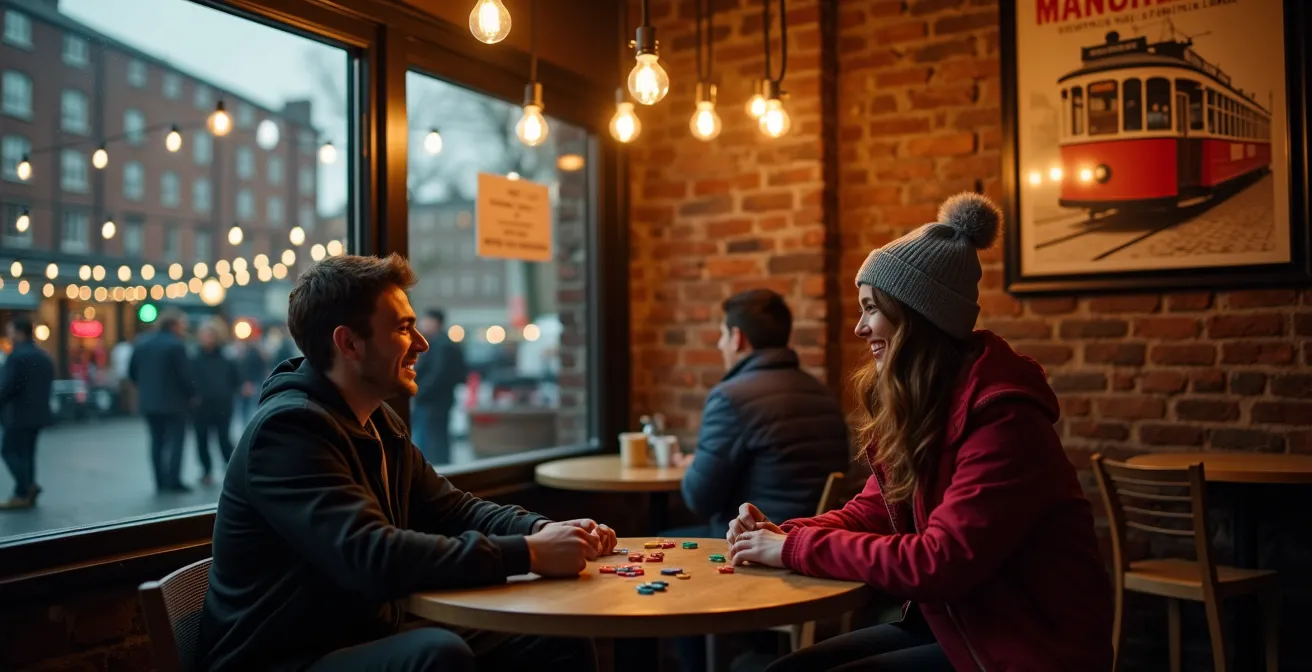
Imagine the scene: it’s dusk in the Northern Quarter, the streetlights are beginning to glow, and you’re heading towards the warm, inviting entrance of a cafe, confident you have a table waiting. This feeling of smooth, successful planning is what sets a great date in motion. It removes the first potential point of stress and shows you’re thoughtful and prepared.

As you can see, the atmosphere is a huge part of the appeal, and everyone wants a piece of it on a weekend. While some larger or more casual venues might accommodate walk-ins, the dedicated board game cafes with curated libraries and expert staff are almost always in high demand. Your strategy needs to adapt based on where you want to go. A one-size-fits-all approach will leave you out in the cold.
This table breaks down the booking and walk-in realities for some of Manchester’s most popular board game spots, based on a recent analysis of the city’s gaming scene.
| Venue | Area | Booking Strategy | Walk-in Success Rate |
|---|---|---|---|
| Fan Boy Three | Northern Quarter | Book in advance or arrive 11am-5pm weekdays | Low evenings/weekends |
| Goodtime Games | West Didsbury | £1.50 deposit booking essential (7 tables only) | Very low |
| Buzzin’ Meeples | Prestwich | Book table online | Medium |
| HOME | City Centre | No booking – open social space | High |
Pandemic or Catan: Which Dynamic Suits Your Friendship Group?
Once you’ve secured a table, the next crucial decision is choosing a game dynamic. This choice is a window into personality and compatibility. Are you two a team who will unite against a common foe, or are you spirited rivals who enjoy a friendly challenge? The answer determines whether you should reach for a cooperative game like Pandemic or a competitive one like Catan. There’s no right or wrong answer, but picking a dynamic that makes your date uncomfortable is a recipe for social friction.
Cooperative games are a fantastic, low-pressure option for a first date, as they immediately establish a sense of “us against the world.” As gaming experts Ryan & Alex from a guide on award-winning games for couples put it:
Cooperative games are board games where the opponent is the game itself. Players work together and try to come out victorious as a team
– Ryan & Alex, 25 Award-Winning Board Games For Couples
This teamwork dynamic fosters communication and shared problem-solving. Winning or losing, you do it together. On the other hand, a lightly competitive game like Catan can reveal a person’s strategic thinking, how they handle negotiation, and their playful side. The key is to gauge which atmosphere your date would prefer. This requires a quick, casual “vibe check” before you commit to a game.
Instead of making an assumption, use these simple questions and framing techniques to navigate the choice together. This act of collaboration is, in itself, a great start to the date.
- Text before the date: “For games, are you more of a team player or do you enjoy friendly competition?”
- At the cafe, ask: “Would you prefer working together against the game, or a light strategic challenge between us?”
- Frame competitive games positively: “Catan is like building the best Manchester tram line – creative competition, not conflict.”
- Suggest starting cooperative if unsure: “Let’s warm up with Pandemic then see how we feel about something competitive.”
The Alpha Gamer Mistake That Ruins Cooperative Games for Everyone
You’ve successfully chosen a cooperative game. You’re a team, ready to save the world in Pandemic. Then it happens. On your turn, before you can even process your options, your date says, “Okay, you need to move your pawn to London and treat two disease cubes. Don’t use that special ability yet.” This is the Alpha Gamer mistake, also known as quarterbacking. It’s when one player, intentionally or not, starts making decisions for everyone else, turning a collaborative experience into a solo game with silent partners. It’s the fastest way to kill the fun of a cooperative game.
The whole point of playing together is the shared struggle and discovery. When an Alpha Gamer takes over, they rob their partner of agency and the joy of contributing. The key to avoiding this is fostering an environment of shared decision-making, where suggestions are offered, not commands given. It’s about the subtle dance of collaboration, where two minds work together.

A brilliant way to sidestep this dynamic entirely is to leverage the cafe’s greatest asset: the staff. As a review of Manchester cafes notes, staff are trained to be neutral arbiters of the rules.
Case Study: Using Manchester Cafe Staff as Neutral Game Teachers
When you arrive at many of Manchester’s top cafes, a member of staff will often bring you a few recommended games and teach you one of them. They want to ensure you get the most out of your visit by playing something appropriate for your skill level and time. By letting the staff explain the rules to both of you, it establishes an equal playing field from the start, even if one person already knows the game. This prevents the “expert” from becoming the default Alpha Gamer.
Beyond using staff, mastering collaborative language is crucial. It’s about changing how you communicate suggestions to empower your partner rather than direct them. Here’s a checklist for better team play.
Action Plan: Your Guide to Collaborative Gaming Language
- Points of contact: Notice moments when you’re about to give a direct order (e.g., “Do this,” “Move there”).
- Collecte: Inventory your existing phrasing. Do you tend to direct or suggest?
- Coherence: Replace ‘You should move there’ with ‘What are you thinking for this turn?’ This invites their opinion first.
- Mémorabilité/émotion: Instead of ‘That’s wrong,’ try ‘Interesting approach! I was considering this angle…’ This validates their thought process while offering an alternative.
- Plan d’intégration: Swap ‘Let me show you’ for ‘Would you like to hear what I’m seeing, or explore your idea first?’ This gives them control over the flow of information.
How to Host a Board Game Tournament in Your Local Pub?
Once you’ve mastered the art of the board game date, you might be ready to scale up. Hosting a small board game tournament with friends in a local pub is a fantastic way to socialise. It takes the low-pressure fun of a cafe and adds a friendly, competitive structure. The key is finding the right venue and a simple format. You don’t need a huge, complicated event; a casual knockout tournament with a fun, fast-paced game can be organised with minimal fuss.
The first step is venue selection. While dedicated board game cafes are great, many Manchester pubs have embraced the trend and either provide their own games or are happy for you to bring your own. Look for a pub with cosy corners or a quieter upstairs area where you won’t be disturbed. The right atmosphere is crucial for a relaxed event. Many organisers have found success by partnering with local venues.
Case Study: D&F Games’ Weekly Pop-Up at Peaky Blinders Bar
The D&F Games group hosts a weekly Monday night pop-up at the Peaky Blinders Bar in central Manchester. For a small fee of £2.50 per person, players get access to a curated game library in a stylish pub setting. They even offer memberships for regulars. This model proves that you don’t need a dedicated cafe to build a successful gaming community; a partnership with a welcoming pub can be a perfect solution, offering both atmosphere and amenities.
To find your own perfect venue, you need to know which pubs are game-friendly. This isn’t always advertised, but a bit of local knowledge goes a long way. Based on information from a guide to Manchester’s best gaming spots, here are a few pubs known for their board game facilities.
| Venue | Location | Game Night | Special Features |
|---|---|---|---|
| Peaky Blinders Bar | Peter Street | Mondays 6:30-10:30pm | £2.50pp, membership available |
| The Briton’s Protection | Near Bridgewater Hall | Casual play | Classic pub games, cozy corners |
| HOME | City Centre | Open all week | Free play, multiple floors |
| Cosy Club | Manchester | Any time | Wide game selection provided |
Why Working with Clay Reduces Anxiety Faster Than Scrollling?
It might seem like a strange detour, but understanding why a tactile hobby like pottery reduces anxiety reveals the secret power of a board game date. Our modern lives are saturated with digital noise. We spend hours scrolling through social media feeds, our minds constantly stimulated but rarely engaged. This passive consumption breeds a low-level, persistent anxiety. Working with clay is the antidote. It demands your full attention. You have to feel the texture, gauge the moisture, and focus on the physical act of creation. It grounds you in the present moment.
A board game does exactly the same thing. It’s a physical, tactile experience that pulls you away from your screen. You’re handling cards, moving pieces, and focusing on a shared, physical object in the centre of the table. This simple act creates a “no-phone zone” without anyone having to say it. The game becomes a shared focal point that replaces the nervous habit of checking notifications. It forces a state of mindfulness, where the endless scroll of anxieties is replaced by the immediate, solvable problems on the board.
This shared focus is what makes the environment feel so low-pressure. You aren’t just staring at each other, trying to fill every second with clever conversation. The game provides a natural rhythm of talking and thinking, of action and reaction. It’s an anxiety-reducer precisely because it replaces the formless, digital void with a structured, tangible reality. It’s a mindful practice disguised as a fun activity.
The Route 55 Hack: Is the Bus Ever a Viable Alternative to the Tube?
In Manchester, the tram network is the obvious, primary way to get around the city centre. It’s fast, efficient, and direct. It’s the “Tube” of Manchester. The bus, like the Route 55, is often seen as the slower, less glamorous alternative. But locals know the “Route 55 hack”—sometimes, the less obvious path is smarter. It might avoid crowded interchanges, drop you closer to your final destination, or simply offer a more scenic journey. It’s about knowing the system well enough to see the creative, unconventional solutions.
This is a perfect metaphor for board game strategy, especially on a first date. In many games, there is an “obvious” move. The Alpha Gamer will spot it and declare it the only correct play. This is the tram route—efficient, but boring and predictable. Following it doesn’t reveal anything about a person’s creativity or style of thinking. The real fun, and the real insight into personality, comes from finding the “Route 55 hack.” It’s the clever, unexpected move in Catan that secures a crucial resource, or the surprising card play in Jaipur that swings the game.
Encouraging this kind of play on a date is far more interesting than just following a prescribed strategy. You can frame it playfully: “What’s the sneakiest move you can see?” or “Is there a ‘Route 55 hack’ we’re missing here?” This signals that you value creativity over cold efficiency. It shows you’re there to have fun and explore the game’s possibilities together, not just to mechanically execute the most optimal strategy. It turns the game from a test of skill into a playground for cleverness.
Key takeaways
- The success of a board game date depends more on the social dynamics you create than the specific cafe you choose.
- Opt for short (under 30 mins), low-conflict, two-player games to act as “interaction catalysts,” not sources of tension.
- Proactively do a “vibe check” to decide between cooperative and competitive games, demonstrating social awareness.
- Avoid the “Alpha Gamer” pitfall by using collaborative language and letting cafe staff act as neutral rule-teachers.
- The tactile, mindful nature of playing a physical game is a powerful antidote to digital-age anxiety, creating a focused, low-pressure environment.
Finding Silence: Best Mindfulness Spots in Central London You Walk Past Every Day?
This title talks about London, but the principle is universal and applies perfectly to a bustling Manchester cafe. You don’t need to find a quiet park to have a mindful moment of connection. “Finding silence” isn’t about the absence of noise; it’s about the presence of focus. A board game cafe is loud—there’s the chatter of other tables, the clatter of dice, the hiss of a coffee machine. But the “mindfulness spot” isn’t the room itself. It’s the small, shared universe you and your date create around the game board.
When you’re both engrossed in a game, the background noise fades away. Your world shrinks to the 2×2 foot space of the board, your hands, your date’s expressions, and the shared challenge in front of you. This is a powerful form of connection. It’s a shared bubble of focus in the middle of a crowded room. You’re not just making small talk; you’re communicating through actions, strategies, and reactions. You learn more about a person by seeing how they react to a surprising turn of events in a game than you do from asking them what they do for work for the third time.
This is the ultimate goal of the board game date: to use the game as a vehicle to create a space for genuine, focused interaction. You’re building a small, temporary world together. The real victory isn’t winning the game, but successfully creating that bubble where you can both relax, be yourselves, and connect on a level that a simple coffee date rarely allows. The “silence” you find is the quiet understanding and shared experience that builds between two people when they stop trying to impress and start trying to play.
So, the next time you’re planning a date, don’t just pick a cafe—plan an experience. Use these strategies to choose the right game, foster a collaborative spirit, and create a memorable connection. Your next great date night adventure in Manchester is just a roll of the dice away.