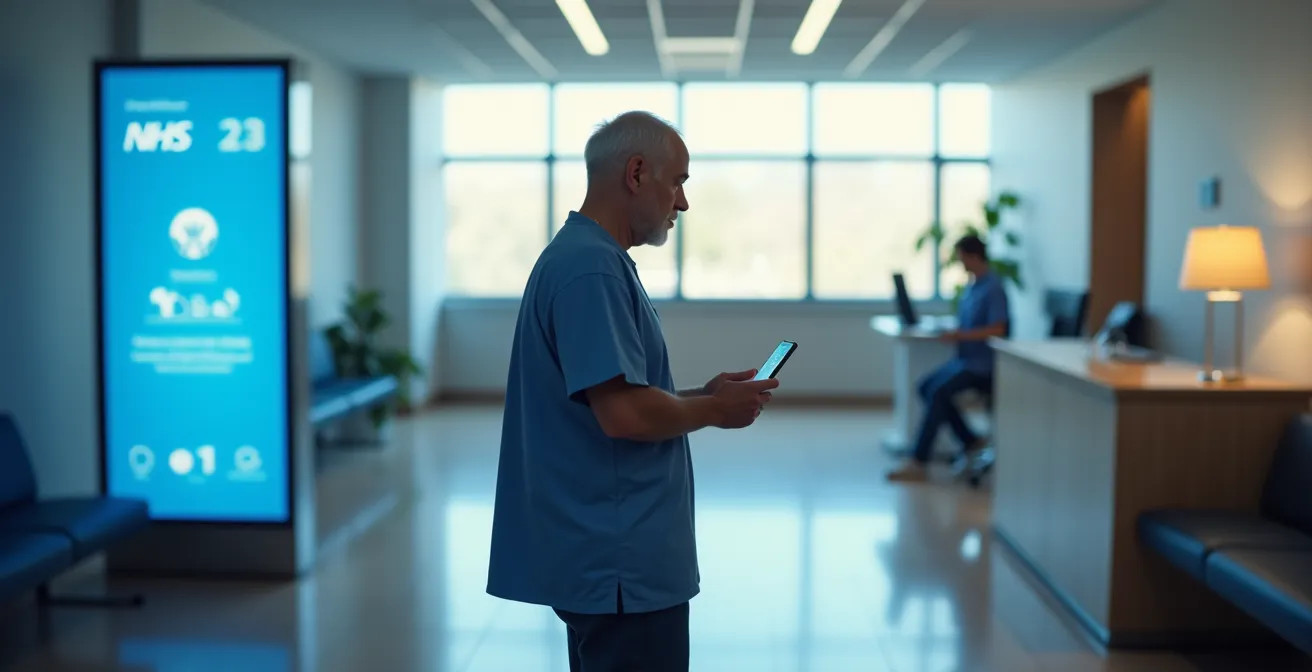
The core issue isn’t replacing your GP, but strategically navigating the NHS system’s bottlenecks to get appropriate care faster.
- Digital tools like NHS 111 Online and the NHS App act as a “digital front door” for efficient triage, especially when same-day GP appointments are scarce.
- Understanding the specific function of each tool—from repeat prescriptions to remote monitoring—is key to bypassing queues and reducing administrative friction.
Recommendation: Instead of viewing apps as a replacement for your doctor, adopt them as your primary tool for navigating the system, reserving GP visits for when physical examination or continuity of care is essential.
We all know the feeling. It’s 8:01 AM, and you’re in a digital queue, repeatedly hitting refresh, trying to secure a GP appointment. The frustration of long waiting times is a shared national experience, often leaving us feeling powerless. The common advice is to simply ‘be patient’ or try a different day, but this overlooks a fundamental shift in the NHS landscape. Digital health services are no longer a novelty; they are an increasingly integrated part of the system, designed to manage demand and direct patients more effectively.
Many discussions about these apps get stuck on the generic idea that they are “convenient” or that “digital is the future.” This misses the point. The true value of NHS-approved applications lies not in their potential to one day replace your GP, but in their current ability to act as a strategic toolkit. What if the key wasn’t to replace your GP, but to master the digital front door to the NHS? This guide moves beyond the surface-level benefits to provide a strategic framework for using these tools to navigate the specific choke points of the English healthcare system—from urgent care triage to mental health support.
By understanding which app to use and when, you can bypass unnecessary queues, secure the right type of consultation, and take back a measure of control over your healthcare journey. We will explore how to use these services for everything from repeat prescriptions to monitoring elderly relatives, while also defining the critical moments when a remote consultation is simply not enough. This is your guide to becoming an empowered patient in a digitally evolving NHS.
While some of the technology has evolved, this video on the rollout of a major national health app offers a valuable glimpse into the mechanics and user experience of integrating such a tool into your daily life. It provides a foundational understanding of how the NHS approaches app-based services.
To help you navigate these options, this article breaks down the strategic use of NHS digital tools into clear, actionable sections. Below is a summary of the key areas we will cover, designed to empower you with the knowledge to make informed decisions about your health.
Summary: A Strategic Guide to NHS Digital Health Tools
- Why Calling 111 Online Might Be Faster Than Your Local Surgery?
- How to Order Repeat Prescriptions via App and Skip the Pharmacy Queue?
- Physical Exam or Video Call: When Is a Remote Doctor Not Enough?
- The Privacy Setting You Must Check on Health Tracking Apps?
- How to Set Up Remote Health Monitoring for Aging Parents Living Alone?
- How to Audit Your Monthly Direct Debits and Recover £500 a Year?
- GP Note or Holiday: Which Should You Take for Mental Exhaustion?
- Burnout in the City: How to Negotiate Mental Health Days with UK Employers?
Why Calling 111 Online Might Be Faster Than Your Local Surgery?
The 8 AM scramble for a GP appointment is a significant system choke point. With the latest GP Patient Survey data for England showing that less than 28% of patients securing same-day appointments in 2024, the traditional route is often a dead end for urgent, but not emergency, needs. This is where a strategic shift to NHS 111 Online becomes a powerful alternative. It functions as a form of digital triage, using a sophisticated algorithm to assess your symptoms and direct you to the most appropriate service, which might be an out-of-hours service, a local urgent treatment centre, or even a call back from a clinician, often faster than waiting for your surgery’s next available slot.
The system is not just a simple symptom checker. Research highlights that the NHS 111 system is growing in sophistication with deeper integration into the wider NHS network, including the NHS App. While uptake varies by demographic, for those comfortable with digital tools, it provides a structured “front door” to urgent care that operates 24/7. It excels where GP surgeries are at their most strained: after hours, on weekends, and when all on-the-day appointments are gone. The key is to use it for new, urgent symptoms that cannot wait for a routine appointment but do not warrant a 999 call.
Understanding when to use 111 Online versus your GP’s own system (like eConsult) or the NHS App is crucial for efficient navigation. Each has a distinct purpose.
Your Decision-Making Checklist: Navigating Urgent Care Options
- Assess your need: Is it a new, urgent symptom when your GP surgery is closed or fully booked? Use NHS 111 Online.
- Manage routine tasks: Do you need a repeat prescription or to book a future non-urgent appointment? Use the NHS App.
- Follow-up with your doctor: Is this a non-urgent query or follow-up with your regular GP who knows your history? Use your surgery’s eConsult platform.
- Check local services: Visit your local Integrated Care Board (ICB) website to see which digital services are commissioned and available in your specific area.
- Enable data access: Ensure your Summary Care Record is enabled for data sharing. This allows clinicians outside your GP practice to access essential information, ensuring continuity of care.
By treating these services not as competitors but as a suite of tools for different situations, you can significantly reduce the time spent waiting for care.
How to Order Repeat Prescriptions via App and Skip the Pharmacy Queue?
One of the most immediate and tangible benefits of embracing NHS digital tools is the ability to streamline the process of ordering repeat prescriptions. This simple administrative task can become a significant time sink, involving phone calls to the surgery and multiple trips to the pharmacy. The NHS App transforms this process by providing a direct digital pathway to your GP’s system. By using the app, you can request your repeat medication with a few taps, have it approved by your GP, and sent electronically to a pharmacy of your choice.
This “nominate a pharmacy” feature is a game-changer. It means you no longer have to physically collect the green paper prescription from the surgery. Instead, it’s sent securely to the pharmacy, which can prepare your medication in advance. For those with stable, long-term conditions, this eliminates a major recurring hassle. Furthermore, the app provides a clear audit trail, showing you when a prescription was requested, approved, and sent, removing the guesswork from the process.
While commercial apps like Pharmacy2U or Boots also offer prescription services, it’s important to understand the difference in their operating model. The official NHS App offers the most direct and integrated route, as shown in the comparison below based on information from the official NHS App digital service page.
| Feature | NHS App | Commercial Apps (Boots, Pharmacy2U) |
|---|---|---|
| Data Pathway | Direct portal to GP system | Intermediary service |
| Processing Time | 48-72 hours typical | 3-5 days including delivery |
| Controlled Drugs | Request only, collect in person | Cannot process |
| Cost | Free (standard prescription charges apply) | May include delivery fees |
| Integration | Full NHS record access | Limited integration |
For most users, the direct integration and speed of the NHS App make it the superior choice for managing repeat prescriptions, saving you both time and unnecessary journeys.
Physical Exam or Video Call: When Is a Remote Doctor Not Enough?
The rise of video consultations offers undeniable convenience, but it’s crucial to recognise their limitations. A digital health advocate’s role isn’t to push for digital-at-all-costs, but to promote its safe and appropriate use. The most important skill for a patient is knowing when a remote consultation is insufficient and a physical, in-person examination is non-negotiable. This is the cornerstone of maintaining your continuity of care and ensuring accurate diagnosis. Video calls are effective for many issues: visual assessments of skin conditions, mental health check-ins, or medication reviews. However, they lack a fundamental diagnostic tool: touch.
A doctor’s ability to palpate an area for tenderness, check for swelling, listen to your chest with a stethoscope, or assess subtle physical cues can be the difference between an accurate diagnosis and a missed one. As a rule, any new, severe, or localised pain (especially abdominal), unexplained lumps, rashes accompanied by fever, or any concerning symptoms in a young child demand an in-person assessment. Trust your instincts; if you feel your issue requires a physical check, insist on one.
This balanced perspective is crucial for the future of digital health. As a research team noted in the Frontiers in Health Services Journal, the technology’s effectiveness is limited by the information it receives:
The use of online portals and symptom checkers offers streamlined automated booking that can use algorithms to direct patients to the most appropriate care, but to function as expected they must be fed reliable data which currently does not exist.
– Frontiers in Health Services Research Team, Frontiers in Health Services Journal
Therefore, while embracing digital tools, the ultimate goal is not to avoid your GP, but to make your interactions more meaningful by reserving their time for when their full diagnostic expertise is truly needed.
The Privacy Setting You Must Check on Health Tracking Apps?
As we integrate digital tools more deeply into our health management, the question of data privacy becomes paramount. While the NHS App is built on a secure framework, it’s essential to practice good digital hygiene and understand the data you are sharing. The single most important setting for any UK resident to be aware of is the National Data Opt-Out. This is a central control that allows you to specify that your confidential patient information can only be used for your direct care and not for secondary purposes like research or planning.
This is not an anti-research stance; it’s about informed sovereignty over your personal data. You can manage this setting directly within the NHS App or via the NHS website. It’s a powerful tool that puts control back in your hands. Beyond this national setting, it is also vital to audit the permissions of individual health apps on your smartphone. Does that fitness tracker really need access to your contacts? Does a symptom checker need your precise location? Disabling unnecessary permissions is a basic but critical step in protecting your privacy.
The distinction between “anonymised” and “pseudonymised” data is another key concept. True anonymisation removes all identifiers, while pseudonymisation replaces them with a key, meaning re-identification is technically possible. When reviewing an app’s privacy policy, look for clear language on which method they use. This visual metaphor helps conceptualise the layers of protection needed for your sensitive health data.

Ultimately, a proactive approach is required. Don’t just accept the terms and conditions. Take a few minutes to navigate to the ‘Your NHS Data Matters’ section in your account settings and review your choices. Being an empowered digital patient means not only using the tools but also understanding and controlling the data trail they create.
This act of digital due diligence is as important for your long-term well-being as any medical consultation.
How to Set Up Remote Health Monitoring for Aging Parents Living Alone?
One of the most powerful and compassionate uses of digital health technology is to support aging relatives who live independently. The concept extends beyond simple video calls to a system of remote monitoring and delegated access, providing peace of mind for families. In England, this is supported by both official NHS channels and council-led initiatives. The key is understanding the difference between commercial ‘elderly care’ gadgets and the integrated services offered through official routes.
The primary tool for family members is gaining Proxy Access to their parent’s NHS App account. This doesn’t mean taking over their healthcare, but rather being able to assist with crucial administrative tasks. With the appropriate consent and setup via the GP surgery, proxy access can allow you to book appointments, order repeat prescriptions, and view test results on your parent’s behalf. This is a formal process that requires applications and proof of identity, ensuring it’s done securely and with the full consent of the individual.
Beyond the app, many local councils, through their Adult Social Care departments, offer ‘Telecare’ services. These are distinct from consumer products as they are often linked to integrated emergency response teams. This official pathway is a core part of the NHS’s strategy to provide more care at home.
Case Study: NHS Virtual Ward Strategy
NHS England’s ‘virtual ward’ strategy is a prime example of this integrated approach. The plan aims to dramatically expand the number of patients monitored remotely, with official data from NHS England’s digital technology division showing a target to grow from 280,000 to 780,000 patients by March 2025. This involves providing patients with devices to measure vital signs like blood pressure and oxygen levels at home, with the data fed back to a clinical team. This differs from standalone commercial products by being directly linked into the NHS care pathway, including council-provided Telecare and its emergency response capabilities.
To set this up, the first step is always to contact your parent’s GP surgery. They are the gatekeepers to enabling proxy access. You will typically need to fill out forms and may need to provide proof of lasting power of attorney for health and welfare if your parent is unable to consent themselves. It’s a process that requires patience but provides a robust and secure way to support your loved ones remotely.
This strategic use of technology can make a profound difference in enabling older people to live safely and independently for longer.
How to Audit Your Monthly Direct Debits and Recover £500 a Year?
While seemingly unrelated, your financial health is inextricably linked to your physical and mental well-being. The stress caused by financial pressure can manifest as minor ailments, increasing the need for GP visits. With projections from the House of Commons Library indicating there could be over 7.4 million people on NHS waiting lists by 2025, any action that reduces strain on the system—and on yourself—is a proactive health measure. A simple, powerful action is to conduct a thorough audit of your monthly direct debits.
This involves scrutinising your bank statements for “subscription creep”—forgotten gym memberships, unused streaming services, or old insurance policies. Cancelling these can often free up £30-£50 a month, potentially recovering over £500 a year. This isn’t just about saving money; it’s about reallocating those funds towards preventative health measures that can keep you out of the GP’s surgery in the first place. That recovered money could pay for a private physiotherapy session to deal with a niggle before it becomes chronic, fund a membership to a mental wellness app, or simply reduce the background financial stress that impacts your health.
Thinking of this financial audit as a health intervention reframes the entire exercise. It’s a tangible step you can take to invest in your own well-being, thereby reducing your future reliance on a stretched NHS. The table below, based on the principle of preventative investment discussed in NHS waiting list analyses, illustrates how these savings can be strategically reinvested.
| Saved Amount | Preventative Health Investment | NHS Service Avoided |
|---|---|---|
| £100 | Vitamin D annual supply + fitness app | Winter illness GP visits |
| £250 | Private physiotherapy sessions (5x) | NHS musculoskeletal referral wait |
| £500 | Annual gym membership + mental wellness app | Multiple stress-related GP consultations |
By taking control of your finances, you are also taking a direct and impactful step towards better managing your long-term health.
GP Note or Holiday: Which Should You Take for Mental Exhaustion?
When facing mental exhaustion or burnout, the choice between taking annual leave or getting a GP’s fit note is a critical one with significant implications for your finances, employment rights, and recovery. It’s not just a question of taking time off; it’s a strategic decision about how you frame and manage your absence. Using annual leave is simple and maintains your full pay, but it offers no formal record of illness or employment protection. It’s essentially using your personal holiday time to recover from a work-related health issue.
A fit note (previously a sick note), on the other hand, formalises your absence as being for health reasons. This triggers important legal and financial mechanisms. Financially, it initiates Statutory Sick Pay (SSP) as a minimum, and any enhanced company sick pay policy you are entitled to. While SSP is significantly lower than full pay, the protection it offers can be invaluable. A fit note provides a formal record that can be crucial if your mental health condition persists and qualifies as a disability under the Equality Act 2010, affording you protection against discrimination.
Crucially, a fit note is not just an “off sick” document. A GP can use it to recommend a phased return to work, amended duties, or altered hours. This makes it a powerful tool for negotiating a sustainable return to the workplace with your HR department. Digital GP services approved by the NHS, like Livi or Push Doctor, can legally issue these fit notes. However, it’s worth noting they may lack the full context of your medical history, which could affect their assessment. The choice is a personal one, weighing the immediate financial hit of sick pay against the long-term protections and recovery support a fit note can provide.
Ultimately, a fit note is a medical and legal tool designed for your protection and recovery, whereas a holiday is simply a break from work.
Key Takeaways
- The goal is strategic navigation, not GP replacement. Use digital tools to bypass specific NHS bottlenecks like appointment booking and prescription repeats.
- Know your tools: Use 111 Online for urgent triage, the NHS App for routine tasks, and eConsult for non-urgent follow-ups with your own GP.
- Always prioritise in-person exams for new, severe pain, lumps, or when physical touch is needed for diagnosis. Digital has its limits.
Burnout in the City: How to Negotiate Mental Health Days with UK Employers?
Navigating mental health in the workplace, particularly in high-pressure environments, requires a proactive and informed approach. The pressure on the NHS is immense, as acknowledged by NHS England when they stated they had “experienced the toughest possible start to 2024 with the longest set of strikes,” which compounds the difficulty for individuals seeking support. This reality means that leveraging digital and self-referral pathways before even approaching a GP can be a more effective first step.
Before you even think about requesting a mental health day, it’s wise to build a foundation of evidence and support. Start by documenting your symptoms and any specific workplace stressors that are contributing to your burnout. The NHS itself provides digital-first mental health support. You can often self-refer to local IAPT (Improving Access to Psychological Therapies) services directly through the NHS website, bypassing the need for a GP referral entirely. Many Integrated Care Boards also commission free access to mental health apps like SilverCloud or Kooth, providing immediate support.
When you do approach your employer, you are then armed not just with a feeling of being unwell, but with a documented history of symptoms and proactive steps taken. When negotiating with HR, referencing official guidance from ACAS (Advisory, Conciliation and Arbitration Service) on managing mental health at work lends significant weight to your conversation. If you do obtain a fit note, remember its power as a negotiation tool for recommending a ‘phased return’ or ‘amended duties’. Many employers also offer an Employee Assistance Programme (EAP), a confidential support service that should be considered a primary resource before escalating to more formal processes. This strategic, multi-layered approach positions you as a responsible employee managing a health condition, rather than simply someone asking for a day off.
Take control of your healthcare journey by strategically integrating these digital and self-referral tools into your interactions with the NHS and your employer, ensuring you get the support you need, when you need it.
Frequently Asked Questions About NHS Digital Services
When should I insist on an in-person examination instead of video consultation?
You should always insist on an in-person examination for any new and localized abdominal pain, unexplained lumps or swelling, rashes accompanied by a fever, any concerning symptoms in children under 2, or in any situation where physical touch (palpation) is likely necessary for an accurate diagnosis.
What diagnostic capabilities are lost in video consultations?
In a video call, doctors cannot physically touch or press on organs (palpate), check for fluid retention in limbs, assess the texture of skin, detect certain odours that can indicate specific infections, or observe the subtle, non-verbal responses to pain that are only visible in person.
Can I de-register from my local GP for a digital-first service?
While it is possible to de-register from a physical GP practice to join a digital-first service, you should consider this very carefully. Doing so can severely limit or complicate your access to local community services, specialist referrals that are geographically based, and the crucial continuity of care provided by a doctor who knows your long-term medical history.
Can NHS-approved apps like Livi or Push Doctor issue valid fit notes?
Yes, qualified clinicians working for digital GP services that are commissioned or approved by the NHS can issue legally valid fit notes for conditions like stress or mental exhaustion. However, be aware that they will not have access to your full, long-term medical history, which may affect the quality and context of their assessment.
What are the financial implications of a fit note vs annual leave?
Using annual leave ensures you receive your full pay but uses up your holiday allowance. A fit note triggers Statutory Sick Pay (SSP), which is a minimum of £109.40 per week (as of 2024), and any contractual company sick pay you’re entitled to. This often means a significant reduction in pay compared to your normal salary.
What employment protections does a fit note provide?
A fit note provides a formal record of sickness absence, which is essential for triggering sick pay policies. More importantly, if your mental health issue becomes a long-term condition, it provides evidence that can support protections under the Equality Act 2010. It also serves as a formal basis for negotiating a phased return to work or amended duties with your employer and HR department.