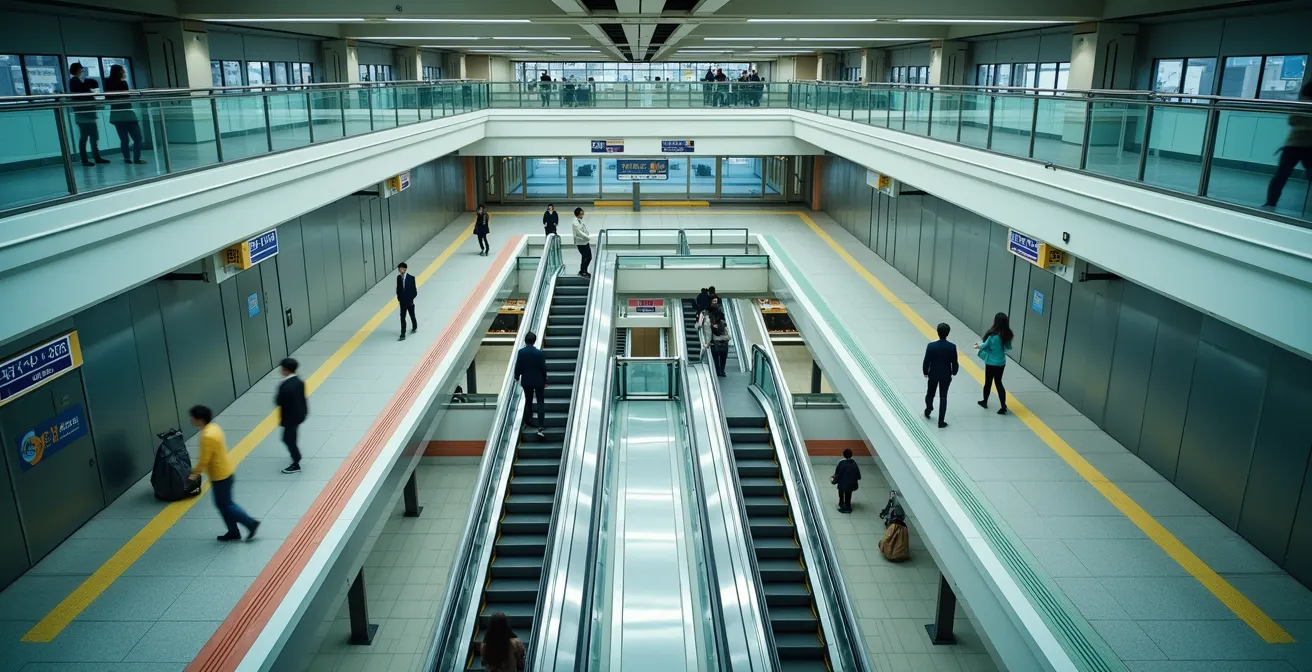
The secret to mastering complex transport systems like Tokyo’s isn’t learning endless new rules, but applying the ‘system hacking’ mindset of a savvy London commuter.
- Common assumptions from the Tube (like daily capping) don’t apply to Tokyo’s IC cards, leading to unexpected costs.
- High-value tourist passes like the JR Pass are often a waste of money for city-only travel compared to targeted metro passes.
Recommendation: Think beyond the default ticket. Whether it’s choosing the right exit in Shinjuku or split-ticketing in the UK, understanding the system’s structure is the key to saving time and money.
The first time you see a map of the Tokyo metro, it feels like a personal challenge. As a Brit, you feel a certain pride in your ability to navigate a complex underground system. The London Underground, with its familiar colour-coded lines and ‘Mind the Gap’ warnings, is second nature. But Tokyo is a different beast. The sheer density of lines, the multiple private companies operating in the same space, and the labyrinthine stations can make even the most seasoned Tube traveller feel utterly lost.
Most guides will give you the basics: buy an IC card, follow the signs. But this advice misses the crucial point. The real frustration comes from the small, unwritten rules and the incorrect assumptions we bring from home. We expect a daily cap like our Oyster card, we underestimate the sheer scale of a station like Shinjuku, and we apply our own escalator etiquette without a second thought. These are the mistakes that cost you time, money, and a little bit of your sanity.
This guide is different. As an expat who made all these mistakes, I’ll show you how to translate your existing Tube-savvy brain to Tokyo’s unique logic. We’ll go beyond the surface-level tips to explore the ‘system hacks’ that locals use. We’ll cover the Tokyo-specific survival skills you absolutely need, from buying the right ticket without speaking a word of Japanese to knowing when the last train *really* is. Then, we’ll bring it back home, showing how these same principles of smart travel can slash your commute costs in London or on a trip to Manchester. This is your guide to navigating not just the metro, but the mindset behind it.
This article provides a comprehensive roadmap, breaking down the essential strategies for mastering urban transport in both Tokyo and the UK. Explore the sections below to transform your travel habits.
Summary: From the Tube to Tokyo: A UK Traveller’s Metro Survival Guide
- Why Choosing the Wrong Exit at Shinjuku Station Adds 20 Minutes to Your Walk?
- Suica or Pasmo: How to Buy and Top Up Without Speaking Japanese?
- 7-Day Rail Pass or Single Fares: Which Saves Money for City-Only Trips?
- The Escalator Etiquette Error That Enrages Tokyo Commuters
- When Does the Metro Actually Close and How to Avoid Expensive Taxis?
- Bus or 20-Minute Walk: When Does Walking Actually Beat Traffic?
- How to Split Your Ticket Legally to Save £50 on a Return to Manchester?
- How to Cut Your London Commute Cost by 30% Using Multimodal Travel?
Why Choosing the Wrong Exit at Shinjuku Station Adds 20 Minutes to Your Walk?
On the London Underground, taking the ‘wrong’ exit might mean crossing the street. At Shinjuku Station, the world’s busiest, it can mean finding yourself in a completely different district, a 20-minute walk from your actual destination. With over 200 exits spread across multiple levels and owned by different rail companies, mastering the station itself is more critical than finding the right platform. This isn’t about just getting on a train; it’s about an exit-level strategy. The station is a city within a city, and navigating it requires pre-planning.
Before you even board your train to Shinjuku, you need to know your specific exit number (e.g., A12, B16) from an app like Google Maps. Once you’re off the train, ignore the temptation to follow the crowd. Instead, look for the overhead signs. In the Tokyo Metro system, yellow signs lead to exits, while blue signs indicate transfers to other lines. These signs are your lifeline, coded to guide you through the maze. Major exits are also often signed with the districts they lead to, such as the West Exit for the business district and skyscraper-filled Nishi-Shinjuku, or the East Exit for the bustling shopping and entertainment areas of Kabukicho.
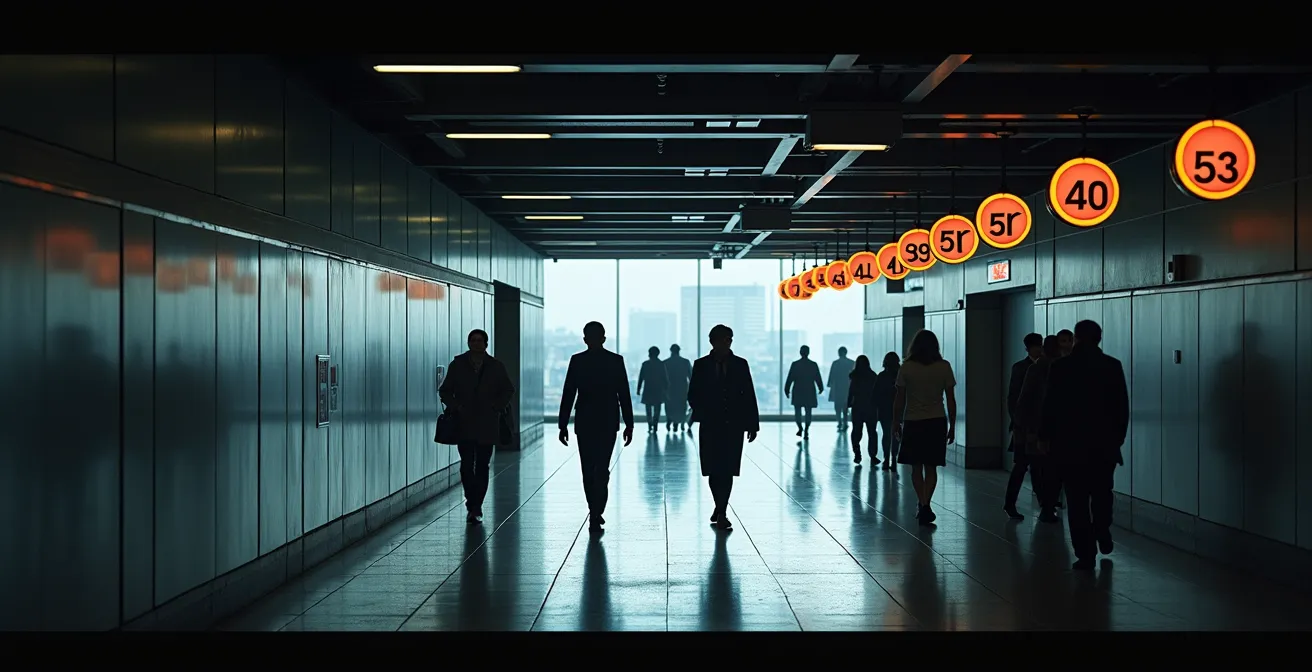
As the illustration suggests, the paths diverge dramatically. A wrong turn underground can have a massive impact on your location at street level. Using a dedicated app like the Tokyo Metro my! app can provide real-time navigation inside the station, acting as a GPS where your phone’s signal can’t reach. Treating the exit as your primary destination is the single biggest mindset shift a Londoner can make to conquer Tokyo’s mega-stations.
Suica or Pasmo: How to Buy and Top Up Without Speaking Japanese?
Your first instinct as a UK traveller is to get the local equivalent of an Oyster card. In Tokyo, this means a Suica or Pasmo card. They are functionally identical, issued by different companies (JR East and Tokyo Metro, respectively), and can be used interchangeably on almost all trains, subways, and buses. The machines at the station have an English language option, making the initial purchase straightforward. You’ll typically need to pay a 500 yen refundable deposit (about £2.80) plus your desired starting credit. So far, so familiar.
However, the real game-changer for UK travellers is bypassing the physical card entirely. This is where you can avoid the common headache of having your UK Visa card declined by Japanese ticket machines.
Case Study: The Digital Wallet Solution for UK Travellers
Many British tourists find their Visa cards are rejected at ticket machines. The most reliable workaround is to add a digital Suica or Pasmo card directly to your Apple Wallet or Google Pay before you even fly to Japan. This process works most effectively with a Mastercard. Once the virtual card is on your phone, you can top it up instantly using Apple Pay or Google Pay, completely avoiding the need for cash or wrestling with ticket machines. It transforms your phone into your ticket for the entire transport network.
The crucial difference to understand is what I call the ‘Oyster Fallacy’. While these IC cards are convenient for tapping in and out, they do not have an automatic daily cap like London’s Oyster or contactless system. You pay for every single journey. If you plan on making multiple trips in one day, a dedicated tourist pass might be cheaper. The table below highlights the key differences.
| Feature | Suica/Pasmo | London Oyster |
|---|---|---|
| Daily Cap | No cap – pay per journey | Automatic daily cap |
| Deposit | ¥500 (refundable) | £7 (refundable) |
| Uses Beyond Transport | Convenience stores, vending machines | Transport only |
| Validity | 10 years | No expiry |
7-Day Rail Pass or Single Fares: Which Saves Money for City-Only Trips?
The Japan Rail (JR) Pass is one of the most famous travel products associated with Japan. It’s heavily marketed to tourists as the ultimate key to the country’s transport network. For cross-country trips on the Shinkansen (bullet train), it can offer incredible value. However, for a tourist whose trip is based solely in Tokyo, buying a 7-day JR Pass is a classic and expensive mistake. It represents a huge value mismatch for city-centric travel.
The core issue is that the JR Pass, while covering the JR lines within Tokyo (like the vital Yamanote loop line), doesn’t cover the extensive Tokyo Metro and Toei subway lines. These subway networks are essential for reaching many key attractions. You would be paying a premium for nationwide travel you’re not using, while still potentially needing to pay for separate subway tickets.
Cost Analysis: The JR Pass Myth for Tokyo-Only Travel
A 7-day JR Pass costs over £270. In contrast, a week of heavy metro and local train usage within Tokyo will rarely exceed £50. For tourists staying within the city, dedicated subway passes offer far superior value. The Tokyo Subway Ticket, which covers all Tokyo Metro and Toei subway lines, is the best option. A 72-hour unlimited pass costs approximately £8.50, and a 24-hour version is just 600 yen (about £3.40). Buying two or three of these during your stay is exponentially cheaper than a JR Pass.
The takeaway is simple: your travel itinerary dictates the best pass. If you’re staying in Tokyo with maybe a day trip to nearby Kamakura or Hakone, stick to single fares on an IC card combined with a 24/48/72-hour subway pass for days with heavy sightseeing. Leave the JR Pass for when you’re actually crisscrossing the country. Don’t pay for a Ferrari to do your weekly Tesco run.
The Escalator Etiquette Error That Enrages Tokyo Commuters
In London, the rule is gospel: stand on the right, walk on the left. It’s a core part of the unwritten ‘commuter’s code’. Instinctively, you’ll do the same in Tokyo, and you’ll immediately find yourself on the receiving end of tuts and frustrated commuters trying to push past you. This is because in Tokyo, the rule is the exact opposite. It’s a small detail that speaks volumes about the importance of observing local customs.
As an expert from the “Complete Guide on Using Tokyo’s Metro” points out, the regional variation is a key point of confusion for visitors:
In Tokyo, it’s the reverse of the Tube: Stand Left, Walk Right. But be warned: in Osaka and the Kansai region, the rule flips to Stand Right, Walk Left, just like London.
– Tokyo Metro Guidelines, Complete Guide on Using Tokyo’s Metro
This isn’t just about escalators. The entire flow of people in a Tokyo station is a masterclass in organised chaos. Unlike the scrum at a Central Line door during rush hour, Tokyo commuters form perfect, orderly queues at designated spots on the platform, marked on the floor. There’s no eating or drinking, phone calls are a major faux pas (phones must be on silent), and you must be mindful of the women-only carriages during peak hours, clearly marked with pink signage. Respecting this public-space etiquette is non-negotiable for a smooth journey.
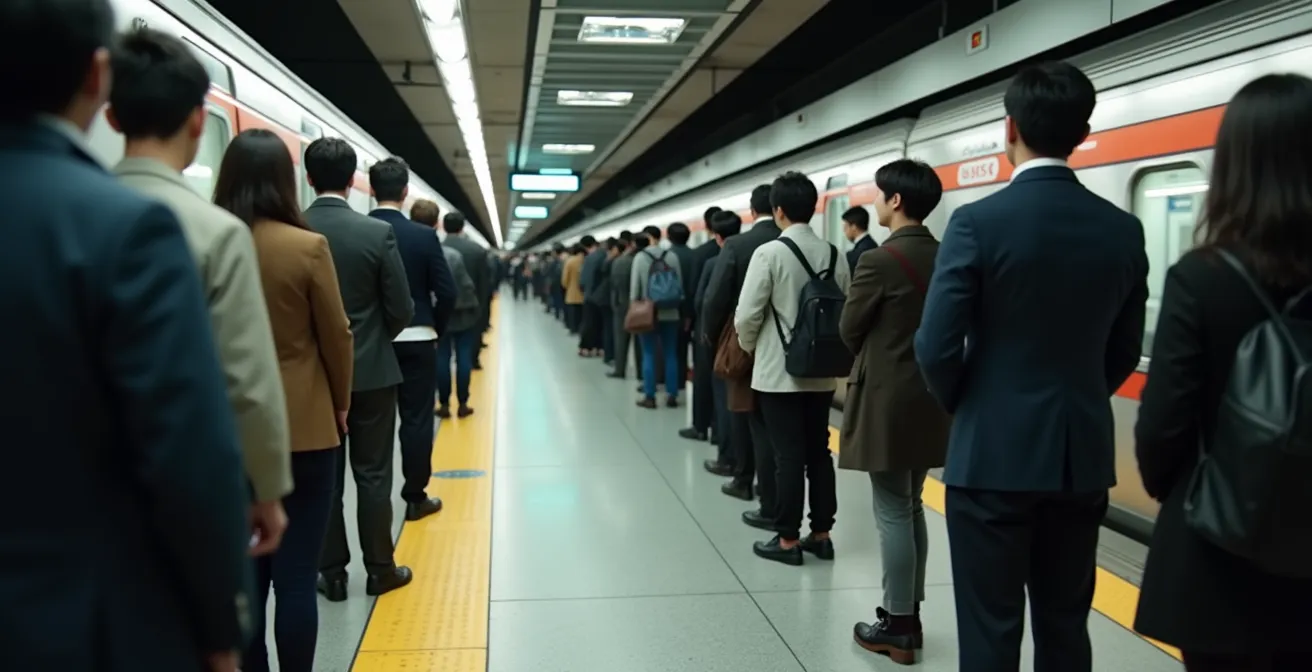
The discipline shown in queuing and boarding is a stark contrast to the London experience. Embracing this organised flow doesn’t just help you avoid angering locals; it makes the entire experience calmer and more efficient. Follow the lead of those around you: queue where they queue, stand where they stand, and keep your interactions to a minimum.
When Does the Metro Actually Close and How to Avoid Expensive Taxis?
One of the biggest shocks for a Londoner in Tokyo is the lack of a Night Tube. While we’re used to key lines running all night on weekends, the Tokyo metro system largely shuts down completely. The last trains on most lines depart their originating stations between 11:30 PM and 12:30 AM, and the system does not reopen until around 5 AM. Missing that last train isn’t an inconvenience; it’s a potentially very expensive problem.
Getting stranded in an area like Shibuya or Roppongi after midnight leaves you with few options, and the most obvious one is a taxi. This is a costly mistake. Unlike a black cab, Japanese taxis have a late-night surcharge, and the fares can be astronomical. For example, a midnight taxi from Shibuya to a hotel in Shinjuku costs between ¥6,000 and ¥10,000. That’s a staggering £35 to £55 for a journey that would have cost about £1.50 on the metro. Always check the last train time for your specific journey on Google Maps or Navitime; don’t assume you have until after 1 AM.
But what if the worst happens and you miss it? Don’t hail a cab. Instead, embrace a uniquely Japanese solution and save a fortune.
Case Study: Alternative Late-Night Options in Tokyo
Instead of a £50 taxi, you have several budget-friendly and culturally interesting alternatives. You can head to a ‘Net Cafe’ (manga kissa) and get a private booth with a reclining chair and internet access for about ¥2,000 (£11) for a few hours. For a proper bed, a capsule hotel is around ¥4,000 (£22). Or, do as many locals do: go to an all-night karaoke box with friends for around ¥3,000 (£17), which often includes unlimited soft drinks. All these options are significantly cheaper and offer a memorable story to tell.
Planning for the metro’s closure is a critical part of your nightly itinerary. Either ensure you’re on that last train or have a fun, budget-friendly backup plan. Your wallet will thank you.
Bus or 20-Minute Walk: When Does Walking Actually Beat Traffic?
This is a universal principle of urban travel hacking that applies just as much in Tokyo as it does in London. We often instinctively hop on a bus or tube for a short journey without considering the alternative. In dense, traffic-clogged city centres, walking is often not just the healthier or cheaper option—it’s the faster and more reliable one. This is especially true during peak hours.
The ’20-minute walk strategy’ is a perfect example of this logic in action, proving that for short distances, your own two feet are your most reliable mode of transport.
The 20-Minute Walk Strategy
In central London, a journey under 1.5 miles by bus between 3 PM and 7 PM can take anywhere from 7 to 25 minutes due to crippling traffic. A brisk walk, however, will consistently take you around 20 minutes. When you have a train to catch or a timed theatre ticket, the certainty of a 20-minute walk is far more valuable than the uncertainty of the bus. The same principle applies in Tokyo’s busiest districts; walking from one part of Ginza to another, or between Shibuya and Harajuku, is often faster than waiting for a train or navigating a station for a one-stop journey.
This mindset shift saves more than just time. In London, for example, consistently choosing to walk these short distances instead of tapping your Oyster card adds up. Small, regular savings can be significant over time. It’s a simple calculation: weigh the time, cost, and reliability. For short urban journeys, walking frequently wins on all three counts, whether you’re in Westminster or Shinjuku.
How to Split Your Ticket Legally to Save £50 on a Return to Manchester?
Just as understanding the Tokyo Metro’s structure unlocks value, applying the same ‘system hacking’ mindset to UK rail travel can lead to dramatic savings. ‘Split-ticketing’ is a perfectly legal method of reducing the cost of train journeys by buying multiple tickets for different stages of the trip instead of one single ticket. It’s especially effective for long-distance or last-minute bookings where standard fares are extortionate.
The practice might feel like a loophole, but it’s officially permitted. As National Rail confirms, it’s a feature, not a bug, of the UK’s complex fare system.
This isn’t a dodgy loophole. It’s explicitly allowed under the National Rail Conditions of Travel.
– National Rail, Conditions of Travel Guidelines
The key is that the train you are on must stop at the station(s) where you ‘split’ your tickets. For example, instead of buying one expensive return from London to Manchester, you might buy separate tickets for London-Milton Keynes, Milton Keynes-Stoke-on-Trent, and Stoke-on-Trent-Manchester. Because the train stops at all those stations, the journey is valid, but the combination of fares can be significantly cheaper. This requires a bit of research, but the savings can be well worth it.
Action Plan: Your Split-Ticketing Audit
- Points of Contact: List the start and end points of your UK train journey (e.g., London Euston to Manchester Piccadilly).
- Collecte: Use an online tool like Trainline’s ‘SplitSave’ feature or a dedicated split-ticketing website to automatically identify potential ‘split’ stations along your route.
- Cohérence: Before purchasing, double-check that the specific train service you intend to use calls at all the intermediate stations where your tickets are split. This is essential for the tickets to be valid.
- Mémorabilité/émotion: Compare the total cost of the split tickets against the price of a standard through-ticket for the same journey to quantify your savings.
- Plan d’intégration: If the savings are substantial, purchase the sequence of tickets. This strategy is most effective for peak-time or last-minute travel when advance fares are unavailable.
Key Takeaways
- Mastering a foreign transport system is less about memorising rules and more about understanding the underlying logic and avoiding false assumptions from home.
- In Tokyo, your ‘exit-level strategy’ for huge stations and knowledge of dedicated tourist passes are more valuable than a generic JR Pass for city travel.
- The same ‘system hacking’ principles—like split-ticketing in the UK or choosing to walk in dense urban areas—apply globally to save you time and money.
How to Cut Your London Commute Cost by 30% Using Multimodal Travel?
The ultimate level of transport system hacking is multimodal travel—strategically combining different modes of transport to exploit pricing structures. In London, this most often relates to Transport for London’s (TfL) zoning system. The price of a monthly or annual Travelcard is determined by the zones it covers, and the cost jumps significantly with each additional zone. This creates an opportunity for what is known as ‘zone boundary arbitrage’.
For a commuter, this means consciously ending your public transport journey a zone earlier and completing the ‘last mile’ by another method, such as walking, cycling, or even driving to a station in a cheaper zone. For instance, the cost difference between a Zone 1-3 and a Zone 1-5 Travelcard is substantial, often adding up to hundreds of pounds per year. By avoiding paying for those outer zones, you can unlock significant savings.
The Zone Boundary Arbitrage Strategy
A commuter living in Zone 4 could drive 10 minutes to a station at the edge of Zone 3, park their car, and then use a cheaper Zone 1-3 Travelcard for the rest of their journey. The monthly savings on the Travelcard would far outweigh the cost of petrol. An even more effective strategy is combining a Travelcard with a personal bike. By cycling from home in Zone 4 to the Zone 3 boundary station, the commuter completely eliminates the need for the more expensive pass, saving over 30% on their annual transport costs.
This approach requires a holistic view of your commute. It’s not just about the train or the tube; it’s about the entire door-to-door journey. By identifying the most expensive leg of your trip (usually the outermost zone) and finding a cheaper alternative, you can fundamentally re-engineer your travel costs. This is the mindset that separates the average commuter from the expert travel hacker.
By adopting this strategic mindset, you can transform your relationship with public transport, turning a daily cost and frustration into a system you can master for your own benefit, whether you find yourself in Tokyo, London, or beyond. Start applying these principles today to make every journey smarter and more affordable.