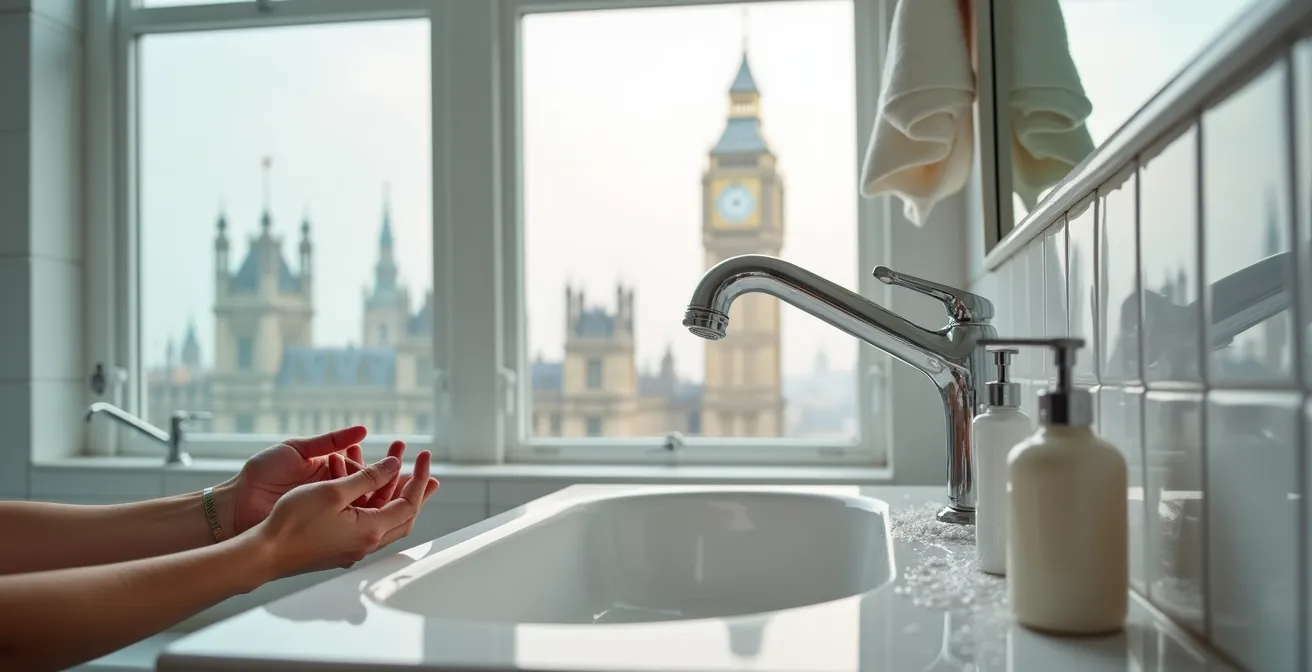
The solution to hard water skin damage isn’t more moisturiser; it’s chemically dissolving the mineral film left on your skin after every wash.
- London’s water contains high levels of calcium and magnesium that form an invisible “mineral matrix,” clogging pores and neutralising cleansers.
- Aggressive physical scrubbing makes the problem worse by creating micro-tears in the skin barrier, allowing more minerals to penetrate.
Recommendation: Adopt a skincare routine that uses oil-based cleansers and chelating agents to remove mineral build-up *before* applying targeted hydration.
If you live in London or the South East, you know the signs: a persistent film of limescale on your kettle, dull-looking hair, and that familiar, uncomfortable tightness in your skin after a shower. Many people resign themselves to this, blaming “sensitive skin” and spending a fortune on heavy moisturisers that offer only temporary relief. It’s a common belief that the only real solutions are expensive whole-house water softeners or simply moving away.
But what if the problem isn’t just dryness? As a dermatologist practising in London, I see the real effects daily. The issue is far more complex than a simple lack of moisture. It’s a chemical battle happening on your skin’s surface. The high concentration of calcium and magnesium in our water creates an invisible film—a mineral matrix—that suffocates the skin, clogs pores, and actively prevents your skincare products from working effectively.
The key isn’t to just mask the symptoms with another layer of cream. The true, science-backed solution lies in understanding this mineral buildup and strategically dismantling it. This involves a shift in how you think about cleansing and hydrating, moving from generic advice to a targeted approach that actively dissolves mineral deposits and repairs your skin’s natural defences.
This guide will break down the science behind hard water damage and provide a practical, dermatologist-approved plan. We will explore why soap scum is a red flag for your skin, how to navigate solutions even in a rental property, and which specific ingredients and application techniques can finally give you back control over your skin’s health in a hard water area.
Contents: How to combat the effects of London’s hard water on your skin
- Why Soap Scum on Your Bath Means Your Pores Are Clogged?
- How to Choose a Water Softener for a Rental Flat?
- Cleansing Balm or Micellar Water: Which Removes Limescale Best?
- The Scrubbing Mistake That Makes Hard Water Damage Worse
- In What Order Should You Apply Hyaluronic Acid in a Dry Climate?
- How to Zone Your Heating Room-by-Room Without Ripping Out Pipes?
- Why You Must Cover Cuts Before Swimming in Slow-Moving Rivers?
- Can NHS-Approved Apps Really Replace a GP Visit for Minor Ailments?
Why Soap Scum on Your Bath Means Your Pores Are Clogged?
That chalky, white residue that forms on your shower screen and taps, commonly known as soap scum, is the most visible evidence of London’s hard water. It’s formed when the fatty acids in soap react with the calcium and magnesium ions in the water. While it’s an unsightly cleaning nuisance, you should view it as a critical warning sign for your skin. Essentially, the same process that creates this scum is happening on a microscopic level on your face and body every time you wash.
This invisible layer is what I call the mineral matrix. As leading dermatologist Dr. Dennis Gross explains, “Simply bathing in hard water may cause redness and dry skin. The calcium settles on the skin and changes one’s own oil chemistry which compromises the skin’s ability to moisturise itself.” This mineral film mixes with your skin’s natural oils (sebum), creating a waxy plug that can lead to clogged pores, breakouts, and a dull, congested complexion. Your skin feels tight not just because it’s dry, but because it’s covered in a restrictive mineral cast.
The severity of this issue in the capital cannot be overstated. Research highlights that some areas are particularly affected; for instance, South London is a hotspot for harsh-impact hard water, and one study points to the small town of Epping, on the outskirts of the city, as having a water supply with an extreme hardness of 370 PPM. This means millions of residents are unknowingly applying a pore-clogging film to their skin daily.
How to Choose a Water Softener for a Rental Flat?
For London renters, the idea of installing a whole-house water softener is often a non-starter. It typically involves plumbing modifications that most landlords won’t approve. However, this doesn’t mean you are without options. A range of temporary and portable solutions exist that can significantly reduce your exposure to hard water minerals without requiring permanent changes to the property.
The best choice depends on your budget, your landlord’s flexibility, and your primary goal (e.g., better showers vs. softer water for the whole flat). Showerhead filters are the easiest and most affordable entry point, while monthly rental models offer a comprehensive solution if you can secure permission. The table below compares the most common solutions available to UK renters.
| Solution Type | Installation | Landlord Permission | Typical Cost | Effectiveness |
|---|---|---|---|---|
| Showerhead Filter | No plumbing needed | Not required | £20-£80 | Moderate (reduces minerals) |
| Countertop Softener | Portable unit | Not required | £150-£300 | Good for drinking/cooking |
| Rental Model (Harvey) | Professional | Required | £25-£35/month | Excellent (whole flat) |
Securing permission for a more effective system like a rental model requires a strategic approach. Presenting it as a health benefit and a protective measure for the property’s appliances can be very effective. Following a clear plan can increase your chances of getting a “yes” from your landlord.
Action Plan: Requesting Water Softener Permission from a London Landlord
- Document Damage: Take clear photos of existing limescale damage on taps, showerheads, and inside the kettle to demonstrate the water’s impact on the property.
- Research Solutions: Focus on non-permanent options like portable units or professional rental services that offer removal upon moving out.
- Cite Legislation: Reference the Tenant Fees Act 2019, which allows tenants to make reasonable requests for improvements to a property.
- Offer to Cover Costs: Propose to pay for the full installation and removal costs yourself, making it a no-cost improvement for the landlord.
- Present Health Benefits: Explain the health advantages, citing NHS-recognised conditions like eczema which are known to be exacerbated by hard water.
Cleansing Balm or Micellar Water: Which Removes Limescale Best?
A common mistake people in hard water areas make is choosing the wrong type of cleanser. Many reach for micellar water, believing its gentle, no-rinse formula is ideal for sensitive skin. However, the chemistry of hard water directly undermines its effectiveness. Micellar water relies on surfactants (the “micelles”) to trap dirt and oil. But the minerals in London’s water, specifically divalent cations like calcium (Ca2+) and magnesium (Mg2+), interfere with these surfactants.
This isn’t just theory; dermatological research indicates that these cations can reduce surfactant efficacy by up to 40%. This means your micellar water isn’t cleaning your skin properly and is leaving behind a cocktail of makeup, dirt, and mineral deposits. In contrast, oil-based cleansers and cleansing balms are far superior. They work by the principle of ‘like dissolves like,’ melting away the oily, waxy mineral matrix on your skin without being neutralised by water hardness.
To truly combat the mineral matrix, look for products containing “chelating” ingredients. These are molecules that bind to the mineral ions, effectively lifting them off your skin and allowing them to be rinsed away.
These unique molecules actually remove the calcium from the skin surface and prevent their penetration. They are essentially water-softening ingredients I add to creams, cleansers, moisturisers and serums.
– Dr. Dennis Gross, on chelating ingredients in skincare
By choosing a cleanser that actively de-scales the skin, you ensure the first step of your routine is working for you, not against you, creating a clean canvas for the products that follow.
The Scrubbing Mistake That Makes Hard Water Damage Worse
When faced with dull, flaky, or congested skin, the instinctive reaction for many is to reach for a harsh physical exfoliant. The thinking is logical: if there’s a layer of buildup, I should scrub it off. However, in a hard water environment, this is one of the most damaging things you can do. This aggressive scrubbing causes micro-abrasion risk, creating microscopic tears in your skin’s protective barrier.
A compromised barrier is like an open door. The very minerals you’re trying to remove can now lodge themselves deeper into your skin, causing further irritation, inflammation, and dryness. Since hard water already leaves a soap residue that can clog pores and lead to conditions like acne or eczema, creating more entry points for these minerals only exacerbates the problem. Your skin becomes trapped in a vicious cycle of irritation and damage.
The solution is not to stop exfoliating, but to switch from physical to chemical exfoliation. Gentle acids like Lactic Acid and Mandelic Acid work by dissolving the ‘glue’ that holds dead skin cells and mineral deposits together, revealing brighter skin without compromising the barrier. This must be part of a wider, gentle protocol.
Follow these steps for a barrier-friendly exfoliation routine:
- Use pH-balanced cleansers (around pH 5.5) to protect the skin’s natural acidity.
- Apply a Lactic or Mandelic Acid serum two to three times per week at night.
- Always pat your skin dry with a soft, clean towel—never rub, which causes friction and damage.
- Immediately follow with a hydrating toner while the skin is still slightly damp.
- Seal everything in with a ceramide-rich moisturiser to rebuild the skin barrier and prevent new mineral deposits from forming.
In What Order Should You Apply Hyaluronic Acid in a Dry Climate?
Hyaluronic Acid (HA) is hailed as a hydration hero, but many Londoners find it ineffective or even drying. The reason again lies in the chemistry of hard water and the city’s often dry, centrally-heated indoor environments. HA is a humectant, meaning it pulls moisture from its surroundings. In a humid climate, it draws water from the air into your skin. But when applied to skin coated in a mineral film, its ability to function is severely hampered.
The invisible mineral matrix acts as a barrier, preventing HA from properly binding with your skin. In fact, water quality research demonstrates that a mineral film can reduce HA efficacy by up to 60%. Worse, if the air is dry, HA can have a reverse effect, pulling moisture *out* of the deeper layers of your skin and leaving it even more dehydrated. This is why a specific application method is essential in a hard water city like London.
The “London Sandwich Technique” is a strategic layering method designed to counteract this. It focuses on neutralising minerals first and then locking in hydration from a controlled source, not from tap water or dry air.
- Cleanse Water-Free: Start with a cleansing balm or oil that you can remove with a soft cloth, minimising contact with tap water.
- Apply Chelating Toner: Use a toner with chelating agents or a gentle acidic pH to neutralise any remaining mineral residue on the skin.
- Hydrate on Damp Skin: While the skin is still damp *from the toner*, pat your Hyaluronic Acid serum on. This gives the HA a direct source of purified moisture to draw from.
- Layer Another Humectant: Consider adding a layer of Polyglutamic Acid or Beta-Glucan, which are larger molecules that can sit on the surface and provide an extra layer of hydration.
- Seal Immediately: Within 60 seconds, apply an occlusive, ceramide-based moisturiser. This creates a seal, locking the hydration in and preventing it from evaporating.
How to Zone Your Heating Room-by-Room Without Ripping Out Pipes?
The battle against hard water damage doesn’t end at the bathroom sink. The ambient environment in your home, particularly the humidity level, plays a significant role. UK homes, especially in winter, rely heavily on central heating, which drastically reduces indoor humidity. This dry air acts like a sponge, pulling moisture from your skin and accelerating the crystallization of mineral deposits left behind after washing.
Low humidity creates a more hostile environment for skin already stressed by hard water. In fact, dermatological studies show that indoor humidity below 40% can increase mineral crystallization on skin by 35%. This makes skin feel tighter, appear flakier, and become more prone to irritation. The traditional approach of heating the entire home to a single, constant temperature is often the primary culprit.
Fortunately, modern smart home technology offers a solution without needing to overhaul your plumbing. Smart thermostatic radiator valves (TRVs) from brands like Tado, Hive, or Netatmo allow for room-by-room temperature control. You can create “skin-safe” humidity zones. For example, you can set bedrooms to a cooler 16-18°C, which helps preserve humidity overnight, while keeping living areas warmer. A UK-based analysis showed that homes using smart thermostats to maintain lower bedroom temperatures reported 25% less skin irritation compared to homes with constant heating, directly linking controlled temperature to better skin health in hard water areas.
Why You Must Cover Cuts Before Swimming in Slow-Moving Rivers?
While the topic of swimming in rivers like the Thames might seem disconnected from your daily shower, it offers a crucial lesson in barrier compromise. London’s tap water famously originates from the River Thames and the River Lee. As the blog London New Girl notes, “While rigorously treated, this illustrates how the ‘journey’ of water matters.” The water’s journey endows it with its high mineral content. A cut or open wound represents the ultimate form of a compromised skin barrier, exposing your internal tissues directly to this mineral-rich, and potentially contaminated, environment.
This extreme example highlights what happens on a smaller scale to skin damaged by hard water. The dryness, micro-tears from scrubbing, and conditions like eczema all represent a weakened barrier. Protecting a cut before swimming is non-negotiable, and you should apply the same protective mindset to your daily skincare routine. The goal is to create a “liquid plaster” to shield vulnerable skin from the constant assault of hard water minerals.
You can create this protective shield with strategic product application:
- Identify Compromised Areas: Look for persistent dry patches, areas of redness, or any skin that feels raw or tight.
- Repair with Ceramides: Apply a serum rich in ceramides directly to these areas. Ceramides are lipids that are a natural component of your skin barrier.
- Layer with Squalane: Add a layer of squalane oil. Its molecular structure is very similar to your skin’s own sebum, making it an excellent, non-irritating protective layer.
- Use an Occlusive on Severe Spots: For severely chapped or cracked areas, apply a thin layer of a strong occlusive like a lanolin or petroleum-based balm to create a physical seal.
- Reapply as Needed: Get into the habit of reapplying a protective layer after every time your skin is exposed to water.
Key takeaways
- London’s hard water leaves an invisible ‘mineral matrix’ on the skin that clogs pores and blocks skincare products.
- Standard cleansers are often neutralised by water minerals; switch to oil-based or chelating cleansers for effective ‘chemical de-scaling’.
- Avoid harsh physical scrubbing. Instead, use gentle chemical exfoliants and a multi-step ‘strategic hydration’ routine to repair the skin barrier.
Can NHS-Approved Apps Really Replace a GP Visit for Minor Ailments?
For many Londoners suffering from persistent skin issues, the question becomes: when is it time to seek professional help? The link between hard water and chronic skin conditions like eczema is not just anecdotal; it’s backed by significant medical research. A landmark 2016 King’s College London study found that living in a hard water area was associated with up to an 87% increased risk of infant eczema. This demonstrates that what seems like a minor annoyance can be a trigger for a recognised medical condition.
Our study builds on growing evidence of a link between exposure to hard water and the risk of developing eczema in childhood.
– Dr. Carsten Flohr, Lead researcher, King’s College London
While NHS-approved apps are excellent for booking appointments and managing prescriptions, they cannot replace a diagnostic consultation for a persistent problem. However, there is a clear, structured pathway you can follow to get the right help. You don’t always need to go straight to a GP; local pharmacists are highly trained to be the first port of call. Following a logical progression and documenting your symptoms is the most effective way to navigate the system.
For skin problems you suspect are linked to hard water, follow the Londoner’s pathway to professional help:
- Start at the Pharmacy: Visit your local Boots or Lloyds pharmacist. They can assess your skin and recommend effective over-the-counter treatments like emollients and mild corticosteroid creams.
- Document Your Symptoms: Use your phone to take clear photos of the affected areas, showing the progression over two to three weeks while using the recommended treatments.
- Book a GP Appointment: If your symptoms do not improve or worsen after four weeks, book a GP appointment. You can do this efficiently via the NHS App.
- Request a Referral: During your appointment, show your photo log and specifically mention hard water as a suspected environmental trigger. This evidence strengthens your case for a dermatology referral.
- Consider Private Options: If the NHS waiting list for a dermatologist is long (e.g., over three months), you might consider a private consultation on Harley Street for specialist advice and patch testing to rule out other allergies.
Don’t just accept hard water skin damage as a fact of London life. Start your pathway to clearer skin today by documenting your symptoms and consulting a pharmacist as your first, crucial step toward a proper diagnosis and effective treatment plan.