
The daily ULEZ charge is not an unavoidable tax; it’s a financial problem that can be solved with regulatory know-how, often without changing your vehicle.
- Challenge incorrect Transport for London (TfL) data using your vehicle’s Certificate of Conformity to prove compliance.
- Leverage grants for retrofitting or strategically adopt multimodal travel to eliminate the charge entirely from your commute.
Recommendation: Before paying a single charge, audit your vehicle’s true emissions status and analyse your daily journey to identify these powerful cost-saving loopholes.
The sight of an Ultra Low Emission Zone (ULEZ) sign can feel like a direct hit to the wallet for many drivers in London. With a daily charge of £12.50, the costs quickly accumulate, leading many to believe the only solution is to sell their beloved older vehicle and invest in a newer, compliant model. This is the standard advice, often paired with suggestions to simply use public transport or pay up. However, this perspective overlooks a crucial reality: for many, buying a new car isn’t financially viable, and giving up a vehicle entirely isn’t practical.
The common narrative focuses on compliance and payment, but it misses the bigger picture of strategic financial management. What if the key to navigating the ULEZ wasn’t just about the car you drive, but *how* you manage its official status and integrate it into a smarter travel ecosystem? This is where regulatory arbitrage comes into play—understanding the system’s nuances to legally and effectively minimise your costs. It’s about shifting from being a passive payer of charges to a proactive manager of your transport expenses.
This guide moves beyond the obvious. We will dissect the financial levers at your disposal, from proving your vehicle is compliant despite what the database says, to retrofitting your van for a fraction of the cost of a new one. We will explore the costly payment traps to avoid, the exemptions you might be entitled to, and the powerful, hidden costs of driving that make alternative strategies surprisingly affordable. This is your playbook for beating the daily charge without surrendering your keys or emptying your bank account.
Summary: How to Avoid Daily ULEZ Charges in London Without Buying a New Car?
- Why Your 2015 Diesel Might Still Be Liable for the Daily Charge?
- Is Retrofitting Your Van for ULEZ Cheaper Than Selling It?
- The Payment Mistake That Leads to a £180 Fine Even if You Willing to Pay
- Blue Badge or Historic Vehicle: Who Is Exempt from the Charge?
- When Will Clean Air Zones Expand to Manchester and Bristol?
- Why Driving to St Ives Might Cost More Than Flying to Faro?
- Why Depreciation Makes Your Parked Car Cost £2000 a Year?
- How to Cut Your London Commute Cost by 30% Using Multimodal Travel?
Why Your 2015 Diesel Might Still Be Liable for the Daily Charge?
One of the most common and frustrating ULEZ scenarios involves the owner of a seemingly modern vehicle discovering it’s non-compliant. The general rule is that Euro 6 diesel cars are compliant. However, the critical detail lies in the registration date. According to RAC’s comprehensive ULEZ guidance, most diesel cars registered before September 2015 do not meet the Euro 6 standard, even if they were manufactured that year. This creates a “compliance anomaly” where two identical cars from the same year can have different ULEZ statuses based on a few weeks’ difference in their first registration.
This discrepancy arises because while the Euro 6 standard became mandatory for all new car *approvals* from September 2014, it only became mandatory for all new *registrations* a year later. Cars approved under the older Euro 5 standard could still be sold and registered up until September 2015. But this isn’t the only reason for errors. TfL’s database can sometimes be out of date or incorrect. It has a known lag in receiving data from the DVLA on new registrations or personalised number plate transfers, leading to compliant cars being wrongly flagged.
This is where regulatory arbitrage becomes a powerful tool. You should not blindly accept the verdict of the online checker. If you believe your vehicle meets the required NOx emissions standard despite its age, you can and should challenge the decision. This requires providing direct evidence to TfL, a process that can save you thousands of pounds a year without changing a single part on your car.
Your Action Plan: Challenging Your Vehicle’s ULEZ Status
- Initial Check: First, confirm your vehicle’s status on TfL’s official checker tool using your registration number. This is your baseline.
- Gather Evidence: Obtain a Certificate of Conformity (CoC) from your car manufacturer’s UK headquarters. This document officially states your vehicle’s Euro standard and NOx emissions.
- Submit Your Case: Submit the CoC as evidence via TfL’s online ULEZ contact form. You can also call their helpline, but having a digital paper trail is advisable.
- Pre-Purchase Verification: If buying a used car, always verify its ULEZ compliance yourself before purchase, rather than relying solely on the seller’s word.
- Know Your Rights: If you were mis-sold a vehicle by a trader who claimed it was ULEZ-compliant, you may have rights under the UK’s Consumer Rights Act 2015.
Is Retrofitting Your Van for ULEZ Cheaper Than Selling It?
For van drivers and small business owners, a non-compliant vehicle isn’t an inconvenience; it’s a threat to their livelihood. The prospect of selling a perfectly functional van at a heavily depreciated price to buy a new one is daunting. However, there is a third option that is often overlooked: retrofitting. By installing a Clean Vehicle Retrofit Accreditation Scheme (CVRAS) approved system, you can bring your vehicle up to ULEZ standards and continue using it.
The key question is financial viability. TfL’s scrappage scheme offers several grants, creating a complex cost-benefit analysis. For instance, as part of the scheme, a £6,000 grant is available for retrofitting a van, an option chosen by hundreds of drivers. This can be significantly cheaper than the upfront cost of a new electric van, even with the larger £9,500 grant for that option. Retrofitting allows you to keep an asset you know and trust, avoiding the uncertainty and higher insurance costs of a new vehicle.
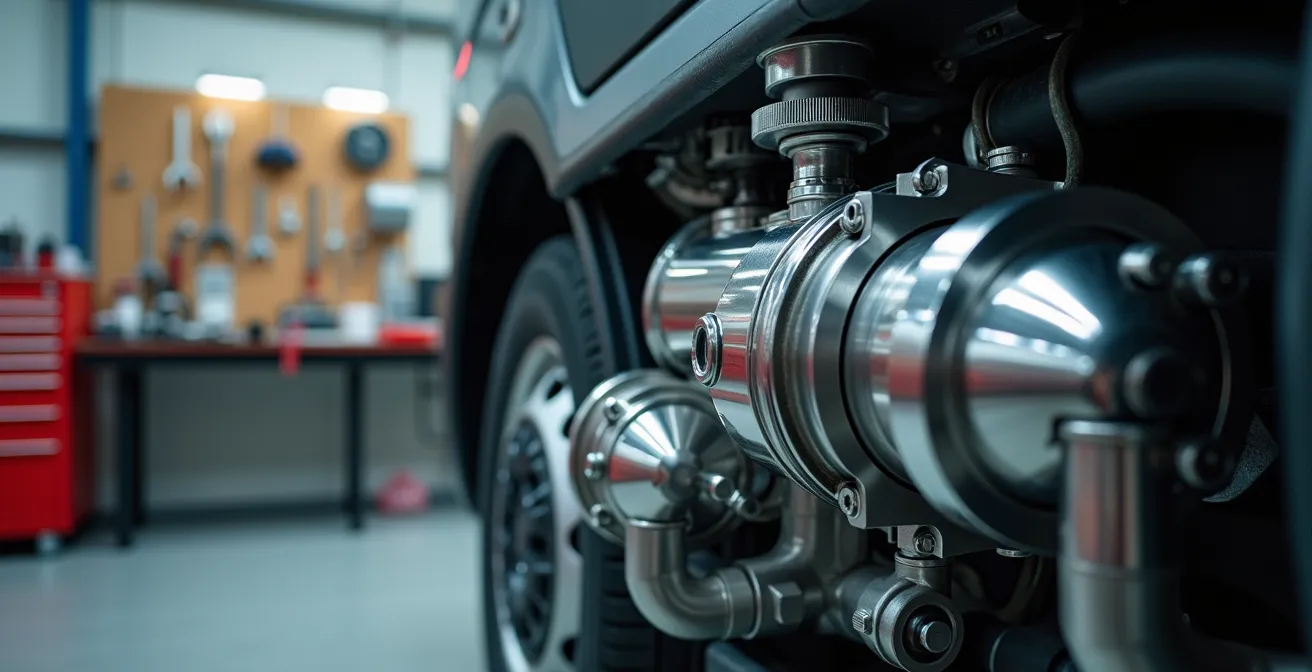
This image showcases the technical precision involved in a CVRAS-approved engine retrofit, a key strategy for ULEZ compliance.
Of course, retrofitting has its own challenges, such as finding an approved installer and managing the vehicle’s downtime. The decision requires a careful comparison of all available financial levers, as detailed in the table below. Selling the van outside of London, where it may fetch a higher price in a non-CAZ area, is another alternative to consider against the simplicity of the scrappage grant.
| Option | Cost/Grant | Pros | Cons |
|---|---|---|---|
| Scrap via TfL scheme | £7,000 grant | Immediate cash, simple process | Need to find replacement |
| Scrap + buy electric | £9,500 grant | Higher grant, future-proof | Higher upfront costs |
| CVRAS retrofit | £6,000 grant | Keep existing vehicle | Complex process, limited providers |
| Sell outside London | Market value | Higher resale value in non-CAZ areas | Time-consuming, uncertain |
The Payment Mistake That Leads to a £180 Fine Even if You Willing to Pay
Even for those who accept they must pay the ULEZ charge, a simple administrative error can be incredibly costly. The most common pitfall lies with the Auto Pay system. While designed for convenience, it can easily lead to a Penalty Charge Notice (PCN) if not managed meticulously. The penalty for failing to pay the charge on time is severe: an £180 PCN, although this is reduced to £90 if paid within 14 days. These fines can stack up rapidly, turning a manageable daily cost into a significant financial burden.
A frequent mistake is selling a vehicle but forgetting to remove it from your TfL Auto Pay account. The new owner might then drive through the zone, racking up charges and subsequent fines that are sent to you, the registered Auto Pay account holder. Similarly, families with multiple cars must register each vehicle separately; assuming one registration covers all household vehicles is a recipe for a fine. Another blind spot is hire cars. Many drivers wrongly assume the rental company will handle ULEZ charges, only to receive a PCN weeks later.
To avoid these expensive errors, treat your TfL account with the same diligence as a bank account. Proactive account management is the only way to ensure you don’t pay a penalty for a charge you were willing to cover. The following checklist outlines the essential habits to adopt:
- Immediately remove any sold vehicles from your TfL Auto Pay account.
- Ensure every vehicle you intend to drive in the zone is individually registered for Auto Pay.
- Always clarify ULEZ payment responsibility with the rental company *before* you drive a hire car in London.
- When possible, use navigation apps with an ‘Avoid ULEZ’ setting if you don’t intend to enter the zone.
- Remember that the charge operates from midnight to midnight. Crossing midnight in the zone means you are liable for two daily charges.
- You have a window to pay: you can pay up to 90 days in advance, on the day of travel, or by midnight on the third day following the journey.
Blue Badge or Historic Vehicle: Who Is Exempt from the Charge?
Before considering selling your car or paying the daily charge, it is crucial to check if you qualify for an exemption. Several specific categories of vehicles and drivers are not required to pay, and falling into one of them is the most straightforward way to avoid the cost entirely. The two most significant groups are disabled drivers and owners of historic vehicles.
For Blue Badge holders, the rules provide a ‘grace period’. While many Blue Badge holders may have to pay the charge, there are key exemptions. Vehicles registered with the DVLA in the “disabled passenger vehicle” tax class are completely exempt until a future date. This exemption has been extended until 24 October 2027, giving drivers in this class several more years of relief. Furthermore, wheelchair-accessible private hire vehicles are also exempt, recognising their essential role in London’s transport network.
The pride of owning a classic car in London is protected by the historic vehicle exemption.

The other major exemption applies to classic cars. Any vehicle with a ‘historic’ vehicle tax class is exempt from the ULEZ charge. To qualify for this class, a vehicle must have been built more than 40 years ago. This is a rolling classification, so each year a new cohort of classic cars becomes eligible. This exemption acknowledges the cultural value of these vehicles and the fact that they are typically driven far less frequently than modern cars, thus having a smaller overall impact on air quality.
When Will Clean Air Zones Expand to Manchester and Bristol?
While London’s ULEZ is the most well-known, it is part of a wider national strategy to improve air quality across the UK. Several other English cities have already implemented their own Clean Air Zones (CAZs), and more are expected to follow. For drivers, this means a ULEZ-related issue is no longer confined to the capital. Understanding the landscape outside London is key to future-proofing your travel and any potential vehicle purchases.
Bristol, for example, already operates a CAZ where non-compliant cars face a daily charge. According to the RAC’s UK-wide overview, Bristol’s CAZ charges £9/day for non-compliant cars, similar in principle to London’s ULEZ but with a different fee. Birmingham also has a CAZ with an £8 daily charge. These zones typically follow the same emissions standards as London (Euro 4 for petrol, Euro 6 for diesel), meaning a car that is non-compliant in London will also be non-compliant there.
Plans for a Greater Manchester CAZ have been subject to extensive review and changes, with the original proposal for a charging zone put on hold. However, the underlying government directive to reduce air pollution remains. This means that drivers in or travelling to major urban centres across England must remain vigilant. A non-charging zone today could become a charging zone tomorrow. This makes it essential to consider national standards, not just London’s rules, when making any long-term vehicle decisions. If you are considering a replacement vehicle, ensuring it meets the highest possible standard is the best form of financial protection.
- Aim for vehicles that meet at least the Euro 6d standard, which is more stringent than the basic Euro 6.
- Look for RDE2-compliant diesel vehicles, as they are exempt from the diesel surcharge in company car tax and represent a higher emissions standard.
- Before travelling to any major city, use its specific official CAZ checker tool, as local rules and boundaries can vary.
- Consider an electric vehicle for complete exemption from all current CAZ charges nationwide (though note that London’s Congestion Charge discount for EVs is set to end in December 2025).
Why Driving to St Ives Might Cost More Than Flying to Faro?
The £12.50 daily ULEZ charge can seem like a manageable, isolated cost. However, this thinking is a financial trap. The true impact of the ULEZ is its cumulative effect, which can transform the economics of travel. When you factor in the daily charge over a year, the numbers become staggering. For a commuter driving into the zone five days a week, the charge alone equates to a £3,238 annual cost, more than enough for a luxury holiday.
This cost fundamentally changes the comparison between domestic and international travel. A week-long holiday in the UK, such as a drive from London to St Ives in Cornwall, can unexpectedly become more expensive than a budget flight to Europe. The moment you start your non-compliant car’s engine for the journey, you incur the £12.50 exit charge. Add the high cost of fuel for a 500-mile round trip, expensive local parking in a tourist hotspot like St Ives, and general vehicle wear and tear, and the total quickly escalates.
In contrast, flying to a destination like Faro, Portugal, involves none of these ULEZ-related costs. While the flight itself has a price tag, the absence of the ULEZ fee, fuel costs, and UK parking charges can make it the cheaper option. This counter-intuitive outcome highlights how the ULEZ is not just a commuting tax but a factor that re-writes the budget for every journey starting from within the zone.
| Cost Component | Driving to St Ives | Flying to Faro |
|---|---|---|
| ULEZ charge (exit London) | £12.50 | £0 |
| Fuel (500 miles return) | £85 | £0 |
| Parking (7 days St Ives) | £140 | £0 |
| Vehicle wear & tear | £50 | £0 |
| Flight (budget airline) | £0 | £120 |
| Airport parking | £0 | £70 |
| Total | £287.50 | £190 |
Why Depreciation Makes Your Parked Car Cost £2000 a Year?
The ULEZ’s financial impact extends far beyond the daily charge. It creates a powerful, unseen force that actively reduces the value of your assets: depreciation. For owners of older, non-compliant vehicles in London, the ULEZ has effectively accelerated this process, making their cars significantly harder to sell within the capital. This hidden cost can often outweigh the daily charge itself, even if the car is barely driven.
Consider a hypothetical 10-year-old diesel car worth £5,000 before the ULEZ expansion. Once designated non-compliant, its potential market of London buyers evaporates. To sell it, the owner must now compete in a saturated market outside London or accept a lowball offer from a trader who will factor in the cost of transporting it. This ULEZ-induced depreciation could easily wipe £1,000-£2,000 off its value in a single year—a silent cost of £83-£166 per month just for it to sit on your driveway. This is a critical factor when weighing up whether to keep the car and pay the charge, or to take a grant from the scrappage scheme.
The effectiveness of this financial pressure is clear from official figures. The ULEZ policy and scrappage schemes have been hugely successful in changing driver behaviour, with TfL data showing the expansion has contributed to achieving a 96% vehicle compliance rate across London. The scrappage scheme, boosted to £210m in funding, has been a key financial lever, helping many Londoners move away from older, more polluting vehicles. While good for air quality, this mass transition floods the second-hand market with non-compliant cars, further depressing their value for those who have not yet made the switch.
Key Takeaways
- A car’s registration date isn’t the final word; challenge TfL’s database with a Certificate of Conformity to prove its true emissions status.
- For vans, retrofitting with a £6,000 grant can be more cost-effective than selling at a heavily depreciated price within London.
- True cost avoidance involves strategic changes, like multimodal commuting, which can completely eliminate ULEZ charges from your daily travel.
How to Cut Your London Commute Cost by 30% Using Multimodal Travel?
For many, the most powerful strategy to eliminate the ULEZ charge is not to change the car, but to change the commute. By adopting a multimodal travel plan, you can surgically remove the most expensive part of your journey—driving within the zone—while retaining the flexibility of using your car. This approach combines driving with public transport or other modes of travel in a way that is both cost-effective and practical.
The daily cost of driving into central London on a weekday can be immense. It’s not just the £12.50 ULEZ charge; you must also add the £15 Congestion Charge. This means a single trip can cost £27.50 before you even account for fuel and parking. A multimodal strategy directly attacks this cost. The core principle is to use your non-compliant car for the portion of the journey outside the ULEZ, park it at a strategic point, and then complete the final leg of your journey using a different transport mode.
This “Park and Ride” concept can be highly sophisticated. You can park at a tube or train station on the very edge of the ULEZ boundary (like Amersham or Chesham) and take the train into the city. For an even cheaper option, apps like JustPark or YourParkingSpace allow you to rent a private driveway near a station on a monthly basis, which is often cheaper than official station car parks. The savings from avoiding the daily ULEZ and Congestion Charges can easily offset the cost of a monthly rail pass, effectively cutting your total commute cost significantly.
Your Multimodal Commuting Strategy Guide
- Identify Boundary Stations: Locate train or tube stations just outside the ULEZ boundary that are convenient for your route.
- Compare Parking Costs: Use apps like JustPark or YourParkingSpace to compare the cost of monthly private driveway rentals against official station parking fees.
- Calculate Total Cost: Add your chosen parking cost to a monthly or annual train/tube season ticket. Compare this total to your current monthly cost of ULEZ charges, Congestion Charges (if applicable), and city-centre parking.
- Optimise with Apps: Use navigation apps like Waze with the ‘Avoid ULEZ’ setting enabled to ensure your driving route to the station never accidentally strays into the zone.
- Consider Last-Mile Options: For connections from your final station to your office, consider using Santander Cycles or a hired e-scooter to further reduce travel time and cost.
To effectively navigate the ULEZ rules and protect your finances, the next step is to use the official TfL vehicle checker and then audit your regular journeys against the multimodal strategies discussed here. By taking these proactive steps, you can create a personalised transport plan that keeps both you and your money moving efficiently.