
Your winter fitness isn’t lost to ‘lack of motivation’; it’s lost to a lack of strategy.
- The right technical gear isn’t a luxury; it’s a non-negotiable tool that makes the gym financially illogical for outdoor training.
- Safety in the dark isn’t about being bright, it’s about understanding the science of ‘biomotion’ to be truly seen by drivers.
Recommendation: Stop making excuses. Systematically dismantle each barrier—gear, technique, safety, and mindset—to turn the British winter from an obstacle into your greatest training advantage.
The clocks go back, and a familiar sense of dread descends upon runners and cyclists across the UK. The crisp autumn mornings are replaced by a persistent, soul-sapping drizzle. Daylight becomes a fleeting commodity, and the sofa’s magnetic pull feels stronger than any personal best. The common advice you hear is to ‘just find the motivation’ or ‘layer up’. But let’s be blunt: that’s lazy coaching. Motivation is fickle. Relying on it is planning to fail. The real enemy isn’t the weather; it’s poor preparation and a failure to respect the specific challenges the British winter throws at you.
This isn’t about finding a mythical inner fire. This is about building a robust, weatherproof system for your body and mind. It’s about understanding the physics of warmth, the biomechanics of a slippery surface, and the psychology of a 4 PM sunset. Forget vague encouragement. The key is to adopt a new mindset: there is no bad weather, only the wrong strategy. Instead of seeing winter as a three-month-long excuse to retreat indoors, we will treat it as a tactical problem to be solved with the right knowledge and equipment. It’s time to stop hibernating and start dominating.
This guide provides a no-nonsense framework to do just that. We will dismantle every common excuse, from inadequate gear and fear of icy roads to the very real mental battle against the winter blues. By the end, you won’t need motivation, because you’ll have a plan.
Summary: Your Strategic Guide to Conquering Winter Fitness
- Why Cotton Is Your Worst Enemy When Running in 5°C Drizzle?
- How to Adjust Your Stride Technique for Wet Leaves and Black Ice?
- £40/Month Gym or High-End Waterproofs: Where to Spend Your Budget?
- The Visibility Error That Cyclists Make on Country Lanes at Twilight
- When to Schedule Runs to Maximise Vitamin D Absorption in January?
- Why 10,000 Lux Is the Magic Number for Your Light Therapy Lamp?
- Wetsuit or Skins: Which Is Safer for a November Dip?
- Combatting SAD: Strategies for Emotional Resilience When the Sun Sets at 4 PM?
Why Cotton Is Your Worst Enemy When Running in 5°C Drizzle?
Let’s get the most fundamental mistake out of the way. If you are wearing a cotton t-shirt for a winter run, you are setting yourself up for failure and misery. Cotton is hydrophilic, meaning it absorbs and holds onto water. Once wet with rain or sweat, it becomes a conductor, pulling heat away from your body with lethal efficiency. This isn’t just about feeling uncomfortable; it’s a performance and safety issue. The term for this is thermal incompetence, and it’s the fastest way to get dangerously cold.
The science is unforgiving. When wet, cotton loses all its insulating properties. In fact, some research on thermal conductivity shows it can lead to heat loss up to 25 times faster than when it’s dry. In a typical British 5°C drizzle, this means your core temperature will plummet, forcing your body to expend precious energy just to stay warm, energy that should be going into your run. This is the “chill” that drives people indoors, but it’s entirely preventable.
The solution is not more layers, but the right layers. A technical, three-part layering system is the cornerstone of any successful winter training plan. It works by trapping insulating air and actively moving moisture away from your skin, keeping you dry from the inside out and protected from the outside in. This isn’t an optional extra; it is the absolute foundation of winter fitness.
Action Plan: The Essential Layering System
- Base Layer: Start with a moisture-wicking base layer made of synthetic (polyester) or merino wool materials that sits snugly against the skin. Its only job is to pull sweat away.
- Mid-Layer: Add an insulating mid-layer, like a fleece or grid-fleece, which is designed to trap warm air created by your body.
- Outer Shell: Top with a waterproof but breathable outer shell. Look for jackets with taped seams to prevent leaks and check for breathability ratings (MVTR) above 10,000g/m² to ensure sweat can escape.
- Garment Maintenance: Re-apply DWR (Durable Water Repellent) coating products, such as Nikwax, every 6-8 washes to maintain the jacket’s ability to bead water off the surface.
- Final Check: Before you buy, check the fit. There should be enough room for the layers to trap air, but not so much that it’s baggy and lets drafts in.
How to Adjust Your Stride Technique for Wet Leaves and Black Ice?
Once your core is warm and dry, the next excuse is the ground itself. A carpet of wet leaves on the pavement or the ever-present threat of a hidden patch of black ice can kill confidence and lead to a tentative, inefficient running form that increases injury risk. Shouting “be careful” is useless. You need a tactical adjustment to your technique and a critical eye on your equipment. You must actively work to maintain grip integrity.
The key change is to shorten your stride and increase your cadence (the number of steps per minute). A shorter, quicker stride means your feet land more directly underneath your centre of gravity. This reduces the braking forces that occur when you over-stride and significantly lowers your chance of slipping. Think of it as your feet ‘tapping’ the ground rather than pushing off it. Keep your posture upright and your arms slightly wider for balance. This adjustment allows you to react instantly if you do hit a slippery patch.
Of course, technique is only half the battle. Your footwear is your only point of contact with the ground, and standard road shoes may not be up to the task. This is where investing in winter-specific or trail running shoes pays dividends, even for road running. Their deeper, more aggressive lugs are designed to bite into soft ground and shed mud, while specialised rubber compounds remain pliable and grippy in low temperatures when normal rubber hardens.
Case Study: Inov-8’s Lake District Solution
The UK-based brand Inov-8, born in the fells of the Lake District, provides a perfect example of engineering for British conditions. They developed trail shoes with deep, mud-shedding lugs and, crucially, pioneered the use of graphene-enhanced rubber compounds. This material maintains its flexibility and grip in near-freezing temperatures, addressing the unique challenges of British winter terrain, from slick chalk paths in the South Downs to wet, treacherous Victorian cobblestones in northern towns.
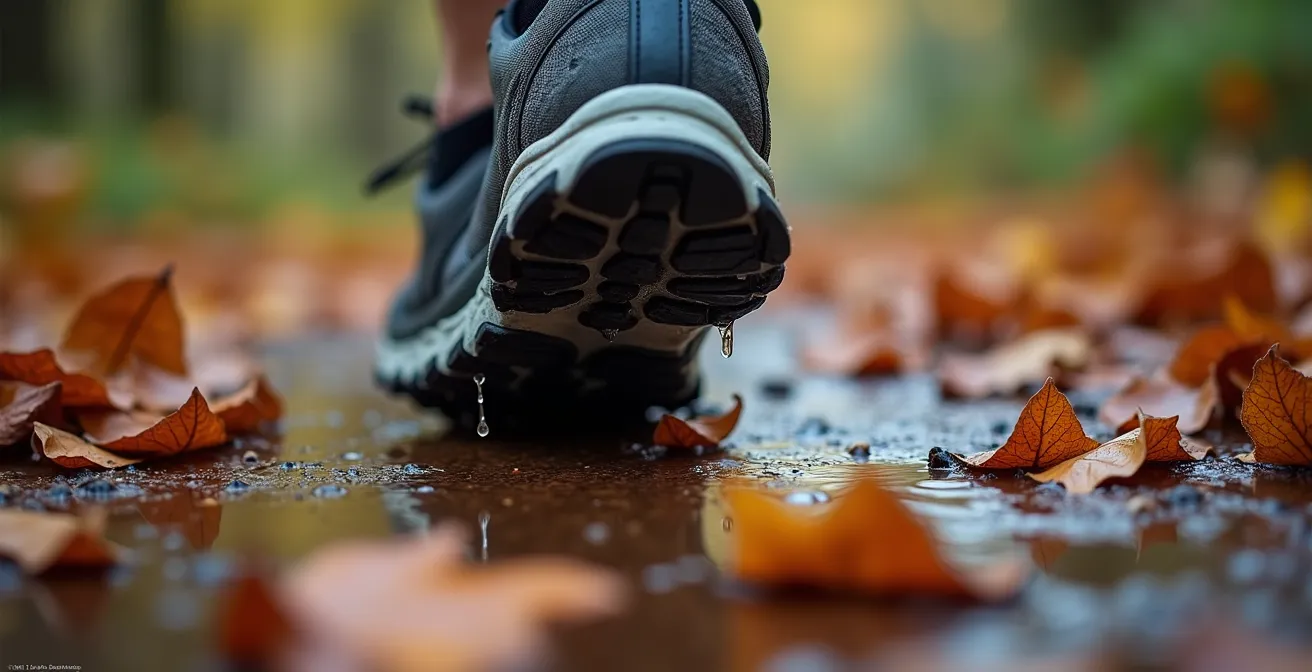
As you can see, the aggressive tread pattern is essential for gaining purchase on unpredictable surfaces. This isn’t about speed; it’s about maintaining secure, consistent contact with the ground, which in turn allows you to run with confidence and proper form. Choosing the right shoe is an active strategy against the fear of falling.
£40/Month Gym or High-End Waterproofs: Where to Spend Your Budget?
The “it’s too expensive” excuse often leads to a false choice: a monthly gym membership versus investing in quality outdoor gear. People see a £250 Gore-Tex jacket as a huge one-off expense, while a £40-per-month gym fee feels manageable. This is a classic financial fallacy. When you do the maths, the gym is almost always the more expensive and less effective solution for someone whose primary goal is to run or cycle outdoors.
A high-quality waterproof jacket and tights, thermal base layers, and winter-specific shoes might cost £350 upfront. That sounds like a lot. But that gear, if properly cared for, will last you a minimum of five years. A budget gym at £20/month costs £240 per year, or £1,200 over five years. A premium gym can easily be double that. The “dreadmill” is not only a poor substitute for the varied terrain and mental stimulation of the outdoors, it’s also a significant financial drain over the long term.
The investment in gear pays dividends beyond just the winter. That waterproof jacket is your shield during a summer downpour, and those trail shoes are perfect for exploring new routes year-round. You are buying 365 days of training freedom, not just a temporary solution for a few miserable months. The choice isn’t really about cost; it’s about commitment. Are you committed to your sport, or are you looking for an easy, but ultimately more expensive, way out?
A recent analysis comparing the long-term costs breaks down the numbers clearly. When viewed over a typical 5-year period, the financial argument for investing in gear becomes undeniable.
| Investment Option | Initial Cost | Annual Cost | 5-Year Total | Benefits |
|---|---|---|---|---|
| Premium Gym (David Lloyd) | £0 | £480 | £2,400 | Indoor comfort, classes, pool access |
| Budget Gym (PureGym) | £0 | £240 | £1,200 | Basic indoor facilities, 24/7 access |
| Gore-Tex Jacket + Gear | £350 | £70 | £350 | Year-round outdoor training, mental health benefits |
| Hybrid Approach | £350 | £310 | £1,550 | Best of both: outdoor freedom + storm day backup |
The Visibility Error That Cyclists Make on Country Lanes at Twilight
Right, let’s talk about not getting hit by a car. In the low light of a British winter, on a narrow country lane, being “visible” is not enough. The common mistake is to rely on a single static reflective panel on a jacket or a bright colour alone. This is lazy safety. A driver’s brain, especially when tired or distracted, doesn’t register a static blob of yellow as a “cyclist.” It just registers a weird, unidentifiable object. To be safe, you need to create a clear biomotion signature.
Biomotion is the brain’s hardwired ability to recognise the pattern of human movement. A driver will identify the up-and-down pumping motion of ankles and knees as a “person” far quicker than they will a stationary reflective patch on a torso. This is why reflective elements on your moving parts are exponentially more effective. Your safety depends on being instantly recognisable as a vulnerable human, not just a bright object.
As Andrea Noel-Doubleday, a physical therapist and public health expert, points out in the Mass General Brigham Winter Safety Guidelines:
The human brain is hardwired to recognise a human form in motion. Reflective ankle bands and overshoes are far more effective at being identified as a ‘cyclist’ by a driver’s brain than a single static reflective panel.
– Andrea Noel-Doubleday, PT, MPH, Mass General Brigham Winter Safety Guidelines
This means your safety checklist needs to be more sophisticated than just “wear a high-vis jacket.” It requires a 360-degree approach that combines powerful lights with strategically placed reflective materials to create that unmistakable human shape in motion, ensuring you are compliant with UK law and, more importantly, are maximally visible from every angle.
Your Checklist for Critical Visibility
- 360-Degree Lights: Use a bright white front light (minimum 200 lumens), a red rear light, and consider side-facing amber lights for junctions.
- Lateral Visibility: Add reflective sidewall tyres or spoke reflectors. This is crucial for being seen from the side at T-junctions.
- Create Biomotion: Wear reflective ankle bands, overshoes, and gloves. These are the most critical items for creating a recognisable human signature.
- Strategic Clothing: Choose high-vis clothing that also has reflective strips at key moving points like the wrists, shoulders, and ankles.
- Highway Code Compliance: Double-check you meet the requirements of Rule 60: a white front light, a red rear light, a red rear reflector, and amber pedal reflectors are legal minimums after dark.
When to Schedule Runs to Maximise Vitamin D Absorption in January?
Here’s a cold, hard fact that demolishes a common piece of well-meaning but incorrect advice: you cannot make Vitamin D from sunlight in the UK in winter. The idea of timing your run for midday to “top up your levels” is a complete myth. This is the Vitamin D Fallacy. From October to March, the sun’s UVB rays are too weak and at the wrong angle to trigger Vitamin D synthesis in the skin. Period.
This isn’t an opinion; it’s a geographical and biological reality. Public Health England guidance confirms that during these months, the UK population relies entirely on its body’s stores and dietary intake. So, let’s be clear: scheduling your run at noon in January for Vitamin D purposes is pointless. You will get precisely 0% of your requirement from that weak winter sun.
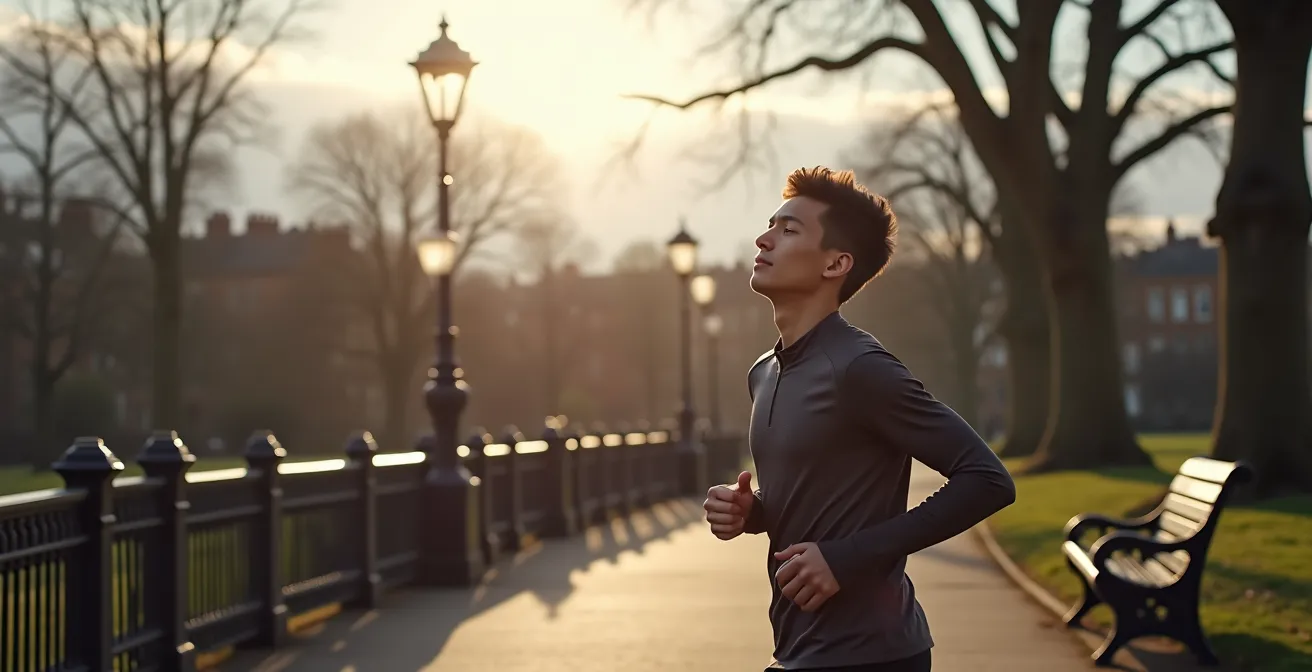
However, this does not mean a midday run is worthless. Far from it. While you won’t be synthesising Vitamin D, you will be getting exposure to natural light, which is critically important for regulating your circadian rhythm—your internal body clock. This helps improve mood, sleep quality, and alertness. That brief moment of winter sun on your face, however weak, is a powerful psychological boost and a key weapon in the fight against the winter blues. The benefit is neurological, not physiological.
So, the strategy is simple. Run at midday when you can, not for Vitamin D, but for the light exposure and the mental lift it provides. And for your actual Vitamin D levels? The official NHS recommendation is that everyone in the UK should consider taking a daily 10-microgram supplement throughout the autumn and winter months to ensure they have adequate levels. Don’t rely on the sun; rely on a smart supplementation strategy.
Why 10,000 Lux Is the Magic Number for Your Light Therapy Lamp?
If you’re serious about combating the energy-sapping effects of dark winter mornings, you need to bring the daylight indoors. A light therapy lamp, or SAD lamp, is a powerful tool, but only if you get the right one. Many so-called “wellness” lights are underpowered gimmicks. The key to effectiveness is intensity, measured in lux. And the figure you need to remember is 10,000 lux.
This isn’t an arbitrary number. It’s the clinical standard for treating Seasonal Affective Disorder (SAD). The goal of light therapy is to simulate a bright, sunny morning to trick your brain into suppressing melatonin (the sleep hormone) and boosting serotonin and cortisol (the wake-up-and-go hormones). To achieve this effect efficiently, you need a powerful dose of light. As clinical studies demonstrate, a dose of 10,000 lux for 20-30 minutes is the established protocol for a significant impact on your circadian rhythm.
Using a lamp with a lower intensity, like 2,500 lux, would require you to sit in front of it for up to two hours to get the same effect. For a busy athlete trying to fit in training, work, and life, that’s simply not practical. Investing in a certified 10,000 lux lamp is an investment in efficiency. It’s the difference between a therapeutic tool and a desk decoration. Be wary of cheap, uncertified lamps or “dawn simulators” that don’t state their lux rating at a specific distance—they are often underpowered and ineffective.
Action Plan: Your Light Therapy Usage Protocol
- Intensity & Distance: Choose a lamp certified to provide 10,000 lux and position it 20-30cm from your face, off to one side. You don’t need to stare into it.
- Timing (Dosing): The most crucial factor. Use it for 20-30 minutes within the first hour of waking up. This has the maximum impact on resetting your body clock for the day.
- Consistency: Use it every single day from October through to March, especially on dark, overcast mornings. It’s a preventative measure, not just a cure on bad days.
- Device Selection: Look for lamps certified as Class IIa medical devices. Reputable UK brands like Lumie are a good starting point, and they are often available from retailers like John Lewis.
- What to Avoid: Steer clear of under-powered lights or those that make vague claims. If it doesn’t clearly state “10,000 lux at X cm,” be suspicious.
Wetsuit or Skins: Which Is Safer for a November Dip?
For the particularly hardy among us, cold water swimming is the ultimate winter challenge. But it comes with a paradox. The obvious safety choice seems to be a thick neoprene wetsuit. It provides insulation and buoyancy. However, this perceived safety can be a trap, often making it the more dangerous option for the unwary.
The issue is that a wetsuit masks the true cold of the water. It allows a swimmer to stay in for far longer than their body is actually prepared for, lulling them into a false sense of security. The real danger in cold water swimming isn’t feeling cold in the water; it’s the ‘afterdrop’ – the continued drop in your core body temperature *after* you get out. A wetsuit user who has stayed in for 20 minutes might feel fine initially, but as the cold blood from their extremities circulates back to their core, their temperature can plummet to dangerous levels. This is where the risk of hypothermia is highest.
Conversely, ‘skins’ swimmers (those in just a swimsuit) receive honest, immediate feedback from the water. The intense cold forces them into shorter, more sensible dips. They learn to acclimatise properly and respect the water’s power. They get out before they get into trouble, not because a timer goes off, but because their body tells them to.
Case Study: The Outdoor Swimming Society’s Safety Paradox
Research from the UK’s own Outdoor Swimming Society (OSS) highlights this risk. They found that wetsuit users often stay in cold water two to three times longer than experienced skins swimmers, significantly increasing their risk of severe afterdrop. At established UK swimming spots like Hampstead Heath Ponds or the Lake District, seasoned skins swimmers have a much better-developed cold acclimatisation. They adhere to strict time limits, such as a two-minute maximum for water below 6°C, a discipline that the artificial warmth of a wetsuit can undermine.
The verdict? For a beginner, a wetsuit can provide an initial confidence boost, but it must be used with extreme discipline. You must time your swim and get out long before you feel you have to. For long-term safety and genuine acclimatisation, learning to swim skins for short durations is arguably the safer, more respectful approach to mastering the cold.
Key Takeaways
- Winter doesn’t stop you; bad preparation does. Focus on strategy over ‘motivation’.
- Your choice of fabric (no cotton) and the science of biomotion for visibility are non-negotiable safety pillars.
- Investing in quality gear is more cost-effective long-term than a gym membership for outdoor athletes.
Combatting SAD: Strategies for Emotional Resilience When the Sun Sets at 4 PM?
We’ve addressed the gear, the technique, and the physical safety. Now for the real fight: the one inside your head. When the world outside is relentlessly grey and dark, maintaining emotional resilience is the final and most important piece of the puzzle. This isn’t about being ‘tough’; it’s about building your psychological armour with practical, proven strategies.
The most potent weapon in your arsenal is the very act of getting out there. Exercise is profoundly effective at combatting low mood and the symptoms of Seasonal Affective Disorder (SAD). It releases endorphins, reduces stress hormones, and provides a powerful sense of accomplishment that can be hard to find in the winter months. In fact, its effects are not to be underestimated.
As highlighted by the Aston University Sport Science Department, the impact is significant:
Research has shown that a good workout can be up to four times more effective than taking antidepressants for improving symptoms of depression.
– Aston University Sport Science Department, Benefits of Training in Cold Weather Study
However, knowing exercise is good for you isn’t enough when your drive is low. The strategy is to embed your training within a social and structured framework. This externalises your commitment, making it about more than just your own willpower. The UK has a fantastic ecosystem for this, from free, community-led events to structured national programmes. Engaging with these is not a sign of weakness; it’s a smart tactical move.
Your Mental Health Audit: The Social Prescribing Pathway
- Consult Your GP: Speak to your GP about ‘Social Prescribing’. They can refer you to a link worker who can connect you with local community groups and activities to support your mental wellbeing.
- Join Parkrun: Find your local Parkrun. It’s a free, timed 5k run or walk every Saturday morning at 9am. It provides a routine, a community, and a reason to get out of bed.
- Connect with Groups: Join a local Ramblers walking group or a cycling club. The commitment to the group will get you out the door on days you wouldn’t go alone.
- Volunteer Outdoors: Get involved with conservation projects through organisations like the National Trust or your local Wildlife Trust. It combines physical activity with a sense of purpose.
- Build Post-Exercise Rituals: Plan something to look forward to after your session. A Sunday long run that ends at a country pub, or a simple routine of a hot bath and tea. This rewards the behaviour and strengthens the habit.
Stop waiting for motivation to strike. Build a system, execute the plan, and own the winter. The first step is to choose one action from this guide and implement it this week. Your future self will thank you for it.
Frequently Asked Questions About Winter Outdoor Fitness
What safety equipment is non-negotiable regardless of wetsuit choice?
A brightly-coloured tow-float for visibility is essential, especially in open water. A neoprene hat is also critical, as you can lose up to 60% of your body heat through your head in cold water. Finally, a changing robe or a dryrobe is vital for immediate re-warming post-swim to combat the risk of afterdrop.
How do I check water quality before swimming?
In England, you should always check the Environment Agency website for the latest water quality ratings for designated bathing spots. Be particularly cautious after heavy rainfall, as this can increase the risk of sewage overflow. As a rule of thumb, it’s wise to avoid swimming for at least 48 hours after a storm.
What is ‘afterdrop’ and how do I prevent it?
Afterdrop is the phenomenon where your core body temperature continues to fall even after you have exited the cold water. It happens as cold blood from your limbs and skin returns to your core. To prevent it, you must limit your swim time, get changed into warm, dry layers immediately, and warm up gradually with warm drinks. Never use a hot shower straight away, as this can rapidly draw blood to the surface and make the afterdrop worse.