
The key to a low-carbon holiday isn’t finding a ‘certified eco’ label, but learning to spot the greenwashing behind it.
- Transport choices are more complex than ‘plane vs. train’; hidden costs and non-CO2 emissions can flip the equation.
- Your spending has a bigger impact than you think: choosing local B&Bs over all-inclusive resorts directly supports the destination’s economy and sustainability.
Recommendation: Apply a ‘True Cost Analysis’ to every decision, from your transport ticket to your hotel booking, to uncover the real environmental and financial price.
You want to travel more responsibly. You diligently search for ‘eco-friendly holidays’ and choose hotels that boast about their green credentials. Yet, a nagging feeling persists: are these claims genuine, or are you just paying a premium for clever marketing? This skepticism is not only justified; it’s essential. The travel industry is rife with vague promises and misleading labels, making it nearly impossible for the conscientious UK traveller to make an informed choice.
The common advice—fly less, pack light, offset your carbon—is a good start, but it barely scratches the surface. It fails to address the systemic issues of greenwashing, hidden carbon in supply chains, and the complex economic realities of tourism. It puts the onus on you to pick the “right” option from a line-up where most of the contestants are cheating. But what if the goal wasn’t to find the one perfect ‘green’ product, but to develop the skills to see through the hype?
This guide is different. It’s not a list of ‘approved’ destinations. Instead, it’s a toolkit for the critical traveller. We will equip you with the questions and frameworks to deconstruct travel choices, moving beyond marketing slogans to understand the real impact of your holiday. We will analyse everything from the non-CO2 effects of your flight to the surprising decomposition time of a banana peel on a British moor, empowering you to plan a trip that is genuinely, verifiably low-impact.
This article provides a structured approach to becoming a more discerning sustainable traveller. Follow along as we dissect the common pitfalls and reveal the practical strategies for making truly responsible choices, right from your planning stages in the UK.
Summary: A Critical Guide to Low-Carbon UK Holidays
- Why That ‘Eco-Friendly’ Hotel Chain Might Be Lying to You?
- Train to Nice or Plane to Edinburgh: Which Journey Emits Less CO2?
- The Single-Use Plastic Mistake That Ruins Your Eco-Efforts Abroad
- All-Inclusive vs Local B&B: Where Does Your Money Actually Go?
- When to Visit National Parks to Minimise Ecological Disturbance?
- Why Driving to St Ives Might Cost More Than Flying to Faro?
- Why Banana Peels Don’t Decompose Quickly on British Moorland?
- How to Explore the Brighton & Lewes Biosphere Without Harming It?
Why That ‘Eco-Friendly’ Hotel Chain Might Be Lying to You?
The term ‘eco-friendly’ has become almost meaningless in the hotel industry, a classic case of greenwashing where marketing claims obscure the truth. Vague statements about “saving water” or using “sustainable sources” are often just a thin veneer over business-as-usual operations. The problem is so widespread that recent UK investigations found that 40% of green claims made online could be misleading consumers. This isn’t just about semantics; it’s about corporations profiting from your good intentions without making meaningful changes.
These hotels rely on you not asking the hard questions. They know that a picture of a green leaf on their website is often enough. A prime example is the case of TUI, who were called out for describing entire holidays as ‘green and fair’. After scrutiny, the company was forced to remove this language from its website, demonstrating how quickly these grand claims can fall apart when challenged. This is where your power as a consumer lies: in the willingness to look behind the curtain.
Case Study: TUI’s ‘Green and Fair’ Reversal
Travel giant Tui heavily promoted its ‘eco hotel’ collections, suggesting they met global sustainability standards. However, its broader claim of offering ‘green and fair holidays’ was challenged as misleading because it oversimplified the total impact of the trip. According to a report by Which?, after being contacted about the ambiguity of this claim, Tui completely removed the ‘green and fair holidays’ branding from its UK website, a clear admission that the marketing had overstepped the reality.
Instead of passively accepting eco-labels, you need to conduct a mini greenwashing audit. This means shifting from a trusting mindset to a verification mindset. The UK’s Competition and Markets Authority (CMA) has a ‘Green Claims Code’ designed to combat this, and you can use its principles to your advantage.
Your Greenwashing Audit Checklist: Questions to Ask Before You Book
- Data, Not Descriptions: When a hotel claims to be ‘water-saving’, ask for specific data like their water usage per guest night. Vague terms are a red flag.
- Certification Check: Verify their certifications. Is that ‘Green Tourism’ award current? What does the ‘AA Eco-Hotel’ rating actually measure—is it just about not changing towels daily or does it cover energy sources and waste?
- Full Lifecycle Inquiry: Ask about the unseen impacts. What materials was the hotel built from? What are the carbon emissions of their supply chain for food and linens? What is their waste-to-landfill ratio?
- Probe for Omissions: A truly transparent hotel will share the good and the bad. Ask what they are not doing well. If they only present a perfect picture, they are likely hiding something.
- Supplier Scrutiny: Question their procurement policies. Do they have a policy to reduce single-use plastics from their B2B suppliers, or is their focus only on guest-facing items?
By adopting this critical approach, you move from being a target of marketing to an empowered auditor, forcing the industry to back up its claims with facts, not just foliage.
Train to Nice or Plane to Edinburgh: Which Journey Emits Less CO2?
The standard advice is simple: take the train, don’t fly. While often true, this binary choice oversimplifies a complex reality. The actual carbon cost of a journey depends heavily on distance, technology, and occupancy. For a UK traveller, a short-haul domestic flight can be dramatically worse than a long-distance international train journey. It’s crucial to look at the numbers, not just the mode of transport. The question isn’t just “train or plane?” but “which journey is truly the lower-carbon option?”
The following data compares two typical journeys from London: a domestic trip to Edinburgh and a European trip to Nice. The difference in emissions is stark, even when accounting for the ‘last mile’ of travel to and from stations or airports.
This direct comparison reveals that flying to Edinburgh emits over 10 times more CO2 per passenger than taking the train. Even the much longer train journey to the south of France is significantly cleaner than the short domestic flight, as this analysis from the Rail Delivery Group highlights.
| Journey | Mode | CO2 per passenger | Including last mile |
|---|---|---|---|
| London-Edinburgh | Train | 12.5kg | 14.2kg (with Underground) |
| London-Edinburgh | Plane | 165.1kg | 175kg (with Heathrow Express) |
| London-Nice | Train (via Paris) | 36kg | 38kg (with Underground) |
| London-Nice | Plane | 250kg | 260kg (with Heathrow Express) |
However, the CO2 figures are only part of the story. This is where we encounter hidden carbon. Aircraft release emissions at high altitudes, creating contrails and other atmospheric effects that trap heat far more effectively than ground-level emissions. In fact, research shows that high-altitude emissions have a warming effect 1.27 to 2.5 times greater than their CO2 emissions alone. This means the total climate impact of your flight is likely double what the basic carbon figures suggest.

As the visual contrast suggests, the choice has clear environmental consequences. Electric trains, powered increasingly by renewables in the UK, have a direct and measurable advantage. When you factor in the amplified warming effect of aviation’s non-CO2 emissions, the argument for rail travel on routes where it’s a viable alternative becomes overwhelming.
The next time you plan a trip, don’t just compare prices. Compare the kilograms of CO2 and remember to mentally double the figure for any flight to account for its full, hidden climate impact.
The Single-Use Plastic Mistake That Ruins Your Eco-Efforts Abroad
You’ve remembered your reusable water bottle and coffee cup—the staples of any eco-conscious traveller’s kit. You feel you’ve done your part. But the reality is that the most significant sources of plastic waste on your holiday are often hidden in plain sight, embedded in the operational supply chains you never see. Focusing only on your personal-use items while ignoring the systemic use of plastic is a common mistake that undermines well-intentioned efforts.
Think about a simple ‘Meal Deal’ grabbed at a UK service station on your way to a holiday cottage. A typical purchase involves a plastic sandwich box, a crisp packet, a plastic bottle, a plastic-wrapped cutlery set, and a carrier bag. That’s five items of single-use plastic before your holiday has even truly begun. A zero-waste picnic sourced from a local farm shop, by contrast, could involve reusable containers and package-free goods, demonstrating a completely different approach to convenience.
This principle extends dramatically when you arrive at your accommodation. The plastic problem goes far beyond the miniature shampoo bottles. Hotels are major consumers of single-use plastics through their suppliers. Linens arrive wrapped in plastic, cleaning chemicals come in disposable containers, and food for the buffet is delivered in vast quantities of plastic packaging. Your individual effort, while commendable, is a drop in the ocean compared to this B2B plastic consumption. To make a real difference, you must start questioning the hotel’s entire operational model.
Instead of just asking if they offer filtered water, start asking more pointed questions that reveal their commitment to reducing plastic across their entire operation:
- Linen & Laundry: “How are your clean linens delivered from the laundry service, and what packaging do your suppliers use?”
- Cleaning Supplies: “What size containers do your cleaning chemicals come in, and do you have a system for refilling them from bulk sources?”
- Supplier Policy: “Do you have a documented B2B plastic reduction policy that you enforce with your food, drink, and equipment suppliers?”
- Procurement Data: “What percentage of your total procurement, by volume or cost, comes in single-use packaging?”
- Operational Waste: “Beyond guest room bins, how do you manage and report on the plastic waste generated from your kitchens, maintenance, and administrative operations?”
Asking these questions sends a powerful signal to the industry. It shows that sophisticated customers are looking beyond the surface-level greenwashing and demanding genuine, systemic change in how hotels manage their resources.
All-Inclusive vs Local B&B: Where Does Your Money Actually Go?
The choice between a large, all-inclusive resort and a small, locally-owned bed & breakfast seems like a matter of taste. But from a sustainable travel perspective, it’s one of the most impactful decisions you can make. The critical issue is economic leakage—the process by which money spent by tourists is siphoned out of the local economy by international corporations. Your holiday spending can either be a powerful tool for local development or a contribution to a system that often exploits the destination it claims to celebrate.
When you pay for an all-inclusive package with a multinational chain, a large portion of that money never touches local hands. It goes to the head office in another country, to international food and drink suppliers, and to foreign-owned management companies. In contrast, spending at a family-run B&B in the Yorkshire Dales or a local pub in Cornwall has a profound multiplier effect. In fact, UK-based economic research demonstrates that £100 spent at locally-owned accommodation circulates 2-3 times within the local economy, supporting a web of other businesses like bakeries, butchers, and craftspeople.
Case Study: The Yorkshire Dales Farm-Stay Effect
A farm-stay B&B in the Yorkshire Dales that sources its breakfast ingredients from within a 10-mile radius is a perfect example of this positive impact. Compared to a hotel chain using national distributors, it reduces food miles by over 95%. More importantly, that B&B’s revenue directly supports at least eight other local suppliers, including the village butcher, the town baker, and nearby dairy farms, strengthening the entire community’s economic resilience.
Choosing local isn’t just about economics; it’s about preserving the very character of the places we love to visit. When tourism revenue supports local enterprises, it gives residents a direct stake in preserving their cultural and natural heritage. They become proud hosts, not just service workers. This creates a more authentic and welcoming experience for visitors, moving beyond the sterile, homogenised environment of a global resort.
As one expert eloquently puts it, the choice has a direct impact on the soul of a place.
Supporting small native businesses not only fights against the homogenisation of places around the world; it also makes locals more welcoming, because we’re helping them have a better quality of life.
– Country Living Travel Expert, Country Living Sustainable Travel Guide 2025
So, before you book, ask yourself: “Who will ultimately benefit from my stay?” Opting for the local B&B is a direct investment in the destination itself.
When to Visit National Parks to Minimise Ecological Disturbance?
Visiting the UK’s stunning National Parks is a cornerstone of low-carbon domestic tourism. You’ve chosen to avoid a flight and immerse yourself in nature. However, true sustainable travel goes beyond just your carbon footprint; it requires maintaining the ecological integrity of the places you visit. The timing of your visit can be just as impactful as your actions on the ground. Arriving during a sensitive ecological period, even with the best intentions, can cause significant and lasting harm to fragile ecosystems and wildlife.
Our National Parks are not static landscapes; they are living systems with crucial cycles of breeding, nesting, and growth. Visiting the Peak District moors during ground-nesting bird season, or the Norfolk coast when seals are pupping, can lead to disturbances that cause parents to abandon their young. Likewise, the pressure of too many visitors during peak wildflower season in the South Downs can lead to soil compaction and trampling, damaging the very beauty people have come to see. This is especially true on bank holiday weekends, when “honeypot” sites face visitor numbers far beyond their carrying capacity.
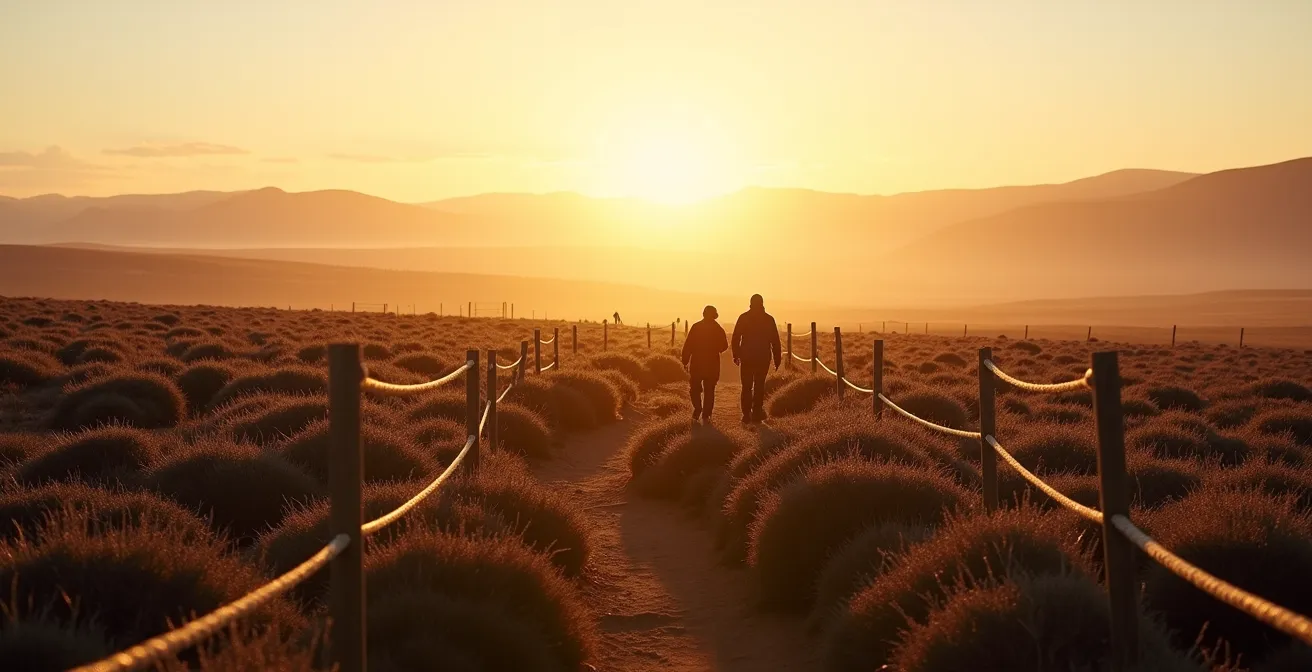
As this tranquil scene shows, responsible enjoyment involves respecting boundaries and giving wildlife the space it needs. The best way to achieve this is to plan your trip outside of these crunch times. This not only protects the environment but also provides a much better experience for you, free from the crowds and with a greater chance of serene wildlife encounters.
Before planning a trip to any UK National Park, a crucial step is to research its specific ecological calendar. Avoiding these sensitive periods is a simple yet powerful act of conservation.
- March-July: Avoid high moorlands like the Peak District and Yorkshire Dales due to the ground-nesting season for birds like curlews and lapwings.
- June-August: Be extremely cautious on the Norfolk coast (The Broads), as this is the peak seal pupping season. Keep a significant distance.
- April-June: In wildflower hotspots like the South Downs, stick strictly to paths to avoid trampling rare orchids and other blooms.
- Autumn (Oct-Nov): Be mindful in deer parks such as the New Forest and Scottish Highlands during the rutting season, when stags are aggressive and easily disturbed.
- All Bank Holiday Weekends: Consider visiting less popular areas of the parks to avoid contributing to erosion and pressure on a few “honeypot” locations like Malham Cove or Snowdon’s summit path.
By shifting your travel dates to the shoulder seasons and avoiding major holidays, you transform your visit from a potential source of stress on the environment into a genuinely positive and low-impact experience.
Why Driving to St Ives Might Cost More Than Flying to Faro?
The assumption that a domestic UK holiday is always the cheaper and greener option can be a costly one. When you conduct a True Cost Analysis, a surprising picture emerges. The low-cost flight to Europe often appears cheaper at first glance, but this is a distorted view created by hidden subsidies for aviation and the often-underestimated costs of a UK road trip, especially during peak season. A critical look at all expenses—not just the ticket price—can reveal that driving to Cornwall may be both more expensive and less relaxing than flying to Portugal.
Airlines benefit from a massive competitive advantage: they pay no tax on kerosene fuel and no VAT on tickets for international flights. Train operators and drivers in the UK, meanwhile, pay full VAT and fuel duties. This market distortion makes flying artificially cheap. When you add the hidden costs of a summer road trip in the UK—peak season accommodation prices, exorbitant parking fees in tourist towns like St Ives, Clean Air Zone charges, and vehicle wear and tear—the balance shifts dramatically.
Let’s compare the true cost of a one-week holiday for a family travelling from Manchester. One scenario is driving to St Ives, Cornwall; the other is flying to Faro, Portugal. The breakdown below reveals the hidden expenses that are rarely factored into a quick budget comparison.
| Cost Factor | Drive to St Ives (UK) | Fly to Faro (Portugal) |
|---|---|---|
| Transport | £95 petrol + £15 M6 toll | £89 return flight |
| Parking/Transfers | £140 (7 days in St Ives) | £30 airport parking |
| Vehicle wear | £48 (800 miles at 6p/mile) | £0 |
| Accommodation | £180/night (peak season) | £65/night (off-season) |
| Clean Air Zones | £8 (e.g., Bristol CAZ) | £0 |
| Total (7 nights) | £1,556 | £639 |
This analysis doesn’t even touch on the environmental cost. While the flight to Faro has a higher carbon footprint, the financial incentives are stacked against the domestic choice. This paradox highlights a systemic problem. If we are serious about promoting low-carbon domestic tourism, the pricing must reflect the true environmental cost. Based on UK government carbon pricing, every tonne of CO2 saved has a societal value of over £250, a cost not reflected in a cheap plane ticket.
This doesn’t mean flying is the ‘better’ option—environmentally, it is not. It means that as a conscious traveller, you must be aware of how skewed the market is and factor in all costs, both financial and environmental, before making a decision.
Why Banana Peels Don’t Decompose Quickly on British Moorland?
It’s one of the most common justifications heard on a hillside walk: “It’s fine, it’s natural, it will biodegrade.” This well-intentioned belief, often used when tossing an apple core or banana peel into the heather, is a fundamental misunderstanding of ecology. While organic matter does decompose, the environment in which it’s left makes all the difference. A banana peel, native to a hot, humid climate teeming with microbes, does not belong in the cold, wet, acidic soil of a British moorland. Leaving it there is not a natural act; it’s a form of pollution.
The decomposition process in the UK’s upland environments is dramatically slower than in a garden compost bin. The low temperatures and acidic peat soils lack the necessary microorganisms to break down foreign organic matter efficiently. As a result, that “natural” piece of fruit waste can linger for months, or even years, becoming an unsightly piece of litter that alters the local soil chemistry. For instance, environmental studies show that orange peels can take over six months to decompose in UK conditions, leaching acidity into the ground as they slowly rot.
The principle of ‘Leave No Trace’ means exactly that: everything you carry in, you must carry out. This includes all food waste. It’s not just about aesthetics; discarded food attracts scavengers and can alter the natural behaviour of wildlife. To maintain the ecological integrity of our wild spaces, we must be aware of the real decomposition timelines.
Here are some realistic decomposition times for common items left in UK wild conditions, which are far longer than most people assume:
- Apple core: Up to 8 weeks. It can attract wasps and other insects, changing local wildlife patterns.
- Banana peel: Over 2 years. In the cold, acidic conditions of a Scottish or Welsh moor, it blackens but breaks down incredibly slowly.
- Orange peel: More than 6 months. Its tough skin and acidic nature make it highly resistant to decomposition in cool climates.
- ‘Biodegradable’ dog waste bag: 1 to 3 years. While it may break apart, it can release methane and doesn’t truly disappear for a very long time.
- Tissue paper: 3-4 weeks, but only if conditions are consistently wet. In dry spells, it can last for months.
The rule is simple and absolute: if you brought it with you, it goes home with you. A zip-lock bag for food scraps is as essential a piece of hiking kit as a waterproof jacket.
Key takeaways
- True sustainability requires critical thinking to see through industry greenwashing, not just trusting ‘eco’ labels.
- Your spending is a powerful tool; supporting small, local businesses directly benefits the destination’s economy and environment.
- The real impact of your travel includes ‘hidden’ factors like non-CO2 emissions from flights and the full lifecycle of costs for a trip.
How to Explore the Brighton & Lewes Biosphere Without Harming It?
So how do all these principles—scrutinising claims, choosing transport wisely, supporting local economies, and respecting ecosystems—come together in a real UK holiday? The Brighton & Lewes Downs UNESCO Biosphere Reserve, known as ‘The Living Coast’, provides a perfect, tangible example. It demonstrates that a truly low-carbon, high-value holiday is not about sacrifice, but about making smarter, more connected choices.
The Biosphere’s success is built on a partnership model. The ‘Living Coast’ initiative brings together over 40 local businesses that are not just operating in the area but are actively contributing to its conservation. When you choose to eat, stay, or book an activity with one of these partners, a portion of your money directly funds vital local projects. This includes everything from protecting the chalk aquifers that provide the region’s drinking water to funding marine research in the Channel and monitoring local biodiversity. It transforms tourism from an extractive industry into a regenerative one.
This model moves beyond passive ‘eco’ tourism. It invites you to become an active participant in the region’s sustainability. Instead of just looking at the South Downs, you can join a guided walk that contributes data to a biodiversity count. Instead of just swimming in the sea, you can take a kayak tour with an operator that shares data with marine charities. This is the future of sustainable travel: engaging, participatory, and demonstrably positive.
Planning a day trip using this framework puts all the theory into practice. It proves that you can have a rich, enjoyable experience while actively benefiting the place you’re visiting.
Your Biosphere-Friendly Itinerary: A Plan for a Perfect Day
- Start with Local Produce: Begin your day at a Biosphere Partner café in Lewes that proudly serves breakfast made with ingredients from Sussex farms.
- Use Public Transport: Take the efficient 28/29 bus service from Brighton or Lewes directly into the heart of the South Downs, eliminating the emissions and stress of driving and parking.
- Become a Citizen Scientist: Join a ‘Big Biodiversity Count’ guided walk with local rangers, learning about the chalk grassland ecosystem while contributing valuable data.
- Pack a Zero-Waste Lunch: Before you set off, visit the Lewes farmers market to assemble a delicious, package-free picnic of local cheeses, bread, and fruits.
- Contribute to Marine Health: In the afternoon, take a sea kayaking tour with a Brighton-based operator who contributes sightings and data to marine conservation charities.
This is the ultimate goal of low-carbon travel: to create a trip where your presence is a net positive for the destination. By applying these critical skills and making conscious choices, you can ensure your next UK holiday is not just memorable, but genuinely meaningful.
Frequently Asked Questions about Low-Carbon Holidays
Is taking the train always better than flying for the environment?
Not automatically, but usually yes for journeys under 500 miles. As shown in the article, a short domestic flight in the UK can produce over 10 times the CO2 of a comparable train journey. The equation can change for very long distances where a full flight’s per-person emissions might be lower than a diesel train journey, but for most UK and near-Europe travel, electric rail is the clear winner, especially when you factor in the high-altitude warming effects of air travel.
What is the most eco-friendly type of accommodation?
The most eco-friendly accommodation is typically a small, locally-owned B&B, guesthouse, or independent rental that sources its food and supplies locally. This is less about ‘eco’ certification and more about economic impact. Your money stays within the community, supporting other local businesses and reducing the carbon footprint of the supply chain, which is often a bigger factor than whether the hotel reuses towels.
How can I truly avoid single-use plastic when I travel?
Beyond carrying your own reusable bottle and coffee cup, the key is to look at operational plastics. Choose farm shops and bakeries over supermarkets for picnic supplies. At your hotel, ask specific questions about their supply chain: How are linens delivered? Do they use bulk, refillable cleaning supplies? A hotel that can answer these questions is far more committed than one that has simply eliminated plastic straws.