In summary:
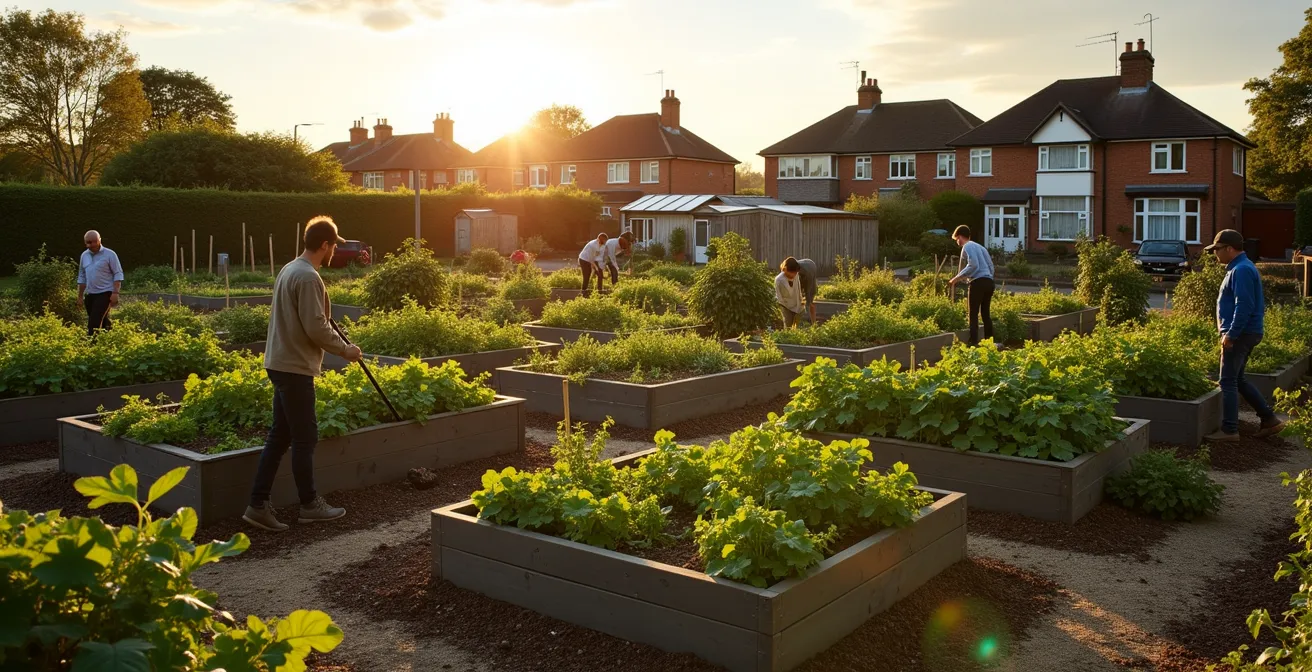
- Bypass individual waiting lists by forming a ‘community group’ to apply for council plots.
- Identify and approach private landowners, such as developers or churches, with a ‘meanwhile use’ proposal.
- If you can’t secure a plot, create a ‘neighbour share’ system for a weekly organic veg box to reduce costs and waste.
- Maximise any small space you get by using potting sheds for high-value crops and starting seeds indoors early.
The desire for a small patch of earth to call your own is a powerful one, yet for many urban residents in the UK, it feels like an impossible dream. You’ve likely put your name down on the local council’s allotment list, only to be told the wait is five, seven, or even ten years long. The frustration is palpable, especially when research confirms that over 174,183 people are currently waiting for council allotments across Great Britain. The standard advice is often unhelpful: “be patient,” “try container gardening,” or “join a community garden,” none of which address the core problem of securing a meaningful plot of land.
But what if the entire approach is wrong? The key to getting an allotment isn’t about waiting patiently in line like everyone else. It’s about thinking like a strategic land negotiator, not a passive gardener. It requires understanding the hidden systems, policies, and opportunities that exist just below the surface of the official process. This isn’t about cheating the system, but about understanding it so well that you can navigate it to your advantage. The truth is, land is available, but it doesn’t always come through the front door of the council office.
This guide will walk you through the insider strategies to secure gardening space. We will explore how to turn council prioritisation policies to your advantage, how to find and persuade private landowners to share their space, and crucially, how to maximise every square metre you acquire so you can start growing immediately and hold onto your hard-won plot. For those who still can’t find a plot, we’ll also cover smart alternatives that deliver fresh, organic produce without the need for your own land.
This article provides a detailed roadmap to bypass the queues and start your gardening journey. Explore the sections below to find the strategy that works best for your situation.
Summary: Your Strategic Guide to Securing a UK Gardening Plot
- Why Some Councils Prioritise Families Over Singles for Plots?
- How to Find Private Landowners Willing to Share Garden Space?
- Raised Bed or Potting Shed: Which Yields More Veg per Square Metre?
- The Maintenance Error That Gets New Plot Holders Evicted in 6 Months
- When to Start Seeds Indoors to Beat the Short UK Growing Season?
- How to Subscribe to Veg Boxes Without Wasting Half the Produce?
- Why Banana Peels Don’t Decompose Quickly on British Moorland?
- How to Eat Organically in the UK for Under £50 a Week Per Person?
Why Some Councils Prioritise Families Over Singles for Plots?
It can feel deeply unfair when you see families leapfrogging you on the allotment waiting list. However, this isn’t arbitrary favouritism; it’s often a direct result of council policy. Many local authorities have a ‘letting policy’ that explicitly outlines a points or priority system. These policies often favour groups over individuals because it aligns with wider community objectives, such as promoting family activities, supporting educational goals, or addressing public health targets. As Birmingham & District Allotments Confederation Secretary Hester Blewitt notes, funding often depends on this community dimension, stating that “applications for additional funds must include a community dimension so that families and children will use the sites.”
Understanding this is the first step to turning it to your advantage. Instead of seeing it as a barrier, view the letting policy as a rulebook you can use to increase your score. The goal is to move from being a low-priority ‘single applicant’ to a high-priority ‘community group’ or ‘special needs applicant’. By actively aligning your application with the council’s stated goals, you can strategically position yourself for a plot. The key is to stop waiting as an individual and start thinking like a community project.
Your Action Plan: Navigating Council Allotment Priority Systems
- Access the Policy: Find your local council’s ‘Allotment Letting Policy’ online. Search for “[Your Council Name] allotment policy” to find the specific document outlining their criteria.
- Identify Priority Categories: Scrutinise the policy for priority criteria beyond just ‘family status’. Look for keywords like social housing residents, school groups, GP-referred health needs, or disability criteria.
- Leverage Community Power: Form a ‘community group’ with 3-5 other single applicants. Registering as a simple ‘unconstituted association’ can allow you to apply as a group, bypassing the individual list.
- Submit a Cultivation Plan: Go beyond the basic application. Submit a detailed ‘cultivation plan’ showing specific crop rotation schedules, biodiversity goals, and weekly time commitments to demonstrate you are a serious, organised applicant.
- Request a Priority Review: If you meet any of the special criteria you identified (even partially), formally write to the council requesting a priority review of your application, clearly stating how you meet their objectives.
This proactive approach fundamentally changes your position from a passive name on a list to an active partner in the council’s community goals, dramatically increasing your chances of being allocated a plot sooner.
How to Find Private Landowners Willing to Share Garden Space?
If the council route proves to be a bureaucratic maze, the most effective strategy is to bypass it entirely. A vast amount of land in and around urban areas is privately owned and temporarily dormant. This includes land held by property developers, church bodies, and large institutions. The key is to stop thinking of yourself as someone asking for a favour and start acting like someone offering a solution. You are offering free grounds maintenance, community engagement, and positive PR in exchange for temporary land use. This is a powerful value proposition.
The most successful model for this is known as ‘meanwhile use’. This involves securing a temporary licence to use land that is awaiting development. It’s a win-win: the developer avoids having a derelict site that can attract anti-social behaviour, and the community gets valuable green space. The Skip Garden in King’s Cross, London, is a prime example of this strategy in action. This temporary community garden was established on land awaiting development, proving that a clear proposal outlining community benefits and a willingness to be flexible can unlock prime urban land. Approaching landowners with a professional, well-thought-out plan for a ‘meanwhile garden’ is far more effective than a casual request.
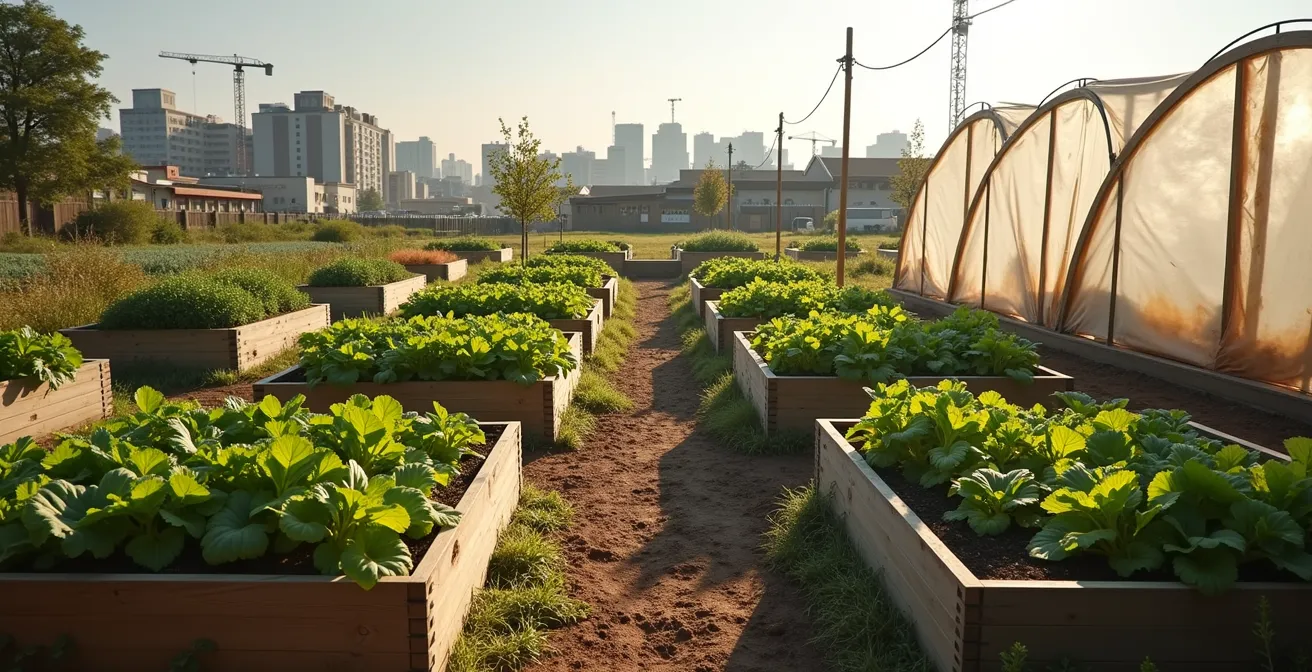
The approach method must be tailored to the landowner. A formal proposal to a property developer will be very different from a community-focused letter to a local church. The table below outlines the most effective strategies for different types of institutional landowners, based on real-world success rates.
This comparative analysis provides a strategic framework for approaching different landowner types, as detailed in a recent review of allotment land strategies.
| Landowner Type | Approach Method | Success Rate | Typical Terms |
|---|---|---|---|
| Church of England (Glebe Land) | Formal letter to diocese land agent | Moderate | 1-5 year lease |
| NHS Trust Grounds | Contact estates department | Low-Moderate | Annual renewable |
| Property Developers | Meanwhile use licence proposal | High for 1-3 years | Temporary until development |
| Private Estates | Community engagement proposal | Low | Long-term possible |
Raised Bed or Potting Shed: Which Yields More Veg per Square Metre?
Once you’ve secured a plot, the next challenge is maximising its productivity. A common debate among new allotment holders is whether to dedicate precious space to structures like a potting shed or to maximise growing area with more raised beds. The conventional wisdom suggests more beds equal more food. However, when viewed through the lens of economic value and year-round production, the answer is surprisingly counter-intuitive. A small potting shed or greenhouse can dramatically outperform a raised bed of the same size.
A UK allotment study compared the output of a 6×4 ft raised bed against a potting shed of a similar footprint. The raised bed, using intensive succession planting, produced a steady supply of hardy crops like radishes, lettuce, beans, and kale for about eight months of the year. The potting shed, however, enabled the year-round cultivation of high-value crops like tomatoes, peppers, and aubergines, which are difficult to grow outdoors in the UK climate. The result was that the shed produced vegetables with a 40% higher market value over the year. The shed doesn’t just provide storage; it acts as a microclimate, extending the growing season and allowing for the cultivation of crops that are expensive to buy organically.
Before you start building, it’s crucial to check your council’s regulations on structures. Most have strict rules on size and placement. While specific rules vary, planning permission is generally not required for structures on allotments, provided they are for purposes incidental to the enjoyment of the allotment. It is wise to stay well within any local guidelines to avoid issues. Your shed is a productivity engine, not just a storage unit, so it’s a strategic investment of your limited space.
The Maintenance Error That Gets New Plot Holders Evicted in 6 Months
Securing an allotment is only half the battle; keeping it is the other. One of the most common and heartbreaking reasons new plot holders face eviction notices within their first year is a misunderstanding of the term ‘cultivation’. Many councils have a clause requiring a plot to be at least 75% cultivated, and new tenants often fall foul of this rule without realising it. The critical error is assuming that ‘cultivation’ only means ‘harvesting’. A plot with slow-growing crops like parsnips or brassicas, or one using a ‘no-dig’ method with cardboard layers, can be misinterpreted as neglected by a passing inspector.
From the council’s perspective, they see a plot that looks untended and a long waiting list of eager gardeners. This is a recipe for a termination notice. The key is to demonstrate active management and clear intention from day one. This means planting fast-growing ‘indicator crops’ like radishes, lettuce, or spinach to quickly show green shoots and visible activity. If you’re using unconventional methods like no-dig, it’s vital to make it look intentional. Use clear wooden edges for your beds and even consider putting up a small, polite sign explaining your method. This communicates that the plot is being managed, not abandoned.
Avoiding Eviction Triggers: A Checklist for New Tenants
To avoid falling into this common trap, new plot holders should adopt a clear strategy. First, immediately plant at least 25% of the plot with fast-growing crops like radishes and salad leaves to show active use. For no-dig methods, ensure beds are clearly demarcated with wooden edges to avoid a ‘neglected’ appearance. Adhere strictly to structure regulations, keeping sheds under the common 6×8 feet limit and avoiding permanent foundations. Critically, document your progress. Take dated photos every two weeks to show the plot’s development, providing concrete evidence of your work if any inspection raises questions. Finally, a regular presence is non-negotiable; visiting at least twice a week during the growing season demonstrates active and committed management to any observer.
Remember, the tenancy agreement is a contract. As the Durham County Council guidelines bluntly state in their tenancy agreement: “You are required to return your plot in a condition that is the same as or better than when you took it over. If you fail to do that, you are liable for the cost of any work needed.” Keeping your plot is about managing perceptions as much as it is about managing plants.
When to Start Seeds Indoors to Beat the Short UK Growing Season?
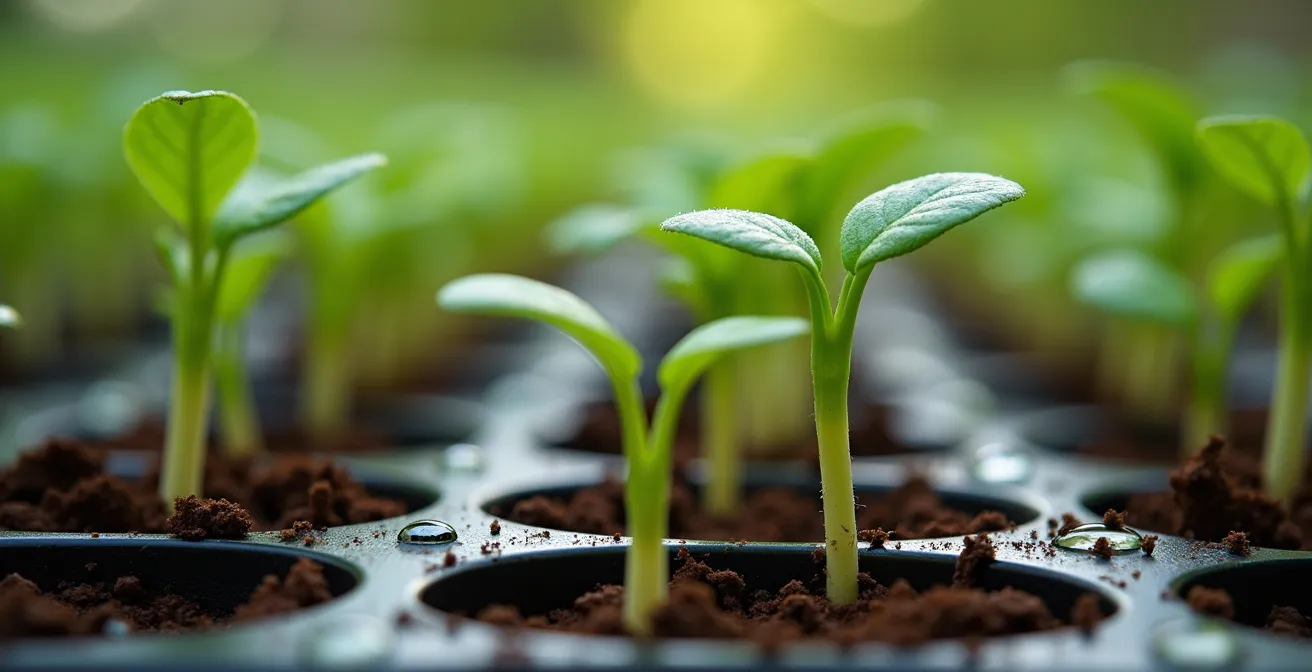
The UK’s relatively short and unpredictable growing season is a major challenge for any gardener. Starting seeds directly outdoors can be a gamble, with late frosts or cool, damp springs leading to poor germination and a delayed harvest. The single most effective technique to overcome this is to start seeds indoors. This strategy effectively extends the growing season by 4-10 weeks, ensuring you have strong, healthy seedlings ready to plant out the moment the weather and soil are suitable. This is not just a technique for seasoned gardeners; it’s an essential strategy for anyone wanting to maximise their yield in a limited timeframe.
For key crops like tomatoes, peppers, chillies, and aubergines, an early start indoors is non-negotiable for a successful harvest in most parts of the UK. These should be sown from late January to March in a warm, bright location like a windowsill or with the help of a simple grow light. For brassicas (cabbage, broccoli, kale) and beans, an indoor start in March or April gives them a vital head start. This indoor nursery period allows you to control the environment perfectly, protecting delicate seedlings from pests and weather, resulting in much higher success rates than direct sowing.
This strategy is particularly vital for those who acquire a plot mid-season. It can feel disheartening to get an allotment in May or June, thinking you’ve missed the boat. However, a case study of UK allotment holders showed that by using commercially grown ‘plug plants’—the equivalent of seedlings you started yourself—they could establish a productive garden immediately. Focusing on plug plants for tomatoes, beans, and courgettes allowed them to achieve a substantial harvest in their very first season, despite the late start. While seeds are cheaper, the £2-£3 for a tray of plugs is a smart investment to guarantee a return in your first year.
How to Subscribe to Veg Boxes Without Wasting Half the Produce?
For those unable to secure an allotment, a veg box subscription can seem like the next best thing. It offers a direct link to seasonal, often organic, produce. However, many people try a subscription only to cancel a few months later, frustrated by food waste. The arrival of a surprise kohlrabi or a mountain of chard can be overwhelming, leading to vegetables wilting in the fridge. The key to making a veg box work is choosing the right scheme and, more importantly, implementing a system to manage the produce.
The UK veg box market offers a variety of models, each with different levels of flexibility. National schemes like Riverford offer high-quality but often fixed boxes, while ‘wonky veg’ schemes like Oddbox provide more customisation and the benefit of reducing food waste. The most effective way to reduce personal waste and cost, however, is to create a neighbourhood sharing system. By splitting a large weekly box between two or three households, you not only slash the cost but also create a mini-market where you can trade items. The person who loves beetroot can swap with the person who can’t stand it, ensuring everything gets used.
Setting up a share system is simple. Find one or two interested neighbours, create a WhatsApp group for communication, and use a free app like Splitwise to manage the costs automatically. This small amount of organisation transforms the veg box from a weekly challenge into a valuable community resource.
The variety of schemes available means there is a fit for almost everyone, but understanding the differences in flexibility and features is crucial to avoid waste, as this comparison of UK veg box schemes highlights.
| Scheme Type | Flexibility | Waste Reduction Features | Average Cost |
|---|---|---|---|
| National (Riverford) | Fixed weekly boxes | Recipe cards included | £13-25/week |
| Local CSA | Swap boxes at collection | Trade unwanted items onsite | £10-20/week |
| Wonky Veg (Oddbox) | Customizable contents | Rescue food that would be wasted | £10-15/week |
| Neighbour Share | Split large box 2-3 ways | Divide contents immediately | £5-8/week per household |
Why Banana Peels Don’t Decompose Quickly on British Moorland?
A common sight on trails across the UK is a discarded banana peel or orange skin, left by a hiker assuming it will “naturally decompose”. While well-intentioned, this reveals a fundamental misunderstanding of the UK’s specific soil and climate conditions. A banana peel that might vanish in weeks in a tropical climate can persist for up to two years on a British moor. The reason lies in the soil chemistry. Much of the UK’s upland soil is highly acidic and cool, with typical moorland soil showing pH levels between 4.5 and 5.5. This is far from the ideal pH of 6.5-7.0 that the bacteria and fungi responsible for rapid decomposition thrive in.
This principle is directly applicable to your allotment. Simply throwing your kitchen scraps and garden waste into a pile and hoping for the best will likely result in a slimy, slow-to-rot mess, not the rich, crumbly compost you need. Your plot’s soil may be equally acidic or lack the right balance of materials. To create high-quality compost quickly in the UK, you need to manage the process actively using a hot composting method. This isn’t complicated, but it does require understanding the basic recipe: a balanced mix of ‘greens’ (nitrogen-rich materials like grass clippings and food scraps) and ‘browns’ (carbon-rich materials like cardboard and woodchip), along with sufficient moisture and air.
A hot composting system aims to create the perfect environment for thermophilic (heat-loving) bacteria to do their work, raising the core temperature of the pile to 60-70°C. This heat not only accelerates decomposition dramatically—producing usable compost in months, not years—but also kills weed seeds and pathogens. Building a dedicated compost bin of at least one cubic metre is essential to retain this heat. Mastering this one skill will transform your garden’s productivity, turning all your waste into ‘black gold’ that enriches your soil year after year.
Action Plan: The Hot Composting Method for UK Allotments
To successfully create compost, begin by layering 30cm of ‘browns’ like cardboard or woodchip at the base of your bin for air circulation. Add a 15cm layer of ‘greens’ such as grass clippings or food scraps to provide nitrogen. Water each layer until it feels like a wrung-out sponge. Continue repeating these layers until the bin is full, ensuring it is at least one cubic metre in size to retain heat effectively. The key to hot composting is to turn the pile weekly with a garden fork. This introduces oxygen and maintains the core temperature at 60-70°C, which is crucial for rapid breakdown. If a pH test shows your compost is too acidic (below 6.0), adding a sprinkle of garden lime can help accelerate the process.
Key takeaways
- The fastest way to get a council allotment is to bypass the individual list by forming a community group and aligning your application with council policies.
- For private land, don’t ask for a favour; offer a solution. A professional ‘meanwhile use’ proposal to a property developer is a highly effective strategy.
- Maximise the value of any plot by using sheds for high-value crops and starting seeds indoors to beat the short UK growing season.
- If you can’t get land, a hybrid strategy of ‘wonky veg’ boxes, supermarket reductions, and sharing systems can achieve the goal of affordable organic eating.
How to Eat Organically in the UK for Under £50 a Week Per Person?
The ultimate goal behind the quest for an allotment is often a desire for healthier, more affordable, and sustainable food. While having your own plot is the ideal, it’s not the only way to achieve this. Eating a largely organic diet for under £50 a week per person in the UK is entirely possible, but it requires the same strategic mindset as acquiring land. It’s not about doing one thing, but about combining several smart tactics into a cohesive ‘hybrid shopping strategy’.
This approach involves being selective about what you grow, what you buy, and where you buy it. An illuminating case study of a UK family of four demonstrated this perfectly. They successfully kept their organic food bill under the £50 per person per week threshold by combining multiple strategies. They used their small garden space to grow only high-value organic items that are expensive in supermarkets, such as herbs, salad leaves, and soft fruits, which can cost £3-5 per small pack. This is a far more efficient use of space than growing potatoes or onions.
For their staple vegetables and fruits, they subscribed to a ‘wonky’ veg box, saving 30-40% on organic produce that would otherwise be wasted. The third pillar of their strategy was strategic yellow sticker shopping. They targeted high-end supermarkets like M&S and Waitrose between 7-8 pm, when organic items are often reduced by as much as 75%. Finally, they supplemented about 15% of their fresh produce needs through seasonal foraging for items like wild garlic, elderflower, and blackberries. None of these strategies on their own is a magic bullet, but combined, they create a powerful and affordable system for accessing high-quality organic food.
By combining these strategies—from hacking council lists and negotiating with landowners to adopting smart food procurement systems—the dream of fresh, affordable, and sustainable food is well within your reach, with or without a traditional allotment.