In summary:
- You must have a Port of London Authority (PLA) permit to search the foreshore; digging is strictly limited.
- Tidal safety is paramount. The Thames can rise over 7 metres, creating dangerous currents and trapping hazards.
- Identifying finds requires practice; most will be common items like clay pipes, but all finds over 300 years old should be recorded.
- Any potential treasure (gold, silver) must be reported to the Coroner via a Finds Liaison Officer within 14 days.
- Researching your finds in local archives is what turns a piece of pottery into a piece of history.
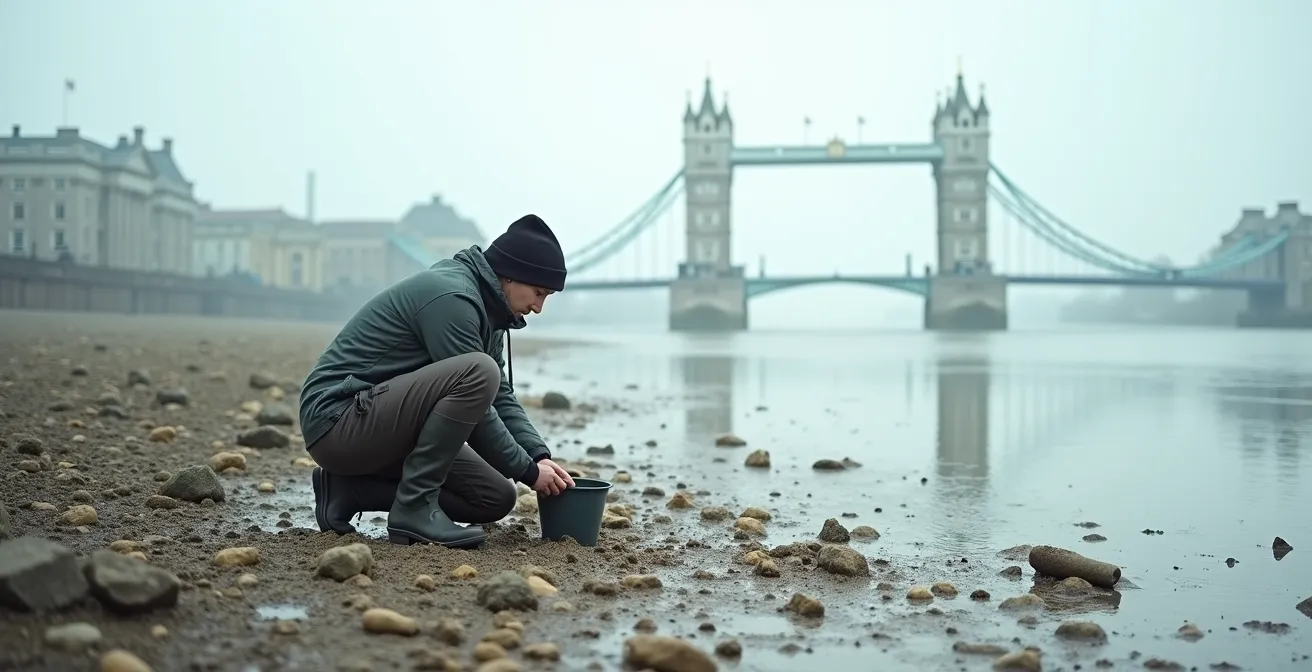
There is a unique magic in pulling an object from the Thames mud, knowing your hands are the first to touch it in centuries. It’s a direct connection to London’s sprawling, chaotic past. But this privilege is not a free-for-all. Many newcomers, eager to find treasure, hear the basic advice—”get a permit,” “watch the tides”—and think they’re ready. They are not. Those are merely the first two lines in a very important rulebook written by the river itself.
This isn’t just a hobby; it’s a responsibility. The real secret to successful and legal mudlarking isn’t just about what you do, but why you do it. It requires adopting the mindset of a river custodian, a temporary guardian of the city’s discarded history. The rules aren’t there to spoil your fun; they exist to protect the fragile archaeological record and, more importantly, to protect you from a river that is as dangerous as it is generous.
This guide will walk you through the non-negotiable steps to mudlarking on the Thames legally and safely. We’ll cover the permits you need, the lethal dangers you must respect, how to distinguish priceless history from modern rubbish, and what to do when you find something that glitters. It’s time to learn how to read the river, not just search it.
Contents: How to Mudlark on the Thames Legally and Safely
- Standard Permit or Daily: What Do You Need to Scrape the Mud?
- The Tide Trap That Catches New Mudlarks at London Bridge
- Clay Pipe or Roman Pottery: How to Tell Trash from Treasure?
- What Happens if You Find Gold or Silver on the Foreshore?
- Rotherhithe or City: Which Stairs Offer the Best Victorian Finds?
- Where to Find Parish Records That Haven’t Been Centralised Yet?
- When to Visit Coastal Reserves to Avoid Getting Cut Off by Tides?
- How to Access UK Public Records and Heritage Archives for Free Online?
Standard Permit or Daily: What Do You Need to Scrape the Mud?
Let’s be unequivocally clear: you cannot simply wander onto the Thames foreshore and start searching. The foreshore is private property, owned by the Port of London Authority (PLA) or the Crown Estate. Searching it without permission is theft. Your first and most critical step is obtaining a mudlarking permit from the PLA. This is your pact with the river and its guardians, a promise to search responsibly. The popularity of this pursuit has exploded recently; the PLA reported over 5,000 active permits in 2022, a massive increase from just a couple hundred a few years prior. This surge is precisely why the rules are so strict—to manage the impact on the delicate archaeological landscape.
For most people, the goal is the Standard Permit. This allows you to search the foreshore and scrape the surface, but any digging is strictly limited to 7.5cm (3 inches). You are not on a construction site; you are carefully examining what the river has revealed. The use of metal detectors is also covered by this permit, but again, the ‘no-digging-deeper-than-7.5cm’ rule is absolute. These permits are in high demand and the PLA has a waiting list system. You must be invited to apply.
Forget the idea of just showing up for a day. While day permits once existed, the system has been streamlined. The Standard Permit is now the primary entry point for any serious amateur historian. It’s a commitment, and the annual fee reflects that. This isn’t a tourist attraction; it’s a regulated activity for those with a genuine passion for history and preservation.
The Tide Trap That Catches New Mudlarks at London Bridge
A permit makes you legal, but it doesn’t make you safe. The single greatest danger to any mudlark is the tide. The Thames is not a gentle, meandering stream; it is a powerful tidal river with a massive tidal range. Newcomers vastly underestimate its speed and force. The water doesn’t just slowly creep in; it often rushes in, filling gullies and cutting off exit stairs with terrifying speed. I cannot stress this enough: never turn your back on the incoming tide. Many areas that were dry sand a minute ago can be several feet underwater before you have time to react.
Certain areas are notorious death traps. Near London Bridge, for instance, the narrowing of the river and the presence of bridge piers create a dangerous ‘funnel effect’. The incoming tide accelerates dramatically, creating powerful currents that can knock you off your feet. As one analysis notes, the ancient channel here creates hazards where you can be trapped against bridge piers or old wharf walls. The water is cold, and the currents are strong. This is not a place for complacency.
Before every single trip, checking the tide tables is not optional; it’s a matter of life and death. You must know the exact time of low tide and plan to be off the foreshore well before the tide turns. Always tell someone where you are going and when you expect to be back. Your phone is a tool, not a saviour—reception can be patchy, and a wet phone is a useless phone.
Your Pre-Search Safety Ritual: A Non-Negotiable Checklist
- Check the PLA tide tables for your specific location, adding one hour during British Summer Time (BST).
- Inform a friend or family member of your exact access point and your estimated return time.
- Wear the right gear: Sturdy wellington boots with good grip, thick waterproof gloves, and layered clothing.
- Identify at least two safe exit points before you descend the stairs to the foreshore. Know your escape routes.
- Have the Coastguard emergency number (999) saved and be ready to give your precise location.
Clay Pipe or Roman Pottery: How to Tell Trash from Treasure?
Once you’re safely and legally on the foreshore, the real hunt begins. Your eyes will slowly adjust to the visual chaos of mud, stone, and debris. At first, everything looks like a rock or a piece of modern rubbish. But with patience, patterns emerge. The key is learning to see not just objects, but shapes, materials, and signs of human craftsmanship. Is that a white stone, or the curved bowl of a 17th-century clay pipe? Is that a brown shard, or a piece of Roman Samian ware?
You will find a lot of ‘trash’ for every piece of ‘treasure’. The most common significant finds are what some call the “Big Three”: fragments of clay tobacco pipes (dating from the 1580s onwards), sherds of mottled brown German stoneware (often from Bellarmine or Bartmann jugs, 1550-1700), and the vibrant aqua of Victorian glass bottles. Learning the typologies—like how the size of a pipe bowl can help date it—is part of the craft.
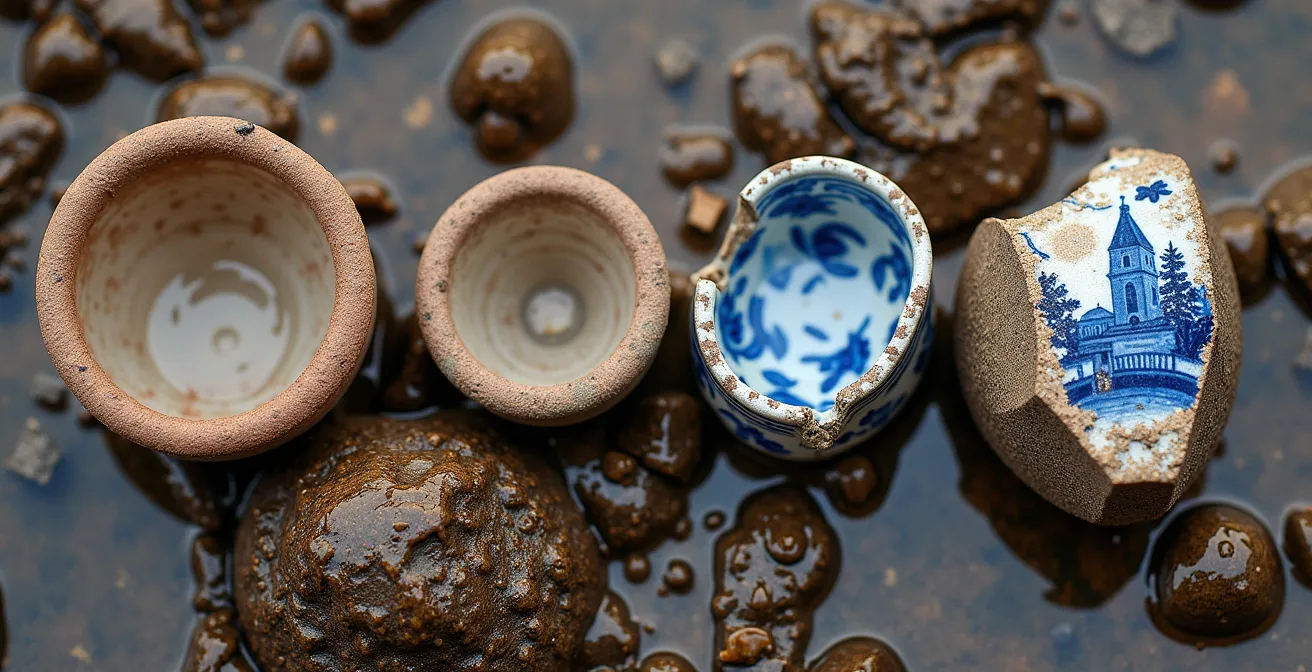
The real thrill isn’t necessarily finding something of monetary value, but something with a story. A simple piece of blue and white patterned pottery might be English Delftware from the 1600s, a remnant of a family’s prized possession. A bent, blackened spoon could have been dropped by a sailor on a trading vessel two centuries ago. Every fragment has a past. The role of the responsible mudlark is to become a detective, piecing together the context of these small, forgotten pieces of London life.
What Happens if You Find Gold or Silver on the Foreshore?
Every mudlark dreams of it: the glint of gold or the dull lustre of a silver coin. If this happens, your responsibilities multiply instantly, and the law becomes extremely specific. You cannot simply pocket a valuable find. Anything you find that could be legally defined as “Treasure” belongs to the Crown until a coroner decides otherwise. Reporting it is not optional; it is a legal obligation under the Treasure Act 1996.
So what qualifies as Treasure? As Professor Michael Lewis, Head of the Portable Antiquities Scheme at the British Museum, explains, it generally includes any object over 300 years old with at least 10% gold or silver content. It also covers hoards of coins. This isn’t a niche occurrence; according to a report from the British Museum, a staggering 1,377 treasure cases were reported in 2022 in England and Wales. Your find could be one of them.
Objects (other than coins) at least 300 years old and with at least 10% gold or silver qualify as treasure, along with coin hoards from the same find that are at least 300 years old.
– Professor Michael Lewis, Head of Portable Antiquities Scheme, British Museum
If you find something you believe is Treasure, you have a strict 14-day deadline to report it to the local Coroner. The best way to do this is by contacting your local Finds Liaison Officer (FLO), who is based at the Museum of London for the Greater London area. They are there to help, not to confiscate. They will guide you through the process, which involves recording the find, its exact location, and submitting a report. If a museum wishes to acquire your find, you will be paid a reward equivalent to its market value, typically split with the landowner (the PLA). Honesty is, quite literally, the best policy.
Rotherhithe or City: Which Stairs Offer the Best Victorian Finds?
Choosing your access point—the set of stairs leading down to the foreshore—is like choosing which chapter of history you want to read. Different areas of the Thames have vastly different historical profiles, yielding different types of finds. The key is to think about what activity dominated that stretch of the riverbank in centuries past. Your choice of stairs is, in effect, a choice of historical focus.
Generally, the northern bank in the City of London and Southwark areas offers the richest and oldest finds. This side of the river has been densely settled for two millennia, from the Roman era onwards. It was the heart of commerce, residence, and entertainment. Here you are more likely to find domestic items that tell the story of daily life: pottery, coins, trade tokens, and personal effects lost or discarded over centuries. The southern bank was historically marshy and less developed until the 18th and 19th centuries.
In contrast, areas like Rotherhithe on the south bank have a different character. This was the heart of London’s shipbuilding and, later, ship-breaking industries in the 18th and 19th centuries. The foreshore here is a treasure trove for those interested in maritime history. You’re more likely to discover nautical items like copper nails and pins, ship fittings, and tools related to the docks and wharves. The finds are generally younger than in the City, but they tell a powerful story of London’s industrial and maritime might.
Where to Find Parish Records That Haven’t Been Centralised Yet?
Finding an object is only the beginning of the story. The real work—and the real magic—happens when you start researching your find. A broken bottle is just a piece of glass until you discover the name of the man who bottled his wares in it. This is where historical archives, particularly local parish records, become an essential tool for the serious mudlark. These records are the key to transforming an anonymous object into a tangible link to a real person’s life.
While many records have been centralised or digitised, a wealth of information still resides in local archives specific to the London boroughs. If your find comes from the south bank, the Southwark Local History Library & Archive is an invaluable resource. For finds from the City, the City of London Records Office is your target. The central repository for the wider area is the London Metropolitan Archives (LMA). These institutions hold parish registers (recording births, marriages, and deaths), business directories, maps, and photographs that can breathe life into your discovery.
Case Study: From a Bottle to a Biography
Imagine you find the base of a stoneware bottle on the Southwark foreshore, clearly marked ‘J. Smith, Southwark’. This is your starting clue. By visiting the Southwark Local History Library and searching parish records and trade directories from the 19th century, you might find an entry for a John Smith listed as a brewer or a ginger beer merchant. You could find his business address, his home address, maybe even the names of his wife and children. Suddenly, that broken bottle is no longer just an object; it’s a direct link to a Victorian entrepreneur, a family man living and working by the river. This is the process that elevates mudlarking from collecting to historical investigation.
These local archives are often underused but are staffed by knowledgeable and passionate archivists. Don’t be intimidated. Go in with your find (or a photo of it) and your questions, and you may unlock a story you never expected.
When to Visit Coastal Reserves to Avoid Getting Cut Off by Tides?
Understanding the tides isn’t just about knowing when low tide is. It’s about understanding the river’s larger rhythm, specifically the difference between Spring Tides and Neap Tides. This knowledge dictates not only your safety but also the potential success of your search. The term “coastal reserves” can be misleading for the Thames; think of it as the “foreshore reserve”—the amount of riverbed exposed by the tide.
Tidal range is the vertical difference between high and low tide. The Port of London Authority warns that the Thames tide can rise over 7 metres twice daily. This range is not constant; it changes in a two-week cycle governed by the moon. Spring Tides, which occur during a full or new moon, have the highest highs and the lowest lows. These are the best times for mudlarking as they expose the maximum amount of foreshore, revealing areas that are usually underwater. However, they are also the most dangerous, as the water comes in faster and the currents are stronger.
Neap Tides occur during the first and third quarter moon phases. They have a much smaller tidal range—the high tides are lower, and the low tides are higher. This means less foreshore is exposed, giving you less area to search. The trade-off is that Neap Tides are generally safer, with slower water movement and less risk of being caught out. For a beginner, starting during a Neap Tide can be a sensible way to familiarise yourself with a new stretch of foreshore without the added pressure of a rapidly incoming Spring Tide.
| Tide Type | Moon Phase | Tidal Range | Mudlarking Conditions | Risk Level |
|---|---|---|---|---|
| Spring Tides | Full/New Moon | Maximum (up to 7m) | Best exposure of foreshore | Highest risk – fastest currents |
| Neap Tides | First/Third Quarter | Minimum (reduced range) | Less foreshore exposed | Lower risk – slower water movement |
Key Takeaways
- Permit First, Always: No PLA permit means no legal mudlarking. This is the absolute first step.
- The Tide Is the Boss: Underestimating the speed and power of the Thames tide is the most dangerous mistake a mudlark can make. Safety planning is not optional.
- Research Is the Real Treasure: A find is just an object until you uncover its story. Using archives transforms your hobby into a historical investigation.
How to Access UK Public Records and Heritage Archives for Free Online?
While local archives are fantastic for deep dives, a revolution in digital access has put incredible research tools at your fingertips for free. Before you even visit an archive in person, you can conduct extensive preliminary research from home. These online resources are essential for identifying your finds, understanding their context, and connecting with a wider community of discoverers. They are the modern mudlark’s primary toolkit.
The first port of call for any find should be the Portable Antiquities Scheme (PAS) database at finds.org.uk. This is a breathtaking public record of over 1.5 million objects found by the public in the UK. You can search for similar items, learn how they were identified, and see their distribution across the country. As the British Museum notes, “to date, over 1.4 million items have been recorded”, creating an unparalleled resource for amateur archaeologists.
Another game-changing tool is the National Library of Scotland’s online map collection. Their side-by-side viewer allows you to overlay historic maps—like Victorian Ordnance Survey maps—onto a modern satellite view. This enables you to see exactly what stood on the riverbank where you found your object 150 years ago. Was it a pub, a factory, a dock, or a row of houses? This context is invaluable. Finally, the online collections of the British Museum and the Museum of London allow you to compare your finds with high-resolution images of professionally excavated artifacts, helping you refine your identifications.
Embracing these digital tools is what separates the casual searcher from the dedicated historian. The story of your find is often waiting in a digital archive, ready to be uncovered.
Your journey into London’s past begins not when you find your first object, but when you commit to these principles. The next step is to get on that permit waiting list, start studying your tide tables, and prepare to become a custodian of the river’s secrets.
Frequently Asked Questions about Thames Mudlarking
What are the ‘Big Three’ finds on the Thames foreshore?
Clay tobacco pipes (dating from 1580s onwards), Bellarmine/Bartmann stoneware from Germany (1550-1700), and Victorian glass bottles are the most common significant finds.
How do I report finds to the Portable Antiquities Scheme?
You should report any find over 300 years old for recording. To do this, contact your local Finds Liaison Officer at the Museum of London by email or phone. They will guide you through the process of adding your discovery to the national database.
What’s the safest way to clean mudlarking finds?
Patience is key. Soak items in regular tap water, changing the water daily until it remains clear. You can use a very soft toothbrush for gentle cleaning on robust items like pottery or glass. Never use harsh chemicals, wire brushes, or sealants, as these can permanently damage historical artifacts.