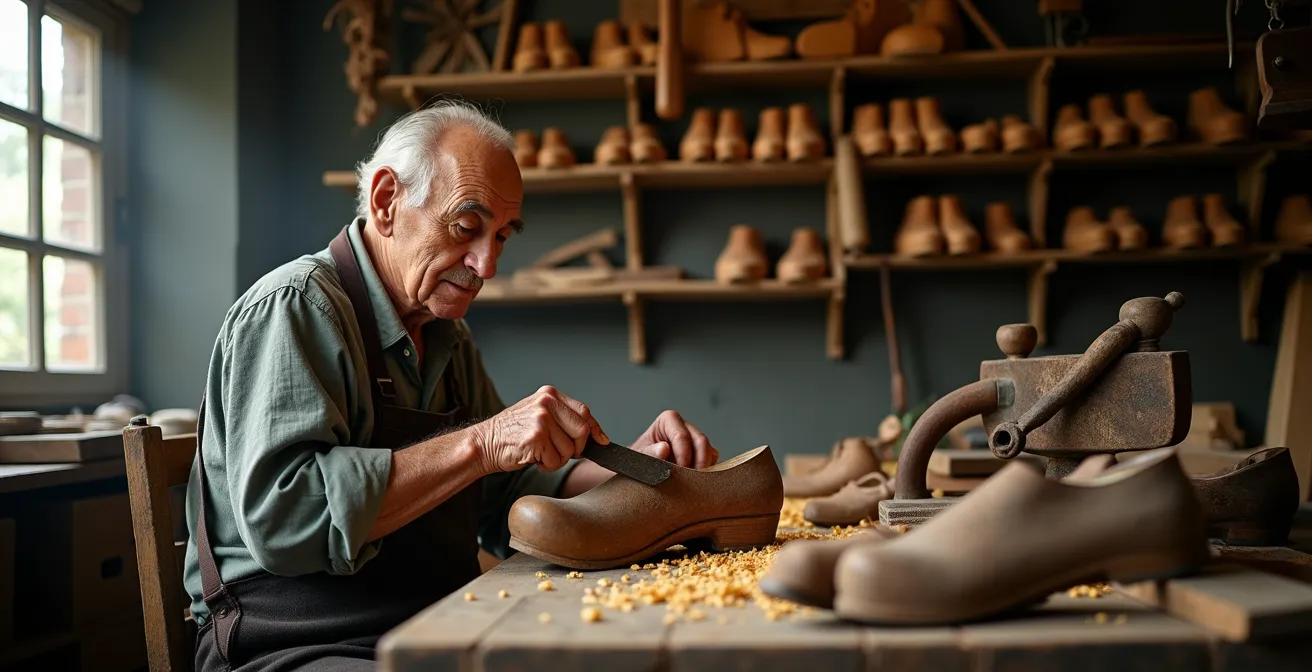
Simply buying “handmade” isn’t enough to save England’s endangered crafts; true support requires understanding and investing in the maker’s entire fragile ecosystem.
- The price of a craft item reflects not just materials, but irreplaceable skill, years of training, and the economic viability needed to prevent a craft’s extinction.
- Supporting makers directly or through transparent channels ensures they receive the profit needed to reinvest, take on apprentices, and secure their future.
Recommendation: Move beyond being a consumer to become an active patron: seek out open studios, commission work directly, and champion the true value of heritage.
There’s a unique gravity to holding an object made by hand. A hand-turned wooden bowl, a pair of bespoke clogs, a forged iron gate—these are not just products, but stories. They carry the echo of the workshop, the scent of the raw materials, and the soul of the maker. As cultural enthusiasts, we are drawn to this authenticity. Yet, a creeping silence is falling over many of England’s traditional workshops. We are at a critical juncture where entire skillsets, passed down through generations, are on the brink of being lost forever.
The common advice is simple: “buy handmade” to support these artisans. While well-intentioned, this platitude barely scratches the surface. It fails to address the complex economic and social pressures threatening these skills. To truly make a difference, we must move beyond passive consumption and become active patrons. This isn’t just about a transaction; it’s about understanding the intricate maker’s ecosystem—the fragile web of training, material sourcing, and economic viability that allows a craft to survive.
But what if the key to preservation lies not just in what you buy, but in *how* you buy it, *why* it costs what it does, and *where* you connect with the masters themselves? This guide is a call to action. It will deconstruct the real challenges facing heritage crafts in England, from the struggle for succession to the true cost of creation. We will explore how to ensure your support directly empowers the makers, demystify the price tags on their work, and reveal how to find the hidden workshops where these legacies are forged. It’s time to turn our passion into a lifeline.
To give a visual sense of the dedication and beauty inherent in these skills, the following video offers an immersion into the world of paper marbling, one of many crafts fighting for its future.
To navigate this urgent issue, we will delve into the specific challenges and opportunities for preservation. The following sections break down the crisis and provide a clear roadmap for how your support can have the greatest impact.
Summary: A Practical Guide to Saving England’s Heritage Skills
- Which British Crafts Are Currently Classified as ‘Critically Endangered’?
- Etsy or Direct: How to Ensure the Maker Gets the Profit?
- Why Are Young People Not Becoming Blacksmiths in 2025?
- Why Does a Hand-Turned Wooden Bowl Cost £80?
- How to Find Open Studios to Watch Masters at Work?
- How to Find independent Workshops Not Listed on Eventbrite?
- Why Does a Life-Size Bronze Statue Cost £40,000?
- Why Pottery Classes Are Replacing Pub Nights for Young Professionals in Bristol?
Which British Crafts Are Currently Classified as ‘Critically Endangered’?
The threat to England’s craft heritage is not an abstract fear; it is a measurable crisis. The Heritage Crafts Association meticulously tracks the health of traditional skills through its “Red List of Endangered Crafts.” This is the frontline report on our cultural inheritance, and the numbers are stark. The latest report identifies over 70 critically endangered crafts in the UK. This category signifies a craft at serious risk of extinction, with few practitioners, limited training routes, and a fragile economic footing.
To understand this classification, the Red List defines risk levels with urgent clarity:
- Critically Endangered: Crafts at serious risk of no longer being practised. This includes skills with a shrinking base of craftspeople, few training opportunities, or no mechanism to pass on knowledge. Clog making is a prime example.
- Endangered: Crafts with enough makers for now, but facing serious concerns about future viability due to an ageing workforce or shrinking market.
- Currently Viable: Crafts in a healthy state, with enough practitioners to transmit skills to the next generation.
Clog making, a once-thriving industry, now personifies this crisis. Simon Brock in Sheffield is one of only a handful of professional clog makers left in the entire UK. He represents the last bastion of a skill that is critically endangered, his workshop a precious, lonely outpost of a vast, lost tradition. His story is not unique; it is a pattern repeated across dozens of disciplines, from bell founding to parchment making. Each name on the Red List is a legacy hanging by a thread, a stark reminder of what we stand to lose.
Etsy or Direct: How to Ensure the Maker Gets the Profit?
Once you’ve decided to support a maker, the next critical question is *how*. In our digital age, marketplaces like Etsy seem like an obvious portal to handmade goods. They offer convenience and discovery, but they come at a cost to the very people we aim to support. True, impactful support demands a commitment to value chain transparency, ensuring the maximum profit reaches the maker’s hands. When a significant portion of the sale price is diverted to platform fees, listing costs, and transaction charges, it directly reduces the funds available for raw materials, workshop upkeep, and, crucially, the ability to invest in training an apprentice.
The difference between buying direct and through an intermediary is not trivial. It can determine the long-term viability of a small craft business. As clog maker Simon Brock passionately states in an interview with Tradfolk Magazine, pricing is a constant struggle for survival: “Be prepared to pay whatever is asked… as far as I can tell, every clog maker of recent times has tried to make clogs accessible by charging the very lowest price they could possibly get away with – sometimes to the detriment of their own business.” This highlights a critical point: makers often undercharge out of passion, making every percentage point of profit essential.
The most powerful form of active patronage is to buy directly from the artisan’s own website or workshop. This guarantees 100% of your money fuels their craft. When that’s not possible, understanding the financial impact of different channels is key.
| Purchase Method | Maker’s Profit Margin | Customer Relationship | Sustainability Impact |
|---|---|---|---|
| Direct from Maker | 100% of sale price | Direct communication possible | Enables reinvestment in craft |
| Via Platform (15-20% fees) | 80-85% of sale price | Platform intermediated | Reduced funds for materials/training |
| Via Gallery/Shop (40-50% commission) | 50-60% of sale price | Limited maker visibility | May limit ability to take apprentices |
Why Are Young People Not Becoming Blacksmiths in 2025?
The image of a blacksmith at the forge is iconic—a symbol of strength, skill, and creation. Yet, this and many other heritage crafts face a profound succession crisis. The core issue is not a lack of interest from a younger generation, but the collapse of the systems that facilitate knowledge transfer. Becoming a master craftsperson is not something one can learn from a book or a YouTube video; it requires years of hands-on apprenticeship under the guidance of an expert. This traditional model is breaking down for several reasons.
Firstly, the economic model is often prohibitive. Master craftspeople, many of whom are sole traders operating on thin margins, simply cannot afford to take on an apprentice. The cost of materials, workshop space, insurance, and the time spent teaching far outweighs the immediate productivity of a learner. Secondly, the formal education system has largely abandoned these vocational pathways, leaving a void that is difficult to fill. Without a structured, funded route into the profession, the path for an aspiring blacksmith, wheelwright, or tinsmith is fraught with uncertainty and financial barriers.
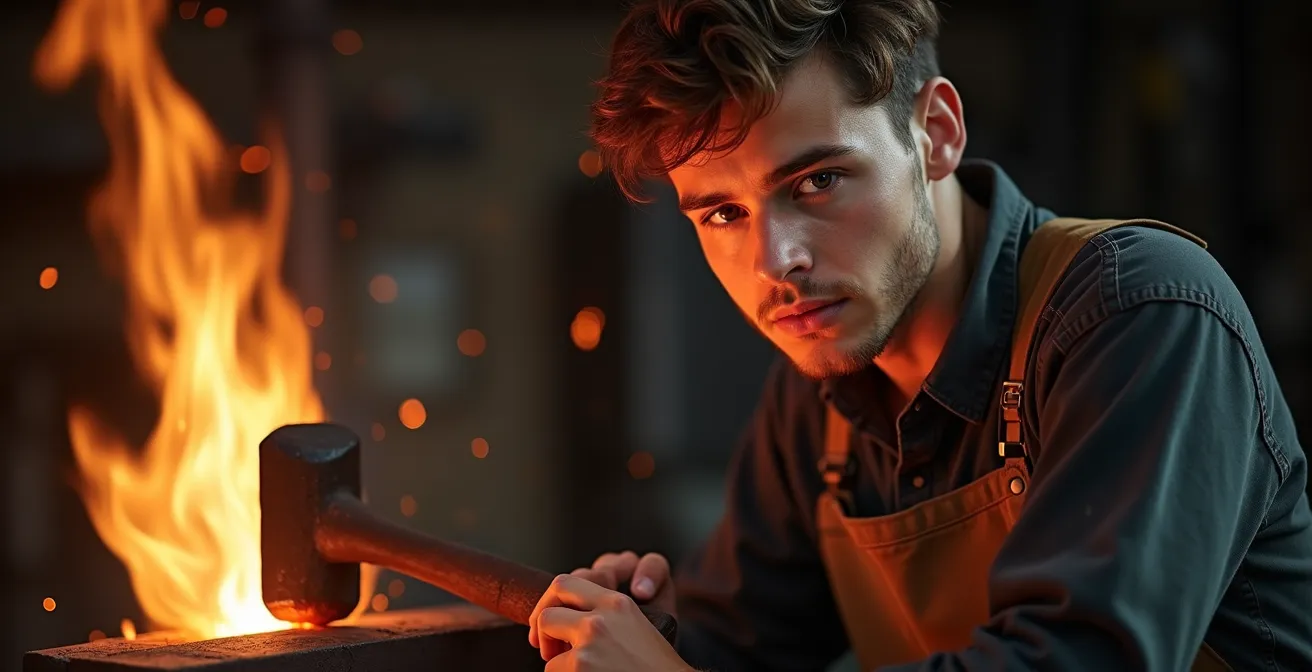
However, glimmers of hope show that this decline is reversible. The story of wheelwrighting provides a powerful blueprint for success. As a craft once facing decline, a concerted effort has revitalised its future. According to a report on the MERL website, a funded apprenticeship scheme has successfully trained new artisans. The Worshipful Company of Wheelwrights is now planning for up to twenty apprentices over the next forty years, a number believed to be sustainable. This proves that with targeted funding and a collaborative structure, the pipeline of new talent can be rebuilt, turning a critically endangered craft into a viable one.
Why Does a Hand-Turned Wooden Bowl Cost £80?
In a world of mass production, the price tag on a handmade object can sometimes feel jarring. An £80 hand-turned wooden bowl or a £200 pair of hand-carved clogs may seem expensive compared to factory-made alternatives. However, this price is not arbitrary; it is a direct reflection of a vanishing economy of skill. The cost encapsulates not just the raw materials, but the years of dedication, the rarity of the knowledge, and the true time it takes to create something of quality and permanence. You are not just buying a bowl; you are buying a piece of a master’s life and helping to sustain their livelihood.
The dramatic decline in the number of makers is a key factor. Consider the history of clog making. At its peak, the industry supported thousands of artisans. Now, that number has dwindled to a tiny handful. An article in Tradfolk Magazine notes that from 6,000 clog makers in its heyday, there are now fewer than ten individuals practising the craft professionally in the UK. This scarcity fundamentally changes the economics. When a skill becomes this rare, each object produced carries the immense weight of that near-extinct knowledge. The price must reflect not only the maker’s time but also the cost of preserving the craft itself against overwhelming odds.
Furthermore, these makers are often competing in a market that doesn’t value their process. As the Heritage Crafts Association points out, a major challenge is the “unwillingness of customers to pay that little bit more for handmade British items.” This pressure forces makers into an impossible choice: lower their prices to compete and risk their business failing, or price their work honestly and risk being overlooked. As active patrons, our role is to understand and champion this true cost, recognising it as a fair price for an irreplaceable piece of our shared culture.
How to Find Open Studios to Watch Masters at Work?
Connecting directly with a craftsperson in their own environment is one of the most powerful ways to support their work and appreciate their skill. Watching a master at the lathe, the anvil, or the loom transforms an abstract appreciation into a tangible understanding. It bridges the gap between the finished object and the incredible process behind it. These visits foster a personal connection, build respect for the craft, and often lead to direct commissions or purchases, providing vital income for the maker. The challenge, of course, is finding them.
Many artisans welcome visitors, but they are often sole traders without a marketing department. Finding them requires a more proactive approach than a simple Google search. Open studio events, often organized by regional guilds or as part of local arts trails, are fantastic opportunities. However, many master craftspeople operate outside of these formal events. A direct, respectful enquiry is often all it takes. These makers are passionate about what they do and are usually happy to share their knowledge with someone showing genuine interest.
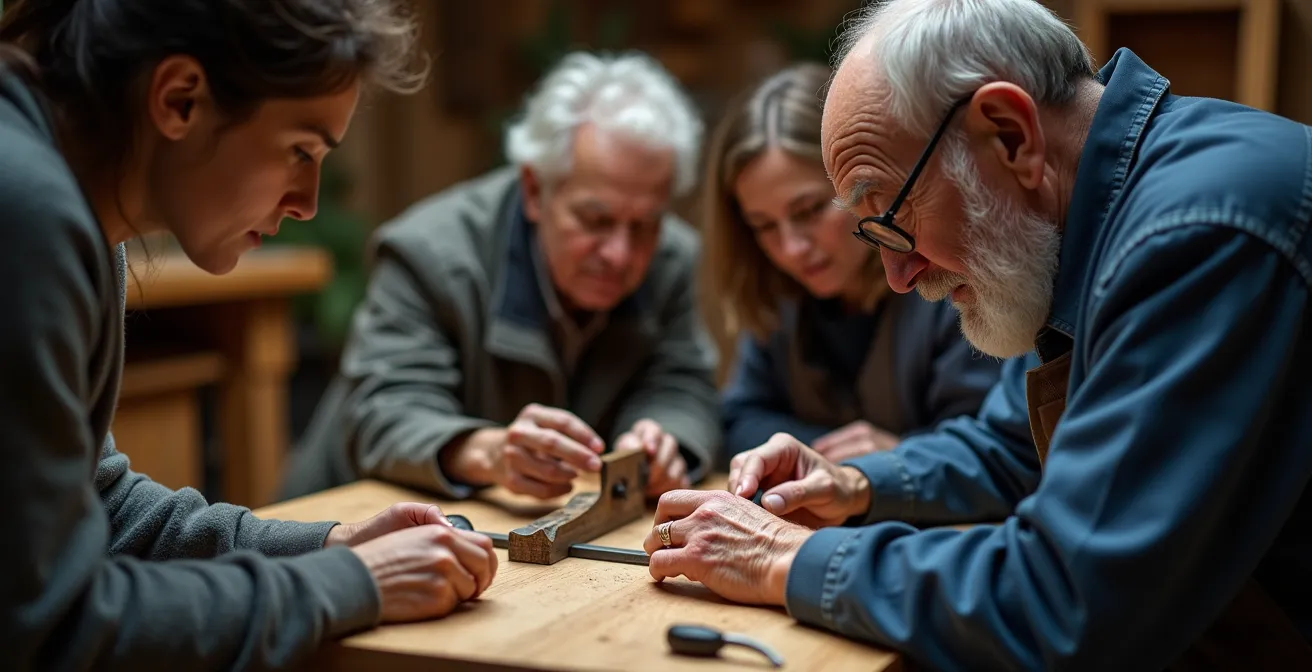
To move from a passive admirer to an active visitor, a targeted strategy is needed. The following checklist provides a practical starting point for discovering and connecting with the hidden workshops of England’s master artisans.
Your Action Plan: Connecting with Master Craftspeople
- Consult the Directory: Start with the Heritage Crafts’ online Maker Directory to find verified traditional craftspeople across England and their direct contact details.
- Track Annual Events: Identify and attend annual gatherings like the Lancashire Wallopers’ Weekend of Step Clog Dance, where multiple makers from a specific craft often congregate.
- Explore Heritage Sites: Look for craftspeople demonstrating at English Heritage and National Trust properties, as many have partnerships to showcase their skills.
- Check Regional Guilds: Investigate regional bodies like The Devon Guild of Craftsmen for information on their members’ open studio events and exhibitions.
- Make Direct Contact: Don’t hesitate to contact makers directly through their own websites or listed workshops. Most appreciate genuine interest, even outside of official open days.
How to Find independent Workshops Not Listed on Eventbrite?
While open studios offer a glimpse into a maker’s world, for those looking to learn a skill, the search becomes even more specific. Mainstream platforms like Eventbrite are excellent for popular classes like pottery or life drawing, but they rarely feature the highly specialised, intensive training required for endangered heritage crafts. Finding a master willing and able to teach skills like hand-carved clog making or wheelwrighting requires looking beyond conventional channels and tapping into the dedicated infrastructure built to preserve these very skills.
The key is to seek out the institutions and organisations whose entire mission is heritage craft education. These are the places that act as a bridge between aspiring learners and master craftspeople who may not have the time, resources, or facilities to run their own courses. They provide the structure, funding, and environment necessary for deep, immersive learning that simply isn’t available through a one-day workshop listed online. This is where true knowledge transfer happens, securing the future of a craft one student at a time.
A prime example of this model in England is West Dean College of Arts and Conservation in Sussex. As highlighted in a discussion by CraftCourses, it represents a beacon for heritage craft education. The college offers residential courses and full-time diplomas in disciplines like musical instrument making, metalwork, and furniture conservation. By providing this dedicated space for learning, West Dean helps to fill the critical gap left by mainstream education. Finding these specialist centres, along with dedicated guilds and associations, is the most effective way to access training that can genuinely lead to professional practice and the continuation of a craft legacy.
Why Does a Life-Size Bronze Statue Cost £40,000?
If an £80 bowl represents the value of time and skill, a £40,000 bronze statue represents the value of infrastructure, legacy, and the monumental risk of extinction. The price of large-scale craftwork is not just about the artist’s talent and the cost of bronze; it is about sustaining an entire, incredibly fragile ecosystem. It pays for the foundry, the specialised equipment, the energy costs, the years of expertise in metallurgy and casting, and the wages of a team of artisans. Each major commission is a vital injection of capital that keeps the workshop doors open and the furnaces lit for the next generation.
When this ecosystem collapses, the results are swift and devastating. The closure of a single major workshop can send an entire craft onto the critically endangered list overnight. The fate of the Whitechapel Bell Foundry is a tragic and potent example. As Britain’s oldest manufacturing company, its closure in 2017 meant the loss of centuries of accumulated knowledge. Consequently, bell founding was immediately added to the Red List. This demonstrates that the high cost of a large commission is, in essence, an investment in preventing such a catastrophe from happening to another craft.
The stakes are incredibly high. The Red List also tracks crafts that have been lost completely. Since 2013, we have witnessed the UK extinction of cricket ball making, gold beating, and sieve making, among others. A Wikipedia summary of the Red List notes that at least five crafts have become extinct in the UK in the last decade. The £40,000 price tag on a statue is not just for a piece of art; it’s a bulwark against adding bronze casting to that tragic list. It is the price of permanence in a world that is forgetting how to build things that last.
To remember
- The Heritage Crafts Red List is a critical tool, identifying over 70 UK crafts at immediate risk of extinction.
- Buying directly from makers is the most impactful form of support, ensuring 100% of your money fuels their work and the potential for training apprentices.
- The price of handmade items reflects a complex reality: years of training, the high cost of quality materials, and the sheer rarity of the skill in the modern economy.
Why Pottery Classes Are Replacing Pub Nights for Young Professionals in Bristol?
Amidst the urgent calls for preservation and the sobering statistics of disappearing skills, a powerful counter-current is emerging. In cities like Bristol and across the country, young professionals are increasingly trading pints at the pub for time at the pottery wheel. This is more than a fleeting trend; it is a symptom of a deeper cultural shift. In an age dominated by digital screens and abstract work, there is a growing, palpable hunger for the tangible, the real, and the authentic. The desire to create something with one’s own hands is a fundamental human impulse that is being rediscovered.
This resurgence of interest in hands-on creativity offers a profound sense of hope for heritage crafts. While a weekend pottery class is not the same as a multi-year blacksmithing apprenticeship, it cultivates the very foundation upon which craft depends: an appreciation for skill, process, and materiality. This trend creates a new generation of informed consumers and potential patrons who understand why a handmade mug is different from a factory-produced one. Research has shown this is a significant movement, with an 180% increase in bookings for Arts & Crafts Experiences on Airbnb in a single year, demonstrating a massive, untapped demand for creative engagement.
This movement shows that the passion for making is not dead; it has simply been dormant. The challenge now is to channel this renewed enthusiasm for “hobby” crafts towards the more endangered, professional heritage skills. The person who discovers the joy of shaping clay today could become the active patron who commissions a hand-forged gate tomorrow. They are part of the same continuum of valuing the handmade. This cultural shift is our greatest asset in the fight for preservation, proving that the desire to connect with our material heritage is not a relic of the past, but a vital need for the future.
The survival of England’s craft legacy rests in our hands. It requires us to be more than just consumers; it demands we become advocates, patrons, and participants. The next step is to take this understanding and turn it into direct, meaningful action. Start today by exploring the makers, visiting the workshops, and investing in a piece of our shared, living history.