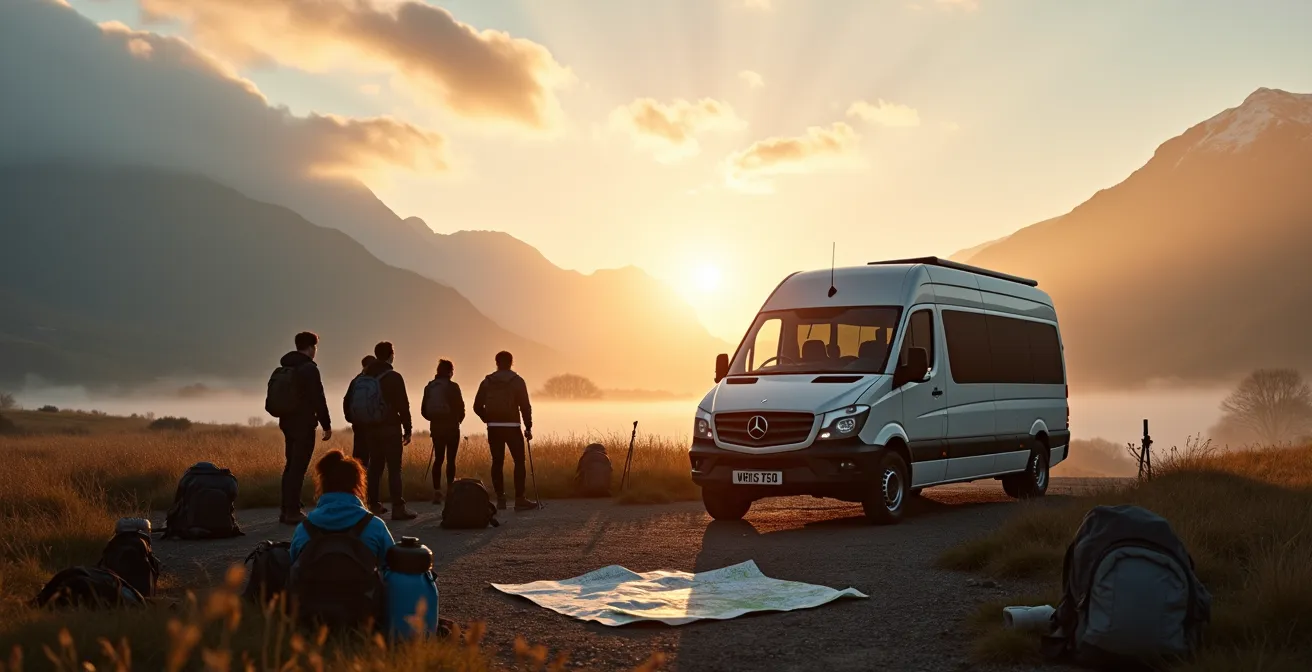
Success in the 24-hour Three Peaks Challenge has little to do with peak fitness and everything to do with mastering the brutal logistics inside the minibus.
- Driver fatigue and illegal minibus operation is the single greatest threat to your team’s safety and success.
- Your fuelling and sleep strategy between mountains is more critical than the energy gels you carry on the ascent.
- Poor logistical planning creates friction with local communities, jeopardising the future of the challenge itself.
Recommendation: Shift your focus from a simple fitness schedule to building a detailed operational plan. Your training must encompass logistical stamina, not just physical endurance.
Every year, thousands of determined hikers stand on the summit of Snowdon, exhausted but triumphant, having conquered Ben Nevis, Scafell Pike, and Wales’ highest peak within 24 hours. The common advice for this monumental undertaking is predictable: do plenty of hill walks, break in your boots, and pack for all four seasons in a day. While this advice isn’t wrong, it’s dangerously incomplete. As an endurance coach, I’ve seen countless physically capable teams fail, not because their legs gave out, but because their logistics disintegrated.
The National Three Peaks Challenge is not just a hiking test; it’s an extreme logistical marathon. The real battle is won or lost in the cramped, sleep-deprived confines of the minibus hurtling down the M6. Your success hinges less on your VO2 max and more on your team’s ability to manage the critical pillars of the challenge: the driver’s state, the gear’s performance, the efficiency of your nutrition, and the strategic use of minimal rest. This is where logistical stamina becomes more important than cardiovascular fitness.
Forget the generic training plans. This guide dissects the operational realities of the challenge. We will tackle the uncomfortable truths about driver safety, the non-negotiable science of gear choices for the Scottish Highlands at night, the fuelling discipline required to perform on zero sleep, and the crucial winter training that builds true resilience for the uniquely demanding British mountain environment.
Summary: The Real Training for the National Three Peaks Challenge
- Why the Driver Is the Most Dangerous Person on a 24-Hour Challenge?
- Waterproofs or Softshell: What Keeps You Alive on Ben Nevis at Night?
- The Minibus Mistake That Angers Wasdale Residents During Peaks Season
- Jelly Babies or Pasta: What Fuels You for 24 Hours of Walking?
- When to Sleep During the Drive to Maximize Performance on Snowdon?
- Why Cotton Is Your Worst Enemy When Running in 5°C Drizzle?
- Bring Your Own Tent or Rent in Puerto Natales: Which Makes Sense?
- How to Maintain Outdoor Fitness Routines During the Wet British Winter?
Why the Driver Is the Most Dangerous Person on a 24-Hour Challenge?
In any 24-hour endurance event, the single biggest point of failure is fatigue-induced human error. For the Three Peaks Challenge, that risk is concentrated in one person: your driver. A team of fit hikers is irrelevant if the person controlling the two-tonne minibus at 70mph is sleep-deprived and operating outside legal limits. Many charity teams, in a bid to save costs, make a critical mistake: they assume anyone with a car licence can drive a 17-seater minibus. This is often illegal and always dangerous. To operate a minibus with 9 to 16 passenger seats for a charity, drivers must be at least 21 and have held a Category B licence for two years just to be eligible for a D1 permit, and even then, strict conditions apply.
Beyond the licensing, there are the GB Domestic Rules for driving hours. A driver is limited to a maximum of 10 hours of driving within a 24-hour period and must take a 30-minute break after 5.5 hours. The total driving time for the challenge is at least 10 hours without traffic. This leaves zero margin for error, delays, or a single driver. Having a dedicated, non-walking driver is not a luxury; it’s a fundamental safety requirement. The alternative is a scenario all too familiar to rescue services. The Wasdale Mountain Rescue Team frequently reports that a significant number of their callouts are for ill-equipped and poorly prepared Three Peaks groups, a direct symptom of logistical failure that often begins with a fatigued driver making poor decisions long before reaching the mountain.
Waterproofs or Softshell: What Keeps You Alive on Ben Nevis at Night?
The gear debate for UK mountains often pits the waterproof hard shell against the breathable softshell. For the Three Peaks Challenge, specifically the Ben Nevis leg which frequently starts in the evening and ascends into darkness, this is not a question of comfort. It is a question of survival. A softshell jacket is excellent for a dry, cold day, offering breathability during high-exertion activity. However, it is water-resistant, not waterproof. In the face of the persistent, wind-driven rain common in the Scottish Highlands, a softshell will eventually ‘wet out’, becoming saturated and useless for insulation. This is where performance decay begins, as your body expends critical energy simply trying to stay warm.
A high-quality hard shell waterproof jacket is non-negotiable. It is your primary defence against wind and rain, the two biggest contributors to hypothermia. The technology in modern waterproof fabrics is designed to block external moisture completely while allowing some internal vapour to escape. This barrier is what keeps your insulating mid-layers dry and functional, which in turn keeps you alive and moving efficiently.

As you can see, the hydrophobic treatment forces water to bead up and roll off, rather than soak into the material. While a softshell might feel more comfortable at the car park, it becomes a liability at 1,000 metres in driving sleet. Your outer layer is not for comfort; it is a piece of safety equipment. The correct choice is always a fully waterproof and windproof hard shell jacket and trousers. There is no compromise.
The Minibus Mistake That Angers Wasdale Residents During Peaks Season
With approximately 30,000 people attempting the challenge annually, the logistical pressure on the small rural communities at the base of the mountains is immense. Nowhere is this felt more acutely than in Wasdale, the gateway to Scafell Pike. The cardinal sin committed by countless self-organised groups is treating the challenge like a race, creating minibus convoys that speed through narrow country lanes and park inconsiderately, blocking access for local residents, farmers, and emergency services. This behaviour, born from poor planning and a flawed “fastest time” mentality, has created significant tension and threatens the long-term viability of the event.
The “minibus mistake” is the failure to build sufficient buffer time into the schedule. A responsible attempt is not about a sub-24-hour finish at all costs. In response to this issue, reputable operators now adhere to a voluntary Code of Practice. This includes stipulating a minimum of 10 hours total driving time within the 24-hour window, effectively building in a buffer that discourages speeding between peaks. This “14-hour rule” (24 hours minus 10 for driving) ensures teams are not incentivised to turn the A-roads of Cumbria into a rally stage. It prioritises safety and respect for local infrastructure over a meaningless leaderboard.
Your team’s legacy should not be one of blocked gates and angry locals. Plan your logistics with respect. This means having a driver who is not rushed, parking only in designated areas (even if it means a longer walk to the start), and keeping noise to an absolute minimum, especially during anti-social hours. The mountain will be there tomorrow; ensure your actions don’t prevent others from being able to access it.
Jelly Babies or Pasta: What Fuels You for 24 Hours of Walking?
Fuelling for a 24-hour endurance event is a science of metabolic discipline, not a random grab-bag of sugary snacks. While Jelly Babies provide a quick-release glucose hit that feels good for a moment, relying on them is a recipe for energy spikes and crashes. Your body needs a sustained release of complex carbohydrates to fuel the hours of walking, and protein to aid muscle repair during the frantic minibus transitions. The goal is to maintain a steady state of energy, not to ride a sugar rollercoaster. This requires a structured approach to nutrition, both on and off the mountain.
A proper fuelling strategy differentiates between on-the-move snacks and between-peak recovery meals. The former should be easily digestible (cereal bars, malt loaf), while the latter must replenish depleted glycogen stores. A hot meal of pasta or porridge in the minibus is not a luxury; it’s a critical component of your performance. Below is a breakdown of the nutritional demands, showing why a pot of pasta is infinitely more valuable than a pocketful of sweets.
The data on nutritional needs for this level of endurance is clear, and a structured plan is essential. A study on hiker energy requirements provides a clear framework.
| Factor | Requirement | Timing |
|---|---|---|
| Additional Calories Needed | 2500-2700 kcal | Across 24 hours |
| Carb-to-Protein Ratio | 4:1 | Between peaks |
| Hydration Breaks | Every 30-45 minutes | During ascents |
| Solid Food Window | First two peaks only | Switch to liquid calories for Snowdon |
The key is to eat little and often, prioritising complex carbohydrates between peaks and saving simple sugars for emergency boosts on the final ascent. Your fuelling plan must be tested rigorously during training. Challenge day is not the time to discover that a particular energy bar disagrees with your stomach. Metabolic discipline means eating when the plan says to eat, not when you feel hungry, because by the time you feel hunger, your performance is already starting to decay.
When to Sleep During the Drive to Maximize Performance on Snowdon?
For most participants, the final ascent of Snowdon is attempted on close to zero sleep. This is where cognitive function plummets, navigation errors occur, and morale evaporates. Experienced participants consistently identify the lack of sleep as one of the hardest aspects of the challenge. However, simply closing your eyes in the minibus is not a strategy. To maximise recovery, you need to understand the basics of sleep cycles and plan your rest. The drive between Scafell Pike and Snowdon is your only meaningful window for sleep, and how you use it will directly impact your ability to finish.
The goal is not deep, restorative sleep, but strategic power napping to stave off the worst effects of sleep deprivation. The human sleep cycle lasts approximately 90 minutes. Waking up in the middle of a deep sleep phase results in “sleep inertia”—that groggy, disoriented feeling that can be worse than no sleep at all. Therefore, your two best options are a short 20-25 minute power nap, which avoids entering deep sleep, or a full 90-minute cycle if time permits. Given the tight schedule, the 20-minute nap is the most realistic and effective tool.
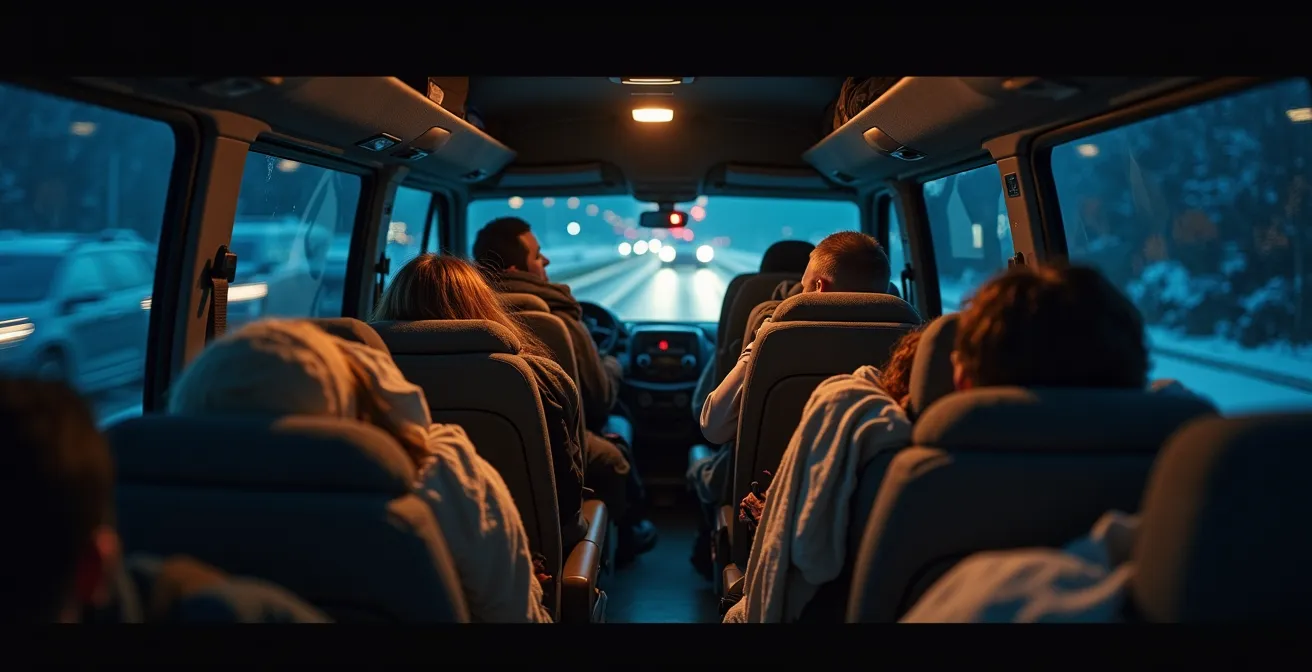
To make this happen, your minibus must become a mobile dormitory the moment you leave Wasdale. This requires discipline: no loud music, use of travel pillows and eye masks, and an agreement to prioritise rest. The ideal time for this nap is as soon as you are fed and settled after Scafell Pike. This small window of managed rest is your best weapon against the mental and physical fatigue waiting for you on the Pyg Track.
Why Cotton Is Your Worst Enemy When Running in 5°C Drizzle?
The old mountaineering adage “cotton kills” is not hyperbole; it is a statement of physics. In the context of the British mountains, where conditions can switch from mild to dangerously cold in minutes, wearing cotton clothing is one of the most significant risks you can take. The danger lies in how cotton fibres interact with moisture, whether from rain, drizzle, or your own sweat. Unlike modern synthetics or wool, cotton is hydrophilic, meaning it loves water. It can absorb up to 27 times its own weight in water.
When cotton gets wet, it loses all of its insulating properties. The fabric clings to your skin, and instead of trapping a layer of warm air, it actively pulls heat away from your body through evaporative and conductive cooling. This process can be 25 times faster than heat loss in dry conditions. In 5°C drizzle, a common scenario on Scafell Pike or Ben Nevis, a wet cotton t-shirt becomes a brutally efficient machine for inducing hypothermia. Your body is forced to burn precious calories not to power your muscles, but in a desperate, losing battle to maintain its core temperature. This is the fast track to exhaustion, poor decision-making, and a potential rescue situation.
The solution is a non-negotiable layering system based on synthetic or merino wool fabrics. These materials are hydrophobic; they absorb very little water and ‘wick’ moisture away from the skin to the outside of the fabric, where it can evaporate without chilling you. A technical base layer is the foundation of your entire clothing system and your first line of defence against performance decay and hypothermia.
Bring Your Own Tent or Rent in Puerto Natales: Which Makes Sense?
This title might seem geographically confused, but let’s use it as an analogy for a core decision every Three Peaks team must make. “Bringing your own tent” represents the self-organised challenge: you have total control, but also total responsibility for every piece of equipment and logistical detail. “Renting in Puerto Natales”—a distant hub for complex expeditions—represents using a professional mountain guiding company. You cede some control and pay more, but you are buying expertise, safety, and streamlined logistics. For a high-stakes, time-critical event like the 24-hour challenge, this choice is pivotal.
The self-organised approach appears cheaper, but it carries a heavy burden of hidden costs and risks. It requires meticulous planning of routes, timings, driver schedules, and emergency contingencies. The higher failure rate for self-organised groups is often due to simple logistical errors like mis-navigation or running out of time due to poor pace management. As this comparison of challenge approaches highlights, the professional option offers a significant increase in safety and success.
| Aspect | Self-Organised | Professional Guide |
|---|---|---|
| Cost | Cheapest option | Higher cost but inclusive |
| Safety | Self-responsibility | Mountain rescue statistics show fewer incidents |
| Logistics | Complex planning required | All transport and timing handled |
| Success Rate | Lower (navigation errors common) | Higher with experienced guides |
| Driver Requirements | Need dedicated non-walking driver | Professional drivers included |
The value of professional guidance becomes most apparent when things go wrong. A case in point involves mountain leaders from one provider, Maximum Adventure, who have on several occasions acted as impromptu rescuers for lost, self-organised groups they encountered on the hill. This demonstrates the immense value of having a qualified Mountain Leader whose entire job is to manage risk, pace the group correctly, and make sound decisions under pressure. For many charity teams, “renting the tent” is the smartest investment they can make, turning a chaotic logistical scramble into a focused physical challenge.
Key Takeaways
- Your driver’s welfare and legal compliance are your team’s primary safety concern; a fatigued driver is the biggest risk.
- Mastering logistics—fuelling, hydration, and strategic sleep in the minibus—is as critical as your physical training on the hills.
- Respect for local communities like Wasdale through responsible parking and scheduling is a non-negotiable part of a successful and sustainable challenge.
How to Maintain Outdoor Fitness Routines During the Wet British Winter?
The endurance required for the Three Peaks Challenge is not built in the final few weeks of spring. It is forged in the wind, rain, and mud of the preceding British winter. Training through the toughest months not only develops the necessary physical strength but, more importantly, it cultivates the mental resilience to perform when you are cold, wet, and miserable. This is a simulation of the conditions you will face on the challenge. Avoiding winter training is avoiding the reality of UK mountain weather.
Your winter programme should focus on three core areas: cardiovascular endurance, leg strength for rugged terrain, and gear acclimatisation. Endurance is built through consistent walking and hiking, progressively increasing distance and ascent. Aim to be comfortable maintaining a pace of at least 3km per hour on hilly terrain. Leg strength is crucial for handling the steep, uneven paths of the peaks; incorporate squats, lunges, and calf raises into your weekly routine to build robust, injury-resistant muscles. Finally, winter is the perfect time to test your equipment. You must use your training walks to identify any issues with your boots, waterproofs, or backpack. A minor pack rub after two hours in the rain can become a debilitating problem after twenty.
Action Plan: Winter Training for Three Peaks Success
- Initiate training 3-4 months prior to the challenge date, establishing a consistent routine.
- Build your hiking pace to a sustainable 3km per hour or a 20-minute kilometre, even on varied terrain.
- Integrate strength training, specifically squats and lunges, to build the leg power needed for steep ascents and descents.
- Deliberately train in adverse weather conditions to test your gear and build critical mental resilience.
- Practice every long hike with your full challenge kit, including your weighted backpack and hydration system, to normalise the load.
Training through a British winter is the ultimate litmus test. If you can stay motivated and consistent from November to February, you will have built a foundation of fitness and fortitude that no gym-based programme can replicate. You will arrive at the foot of Ben Nevis knowing you can handle whatever the mountains throw at you.
Now, take these principles and build your operational plan, not just a fitness schedule. Your success on the National Three Peaks Challenge depends on this logistical discipline. Start planning today.