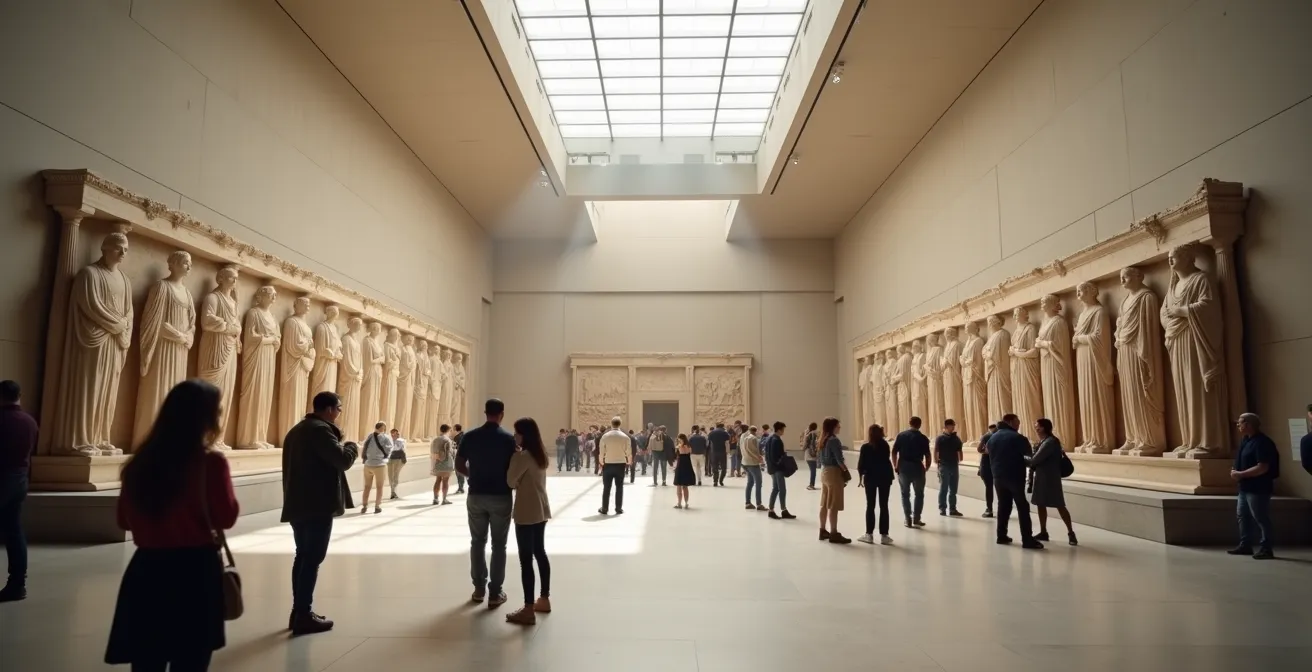
The decision to visit the British Museum is not about seeing objects, but about understanding the power structures that brought them there.
- Narratives are curated: Language on plaques and in audio guides often obscures violent colonial acquisition and erases the origins of artefacts.
- Funding is political: The museum’s ‘free’ entry is subsidised by controversial partners like BP, creating an ethical paradox between cultural access and environmental responsibility.
Recommendation: Use your visit as an act of critical inquiry. This guide provides the tools to question the stories told and to seek out the ones that are silenced, transforming you from a passive tourist into an informed observer.
To stand before the Parthenon Marbles or the Benin Bronzes inside the British Museum is to feel the weight of history. For the socially conscious visitor, this experience is often fraught with a quiet conflict: the awe of witnessing priceless human creativity clashing with the unsettling knowledge of contested ownership and colonial legacies. It’s a dilemma that simple answers fail to resolve. Many guides will tell you it is a “complex issue” or advise you to simply “enjoy the art while acknowledging the controversy,” platitudes that offer little real guidance.
But what if the goal wasn’t to resolve the conflict, but to engage with it? What if visiting the museum could be an active exercise in critical thinking rather than a passive act of consumption? This guide proposes a different approach. The true question is not *if* you should visit, but *how* you visit. The key is to develop an ethical gaze—a way of seeing that penetrates the polished surface of the exhibits to understand the power dynamics at play. It involves learning to deconstruct the museum’s own narrative, from the carefully chosen words on a display plaque to the very source of its funding.
This article will provide you with an intellectual toolkit. We will begin with the most famous case—the Parthenon Marbles—to understand the core arguments. From there, we will zoom in on the subtle language of curatorial bias, question the neutrality of audio guides, and examine the financial structures that keep the institution running. Finally, we will look beyond the museum’s walls to consider what true heritage preservation might look like in the 21st century, both for artefacts abroad and for living traditions here in England.
This journey will equip you to navigate the grand halls of the British Museum not as a consumer of culture, but as a critical and informed participant in one of the most important conversations of our time.
Summary: An Ethical Framework for Visiting the British Museum
- Why Greece Wants Them Back and Why the UK Refuses?
- How to Spot Colonial Bias in Museum Information Plaques?
- Do Audio Guides Tell the Whole Story of Looted Artifacts?
- Why Is the British Museum Free and Who Actually Pays for It?
- Which Independent Tours Tell the ‘Uncomfortable’ History of the Museum?
- Castles or Coastlines: Which Membership Suits Your Weekend Style?
- How Climate Change Is Threatening the Orkney Neolithic Sites?
- How to Support Endangered Crafts Like Clog Making Before They Vanish?
Why Greece Wants Them Back and Why the UK Refuses?
The debate over the Parthenon Marbles, also known as the Elgin Marbles, is the epicentre of the museum repatriation controversy. For Greece, these sculptures are not mere artefacts; they are a vital piece of national identity, violently severed from their architectural home, the Parthenon in Athens. The campaign for their return is a matter of cultural and historical justice, a desire to see a masterpiece restored to its original context. Public sentiment in the UK appears to be shifting in favour of this view. For instance, a poll revealed that 64% of the UK public believes the sculptures should be returned to Greece, suggesting a growing disconnect between the people and the institution.
Despite this, the British Museum’s position remains unyielding, anchored in a legal framework and a specific institutional worldview. The museum contends it has legal ownership, citing the controversial permission Lord Elgin obtained from the Ottoman Empire in the early 19th century. This position is reinforced by the British Museum Act of 1963, which severely restricts the institution’s ability to deaccession or dispose of objects from its collection. The museum’s leadership has made it clear that a permanent return is not on the table. In 2019, the director stated that the marbles would never be given back unless the Greek government first acknowledged the British Museum’s legal ownership—a condition Greece finds unacceptable. This deadlock illustrates the structural blindness of the institution, where legal precedent and a self-proclaimed role as a ‘world museum’ preserving objects for a global audience override the powerful ethical and cultural claims of a nation of origin.
How to Spot Colonial Bias in Museum Information Plaques?
The battle over meaning is often fought in the quietest corners of the museum: the small information plaques beside each artefact. These texts are not neutral descriptions; they are a primary tool of curatorial bias, shaping visitor perception through carefully chosen language. For the visitor equipped with an ethical gaze, learning to decode this language is the first step in narrative deconstruction. The museum’s narrative often employs euphemisms that obscure violent or coercive histories of acquisition.
To engage critically, pay close attention to the vocabulary used. Watch for words that create a passive and legitimising story:
- ‘Acquired’: This neutral-sounding term can conceal a vast range of actions, from legitimate purchase to forceful taking or transactions based on profoundly unequal power dynamics.
- ‘Discovered’: This word often implies an object or place had no meaning or owner before a European arrival, erasing its existing cultural significance and the local people who knew of it.
- ‘Excavated by’: This phrase frequently centres the European archaeologist while obscuring the crucial, and often forced, labour of local populations who did the actual digging.
- ‘Gifted by’: A ‘gift’ in a colonial context could often be the result of immense political pressure, coercion, or a desperate attempt by a local leader to curry favour with an occupying power.
This critical reading transforms a passive visit into an active investigation, questioning the very stories the museum tells about itself and its collection.
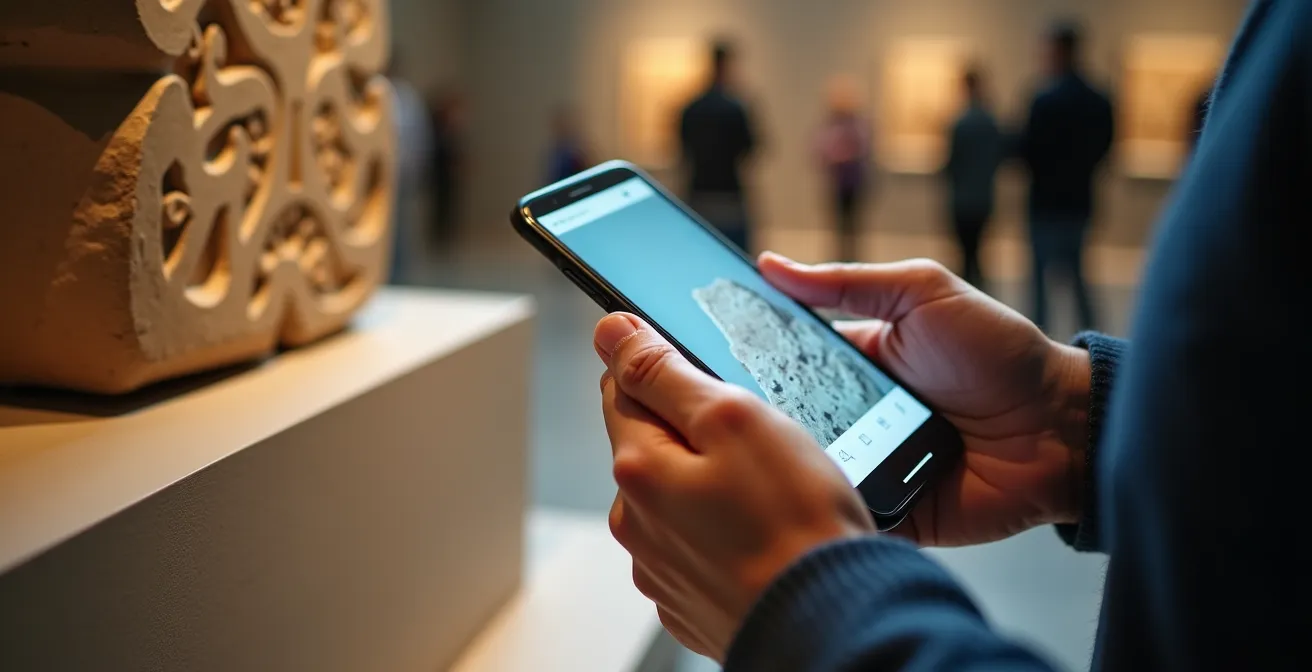
As this image suggests, modern tools can be used to seek out counter-narratives in real-time. While reading the museum’s official text, a quick search can reveal the other side of the story—the perspective of the culture from which the object was taken. This simple act of cross-referencing is a powerful form of resistance to a single, dominant narrative.
Do Audio Guides Tell the Whole Story of Looted Artifacts?
If information plaques offer a curated micro-narrative, then audio guides present the museum’s grand, authorised story. Often voiced by beloved British actors, their authoritative, calming tones create a sense of trust and discourage critical listening. However, these guides are not purely educational tools; they are also commercial products designed for a smooth, uncontroversial visitor experience. This financial imperative often leads to the sanitisation of difficult histories. Contentious details about an object’s violent removal or its status as a looted cultural treasure are frequently downplayed or omitted entirely to avoid causing discomfort.
The business model prioritises a pleasant, easily digestible narrative over a complete and challenging historical account. The result is a story that reinforces the museum’s legitimacy while glossing over the very controversies that bring many socially conscious visitors through its doors. This approach, while commercially sensible, perpetuates a one-sided history. But visitors are not powerless. As one museum professional notes, independent counter-narratives are readily available for those willing to seek them out.
The British Museum claims to have distanced itself from Britain’s history of imperialism by rebranding as a ‘global museum’, yet continues to perpetrate imperialist practices through its stance on repatriation. Independent tour operators and academic podcasts offer crucial counter-narratives that visitors can access inside the museum.
– Museum Professional’s Perspective, Epochs
The simple act of taking off the official headphones and putting on your own—to listen to a podcast like ‘Stuff the British Stole’ or a university lecture—is a powerful way to reclaim your intellectual autonomy within the museum space. It allows you to juxtapose the official, sanitised story with the often more complicated and challenging truth.
Why Is the British Museum Free and Who Actually Pays for It?
The British Museum’s policy of free admission is a cornerstone of its identity as a public institution dedicated to universal access. However, this ‘freeness’ is an illusion; maintaining such a vast collection and building is incredibly expensive, and the funding comes from a combination of government grants, private donations, and controversial corporate sponsorships. This financial structure creates its own set of ethical dilemmas, most notably the museum’s long-standing and recently renewed partnership with the fossil fuel giant BP.
In late 2023, it was announced that BP’s new sponsorship deal represents £50 million over 10 years to fund the museum’s masterplan. For climate activists and even many within the arts sector, this partnership is a stark example of ‘artwashing,’ where a company with a devastating environmental impact uses association with a prestigious cultural institution to burnish its public image. The museum, in effect, trades its cultural legitimacy for financial security, making visitors unwitting participants in this exchange.
The dissonance is not lost on other major figures in the UK museum world, highlighting a deep division on the issue. Maria Balshaw, the director of the Tate (which ended its own BP sponsorship), has publicly questioned the decision.
the public has moved to a position where they think [the BP deal] inappropriate. There’s a dissonance between wishing to be seen as extremely sensitive in the way we relate to other cultures and careful about the resources we consume, and then taking money from a company that has not yet demonstrated whether it’s really committed to changing
– Maria Balshaw, Tate Director and Chair of National Museum Directors’ Council
This “dissonance” is at the heart of the visitor’s conflict. The free ticket in your hand is, in part, paid for by a corporation whose business model contributes to the very climate change that threatens global heritage sites—a profound ethical paradox that hangs in the air of every gallery.
Which Independent Tours Tell the ‘Uncomfortable’ History of the Museum?
For visitors who wish to actively engage with the museum’s contested histories, the most direct method is to seek out the ‘uncomfortable’ narratives that the institution itself often sidelines. Several independent academics, activists, and guides offer alternative tours—either in person or through digital guides—that focus specifically on the legacies of empire and colonialism within the collection. These tours provide the context and counternarratives that are often missing from the official displays.
You can create your own ‘uncomfortable tour’ by focusing on a few key objects and researching their acquisition histories beforehand. This DIY approach allows you to move through the museum with a critical framework, contrasting the official narrative on the plaque with the documented reality of its colonial past. A starting itinerary could include:
- The Parthenon Marbles (Room 18): Contrast the museum’s narrative of ‘legal acquisition’ by Lord Elgin with Greece’s 200-year campaign for the reunification of a national monument.
- The Benin Bronzes (Room 25): Research the 1897 British ‘punitive expedition’—a brutal military raid on Benin City that resulted in the looting of thousands of artefacts—and compare it to the gallery’s more subdued display text.
- Hoa Hakananai’a (Room 24): Investigate how the Rapa Nui people of Easter Island view this statue not as an object, but as a stolen ancestor, and their ongoing pleas for its return.
- The Rosetta Stone (Room 4): Consider its journey as a spoil of war, taken by British forces from the French, who had themselves taken it from Egypt. This complicates the simple story of a key to deciphering hieroglyphs.
Case Study: The Activism of ‘BP or not BP?’
The activist theatre group ‘BP or not BP?’ provides a powerful example of direct intervention. For years, they have conducted guerrilla-style ‘Striking Back at the Empire’ tours inside the museum. These performances and tours explicitly link the museum’s colonial past—the looting of artefacts from other cultures—with its present-day sponsorship deals, arguing that taking money from a corporate giant like BP is a modern form of extraction. Their work highlights how the museum, despite its claims of reform, remains entangled in systems of power and exploitation.
By seeking out these alternative perspectives, a visitor can re-politicise a space that strives for a sense of timeless neutrality, revealing the urgent contemporary debates embedded in its ancient stones.
Castles or Coastlines: Which Membership Suits Your Weekend Style?
The ethical questions raised by the British Museum are not confined to its London walls; they ripple out across the entire English heritage landscape. Institutions like the National Trust and English Heritage, which manage hundreds of historic properties from castles to coastlines, face their own reckoning with the past. For a visitor choosing where to spend their weekend and their money, applying the same ethical gaze developed in the museum becomes a crucial practice.
The National Trust’s landmark 2020 report on its properties’ links to colonialism and the slave trade was a pivotal moment. The report detailed how wealth generated through slavery and colonial exploitation funded the construction or maintenance of dozens of stately homes now enjoyed as idyllic tourist destinations. This revelation sparked a fierce debate, forcing the organisation and its visitors to confront the uncomfortable truth that the beauty of the English countryside is, in part, built on a foundation of imperial violence and exploitation. It demonstrates that the ‘country house’ is as much a colonial artefact as a Benin Bronze.

When choosing between a membership to visit historic castles or one to access natural coastlines, the ethically conscious visitor might now ask different questions. Is the organisation transparent about the colonial sources of its properties’ wealth? Does it use its platform to educate the public on these difficult histories? Does it invest in reparative work or community projects? The choice of where to go for a weekend walk is no longer just a matter of scenery; it has become a statement about which version of history we choose to support and engage with.
How Climate Change Is Threatening the Orkney Neolithic Sites?
One of the British Museum’s primary justifications for retaining contested artefacts is the argument of superior preservation. The museum presents itself as a safe haven, a climate-controlled sanctuary that protects global heritage from the instability and risks of the outside world. However, this argument collapses under the weight of a profound hypocrisy when viewed through the lens of its own funding and the state of heritage within the UK.
The very same corporate partner, BP, whose sponsorship funds the museum’s redevelopment, is a primary driver of the climate change that is actively destroying priceless heritage sites on British soil. As one analysis in The Art Newspaper bluntly puts it, the £50m sponsorship is essentially a payment for reputation enhancement from a company that has recently downgraded its commitment to renewable energy. This creates a “preservation paradox” where the museum claims to be a guardian of world culture while profiting from the industry most responsible for its destruction.
This paradox is not abstract; it has real-world consequences. The following table highlights the stark contrast between the museum’s claims and the reality faced by UK heritage sites, many of which are at severe risk. This data is confirmed by multiple heritage bodies and environmental reports, such as a recent comparative analysis on preservation risks.
| Threat Type | UK Heritage Sites at Risk | Museum’s Preservation Argument |
|---|---|---|
| Coastal Erosion | Neolithic sites in Orkney, a UNESCO World Heritage site, face immediate threat from rising sea levels. | Claims superior preservation conditions for foreign artifacts in its London facility. |
| Climate Change | Multiple UK World Heritage sites are flagged as highly vulnerable to flooding, erosion, and extreme weather. | Argues its climate-controlled storage justifies retaining objects from other, often more stable, climates. |
| Funding Shortfalls | Domestic sites often lack the resources for essential climate adaptation and protection measures. | Accepts £50m from a major fossil fuel company while local heritage deteriorates due to climate impacts. |
This reality fundamentally undermines the museum’s moral authority to act as a global protector. It suggests that the preservation argument may be less a matter of principle and more a convenient justification for retaining a world-class collection, regardless of the ethical or environmental cost.
Key takeaways
- Critically analyse language: Question seemingly neutral words like ‘acquired’ or ‘discovered’ on museum plaques, as they often mask violent or coercive colonial histories.
- Follow the money: Recognise that ‘free’ admission is subsidised by controversial corporate partnerships, implicating the museum and its visitors in complex ethical issues like ‘artwashing’.
- Challenge the preservation argument: Contrast the museum’s claim of being a safe haven with the reality of at-risk heritage sites within the UK, threatened by climate change linked to its sponsors.
How to Support Endangered Crafts Like Clog Making Before They Vanish?
An ethical engagement with heritage should not end at the museum exit. The intense focus on preserving ancient objects from distant lands often creates a blind spot for the fragile, living heritage that is disappearing within the UK itself. While the British Museum invests millions in displaying artefacts from past civilisations, traditional English crafts like clog making, scissor smithing, and bell founding are critically endangered, at risk of vanishing within a generation due to a lack of funding and public awareness.
Supporting these living traditions offers a powerful, constructive response to the ethical dilemmas posed by the museum. It shifts the focus from passively viewing the past to actively investing in the cultural fabric of the present. This reorientation is gaining momentum, as evidenced by the fact that since 2016, a total of 14 major UK cultural institutions have ended their fossil fuel sponsorships, signaling a growing desire for a more ethical approach to culture. For the individual, this can translate into direct, meaningful action.
Your Action Plan: Supporting Living Heritage in England
- Identify Endangered Crafts: Visit the Heritage Crafts Association website and consult their ‘Red List’ to discover which traditional skills are most at risk in your region of England.
- Learn from the Source: Book a workshop with a traditional artisan. Many practitioners across the country offer courses, providing a direct way to support their work and understand the skill involved.
- Purchase with Purpose: When buying souvenirs or gifts, purchase directly from makers at craft fairs or from their own websites, rather than from mass-produced items in large museum gift shops.
- Advocate for Recognition: Support campaigns that call for better government funding and official recognition for intangible cultural heritage, putting it on par with the protection afforded to historic buildings and objects.
- Question Institutional Priorities: Ask museums and heritage organisations what they are doing to support living, local traditions, not just the preservation of objects from abroad.
This proactive approach transforms the visitor from a critic into a patron. It channels the energy of the repatriation debate into a positive force, helping to ensure that future generations will have a rich tapestry of living culture to experience, not just relics of the past to view behind glass.
Transform your next museum visit from a passive tour into an active investigation. The choice is not simply to go or not to go; it is to decide *how* you will look and what questions you will ask. By doing so, you participate in shaping a more conscious and equitable future for our shared global heritage.