
Contrary to the old adage, being ‘overdressed’ can cost you a job in modern Britain; success lies in speaking the specific ‘tribal code’ of the industry through your attire.
- A full suit signals a cultural mismatch at a tech startup, while it’s non-negotiable for a City law firm.
- Authority is now projected through ‘fit, fabric, and function’ rather than pure formality.
Recommendation: Stop trying to impress with formality and start signalling your cultural understanding by investing in a versatile, high-quality capsule wardrobe tailored to the specific sector you’re targeting.
The invitation to a promising interview in London or Manchester arrives, and after the initial elation, a familiar sense of dread sets in: “What on earth do I wear?” For professionals navigating the modern British job market, this question has become a minefield of ambiguity. The lines between ‘formal’, ‘business casual’, and ‘smart casual’ have blurred into an indecipherable mess, leaving many candidates confused and anxious. Traditional advice often defaults to the seemingly safe platitude of “it’s better to be overdressed than underdressed.”
But in a country where the professional landscape is sharply divided between the pinstriped traditions of the City and the disruptive energy of the tech scene, this advice is not just outdated—it’s dangerous. Wearing a full suit to a Shoreditch startup can signal you’re out of touch, just as arriving in chinos at a magic circle law firm can suggest a lack of seriousness. The generic rules no longer apply because the game has changed. The key isn’t about following a universal dress code, but about demonstrating your social and cultural intelligence.
The true secret to dressing for a UK interview is to think like a stylist and an anthropologist. It’s an exercise in strategic communication. Your outfit is your opening statement, a non-verbal signal that you understand the ‘tribe’ you wish to join. This guide moves beyond the generic to give you an actionable framework based on a new trinity: fit, fabric, and function. We will decode the specific sartorial language of different UK professional sectors, showing you not just what to wear, but why it works, ensuring you project confidence and cultural fluency before you’ve even said a word.
This article provides a detailed breakdown of how to navigate these complex sartorial waters. Below, you will find a guide to everything from the foundational wardrobe pieces to the subtle details that make all the difference in a British professional context.
Summary: Mastering the Nuances of the British Professional Dress Code
- Why a Tie Can Cost You the Job at a Shoreditch Startup?
- How to Build a Work Wardrobe with Only 10 High-Quality Pieces?
- Full Suit or Chinos and Blazer: Which Projects Authority in 2025?
- The Footwear Error That Ruins a Polished Outfit in Rainy Weather
- How to Add Personality to a Grey Suit Without Looking Unprofessional?
- The ‘Always On’ Error That Leads to Burnout for 60% of Hybrid Workers
- How to Build a Professional Network When Studying 100% Remotely?
- Why a £200 Trench Coat Is a Better Investment for British Weather Than Fast Fashion?
Why a Tie Can Cost You the Job at a Shoreditch Startup?
In the world of British tech, which saw startups raise an impressive £21.3 billion in 2023, conformity is the enemy and ‘cultural fit’ is king. The traditional symbol of corporate professionalism, the suit and tie, is often perceived not as a sign of respect, but as a rigid, hierarchical relic. It signals that a candidate doesn’t understand the informal, collaborative, and fast-paced nature of the startup ecosystem. Your attire should communicate agility and creativity, not boardroom bureaucracy. Wearing a formal suit can create an immediate barrier, making you seem unapproachable and out of sync with the team’s dynamic ethos.
This is not a theoretical risk; it has real-world consequences. A hiring manager in the UK media industry candidly shared an experience that perfectly illustrates this point. As they explained on a PistonHeads UK forum discussion, their team made a clear-cut decision based on attire:
She has rejected a candidate specifically because he turned up to an interview wearing a full suit and tie, sweating and nervous as hell, and the decision was that he ‘just wouldn’t fit in’
– UK Hiring Manager in Media, PistonHeads UK Forum Discussion
This example powerfully demonstrates that in creative and tech sectors, dressing up can actively work against you. The goal is to project “smart creativity,” not “corporate formality.” Think a well-fitting, unstructured blazer, premium knitwear, dark denim or chinos, and clean, minimalist trainers. It’s a look that says you’re serious about your work but not bound by outdated traditions. It’s crucial to research the specific ‘tribal code’ of the company before your interview.
Action Plan: Decode a Company’s Dress Code via LinkedIn
- Search for the company on LinkedIn and browse the profiles of employees at your target seniority level. Note their headshot attire.
- Look for recent photos from company events or team pictures on their social media pages to observe the general style.
- Check employee reviews on Glassdoor, specifically searching for mentions of “workplace culture” or “dress code.”
- If you are still uncertain, contact the HR department or your recruitment contact directly. They appreciate candidates who are thorough.
- Compare profiles between employees at a London FinTech company versus a Bristol creative agency to spot the distinct regional and sectoral differences.
This cultural intelligence is your first test, demonstrating you’ve done your homework and understand the environment you aim to enter.
How to Build a Work Wardrobe with Only 10 High-Quality Pieces?
Navigating Britain’s diverse professional landscape and unpredictable weather doesn’t require an overflowing wardrobe. It requires a strategic one. The concept of a “capsule wardrobe” is not about minimalism for its own sake, but about maximising versatility and projecting consistent quality. By investing in just ten high-quality, interchangeable pieces, you can create a range of appropriate outfits for almost any interview or work scenario, from a creative agency in Bristol to a finance house in Canary Wharf. The key is to focus on superior fabrics, classic cuts, and a neutral colour palette that allows for easy layering and adaptation.
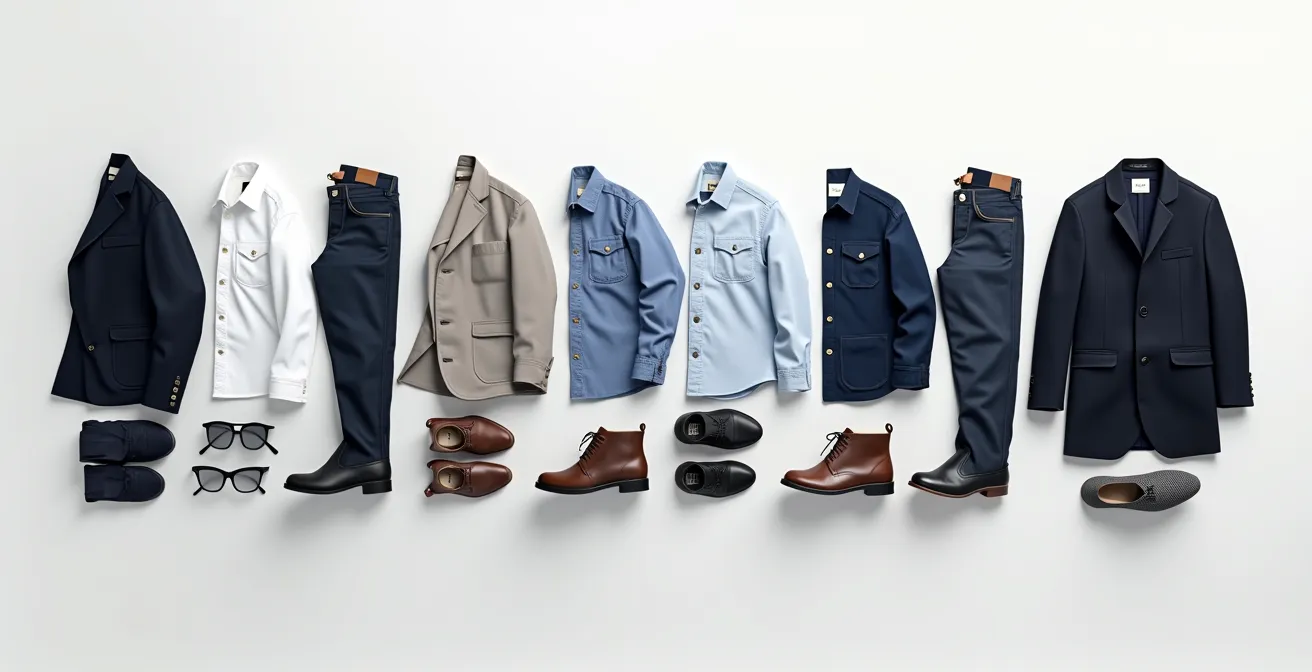
As the flat lay above illustrates, the core components are timeless and versatile. A navy unstructured blazer, high-quality white and blue shirts, a merino wool sweater, dark chinos, smart dark-wash jeans, and classic leather shoes form the foundation. These are pieces that speak a language of understated quality and can be dressed up or down. The initial investment in quality is higher, but the long-term value, both financially and in terms of personal brand, is undeniable.
The British Three-Season Wardrobe Principle
UK style experts champion a wardrobe built around layering essentials that can handle the notoriously fickle weather from September through June. The core strategy, as highlighted by professional career guides, revolves around a few key items: fine-gauge merino wool knitwear for its excellent temperature regulation, an unstructured wool or cotton blazer that works formally or casually, a quality mac or trench coat for rain protection, versatile chinos (with brands like Spoke London often cited for fit), and well-made shirts from specialists like Charles Tyrwhitt. This approach provides maximum sartorial flexibility with minimal pieces, ensuring a polished appearance across London’s varied microclimates and social settings.
Investing in quality over fast fashion is also a sound financial decision. A higher initial outlay on well-made items results in a significantly lower “cost-per-wear” over time, as they last longer and maintain their appearance. This table breaks down the economic sense of buying better, but fewer, pieces.
| Item | Quality Option | Fast Fashion | 3-Year Cost Per Wear |
|---|---|---|---|
| Shoes | £150 Goodyear-welted | 3x £50 pairs | £0.20 vs £0.60 |
| Blazer | £200 Unstructured wool | 2x £60 polyester | £0.50 vs £0.80 |
| Shirts | 3x £60 Charles Tyrwhitt | 6x £20 high street | £0.35 vs £0.55 |
This strategic investment ensures you are always prepared, projecting an image of quiet confidence and discerning taste that is highly valued in the UK professional sphere.
Full Suit or Chinos and Blazer: Which Projects Authority in 2025?
The definition of sartorial authority in the British workplace has undergone a seismic shift. For decades, the full suit was the undisputed uniform of power and professionalism. Today, its authority is contextual. While it remains essential in traditional sectors like law and high finance, in the ever-expanding tech and creative industries, a different set of signals projects competence. In these environments, which account for a significant portion of the UK economy, with 36% of UK tech investments concentrated in London alone, authority is conveyed through a mastery of smart-casual codes.
This new authority is less about rigid conformity and more about intelligent choices. It’s projected by the quality of a fabric, the precision of a fit, and the appropriateness of an outfit for the environment. An unstructured, perfectly-fitting blazer paired with smart chinos and quality leather shoes can communicate more confidence and contemporary relevance than a generic, ill-fitting suit. It shows you are current, adaptable, and understand the modern professional landscape. As UK career expert Joe McDermott notes, the paradigm has fundamentally changed.
In the current UK business climate, authority is projected by ‘fit and fabric’ over ‘formality’
– Joe McDermott, InterviewGold UK Dress Code Guide 2025
The choice between a suit and a blazer/chino combination is therefore a strategic one. For an interview at a magic circle law firm, the suit is a non-negotiable sign of respect for the institution’s culture and traditions. It shows you understand and are ready to conform to their established norms. However, for a role at a FinTech firm in Canary Wharf or a media agency in Soho, the blazer combination signals that you are a modern professional: serious and capable, but also agile and culturally aware. The true sign of authority in 2025 is not wearing the “right” uniform, but demonstrating you know which uniform is right for which tribe.
Ultimately, projecting authority is about showing you belong, and your clothing is the first and most visible way to make that statement.
The Footwear Error That Ruins a Polished Outfit in Rainy Weather
In the UK, no outfit is truly complete without considering the weather. A perfectly tailored suit or a sharp smart-casual ensemble can be instantly undermined by the wrong choice of footwear on a damp day. The most common and damaging error is wearing elegant, but impractical, leather-soled dress shoes on wet city pavements. Not only do they offer treacherous grip, but water damage can quickly ruin expensive shoes, leaving them stained and misshapen. Suede shoes, while stylish, are an even greater liability in an unexpected downpour. This mistake broadcasts a lack of foresight and practicality—qualities no professional wants to be associated with.
The solution is not to sacrifice style for function, but to integrate them. This is the essence of modern British pragmatism. The ‘London Commuter Strategy’ involves a multi-pronged approach to keeping your footwear sharp, regardless of the forecast. This includes having a dedicated pair of formal office shoes at your desk and commuting in more robust, weather-appropriate options. For all-day wear, the key is investing in shoes that are designed for the British climate from the ground up.
The Dainite Sole: A British Solution to a British Problem
Recognising the impracticality of traditional soles, legendary Northamptonshire-based shoemakers like Loake, Cheaney, and Grenson have long championed the British-invented Dainite rubber sole. This studded rubber sole provides the grip and durability needed for wet pavements while maintaining a sleek, formal profile that doesn’t compromise the shoe’s aesthetic. It is the perfect marriage of elegance and practicality. These heritage brands report that a majority of their professional footwear sales, often over 60%, now feature these weather-resistant soles. This reflects a clear shift among discerning British professionals who prioritise practicality without sacrificing a polished appearance.
Adopting a weather-proof footwear strategy is a hallmark of a seasoned British professional. It demonstrates an attention to detail and a practical mindset. Key tactics include:
- Choosing shoes with Dainite or similar slim-profile rubber soles for all-weather wear.
- Wearing stylish, waterproof options like leather Chelsea boots or sleek, dark trainers for the commute, and changing at the office.
- Opting for a ‘no-break’ or slightly cropped trouser length to keep hems clear of puddles and dirt.
- Investing in quality wooden shoe trees to help shoes dry correctly and maintain their shape, along with regular waterproofing treatments.
It’s a subtle detail, but one that speaks volumes about your preparedness and sophistication.
How to Add Personality to a Grey Suit Without Looking Unprofessional?
The corporate world, particularly in sectors like finance and law, often demands a uniform of conservative colours—navy, charcoal, grey. While this ensures a baseline of professionalism, it can also feel anonymous and stifling. The challenge for the British professional is to express individuality within these constraints without appearing unprofessional or flashy. The secret lies not in loud colours or bold patterns, but in the quintessentially British art of strategic understatement. Personality is communicated through the subtle interplay of texture, quality accessories, and pieces with a personal story.
Rather than a bright, block-colour tie, consider one made from a knitted silk or a wool-cashmere blend. The texture adds visual interest and a tactile sense of quality that is sophisticated and modern. This principle of “understated texture over loud colour,” as advocated by bespoke tailors like King & Allen, is fundamental to refined British style. A classic grey suit can be transformed by pairing it with a shirt that has a subtle herringbone weave or a blazer crafted from a Donegal tweed with its characteristic flecks of colour. These are details that are appreciated up close and signal a discerning eye.
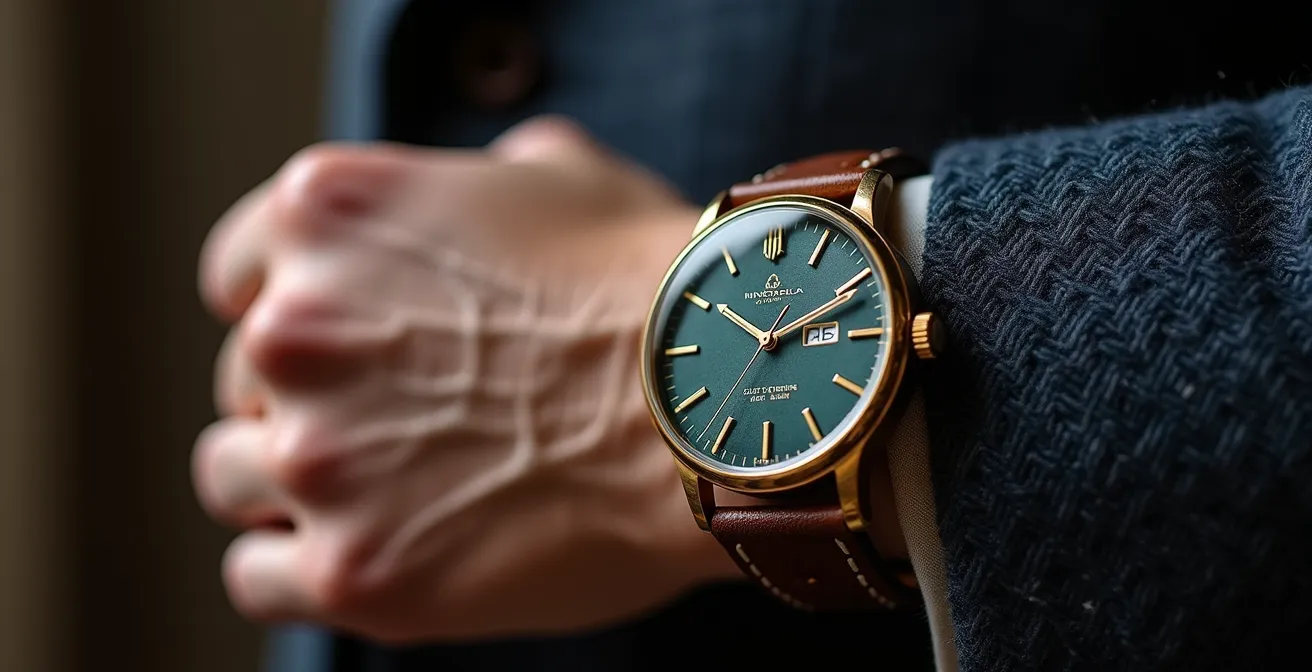
Accessories are the other key vehicle for personal expression. They should be chosen for their quality and meaning, not their brand recognition. A vintage watch passed down from a family member, a pair of university cufflinks, or a beautifully crafted leather portfolio all tell a story and add a layer of personality to your ensemble. Even socks offer a sanctioned space for expression; a flash of colour from a pair of Paul Smith stripes is a widely accepted nod to British creative flair. The goal is to curate a look with a few well-chosen ‘story pieces’.
Here are some strategic ways to inject personality into formal attire:
- Opt for a pocket square with a subtle, interesting pattern, perhaps from a heritage brand like Liberty London, to add a touch of cultural sophistication.
- Choose knitted silk ties or those with a subtle woven pattern over shiny, solid-coloured satin.
- Incorporate fabrics with inherent texture, such as a Prince of Wales check or a subtle birdseye weave in your suit or blazer.
- Select a ‘story piece’, like a quality watch or a pair of meaningful cufflinks, that acts as a quiet conversation starter.
- Use high-quality socks from brands like Paul Smith or Pantherella for an acceptable and classic expression of colour.
By focusing on these subtle details, you can create a look that is both individual and impeccably professional, demonstrating a sophisticated understanding of modern British style.
The ‘Always On’ Error That Leads to Burnout for 60% of Hybrid Workers
The rise of hybrid and remote work in the UK has created a new professional challenge: the ‘always on’ culture. Without the physical separation of the office, the boundaries between work and home life have become dangerously porous, leading to a well-documented increase in employee burnout. While digital detoxes and time management techniques are often prescribed, one of the most powerful and overlooked tools for creating this separation is your wardrobe. The psychological principle of ‘enclothed cognition’ suggests that the clothes we wear have a direct influence on our mental state and cognitive processes.
Dressing for the workday, even when at home, is not about vanity; it’s a mental trigger. Changing from ‘home clothes’ (loungewear) into ‘work clothes’ (a smart shirt, chinos, or a comfortable blazer) signals to your brain that it’s time to focus and be productive. Conversely, the ritual of changing out of your work attire at the end of the day is a powerful psychological cue to switch off, disconnect from professional responsibilities, and be present at home. This simple act creates a mental firewall that helps prevent the work-related stress and anxiety that contribute to burnout.
The ‘Shutdown Ritual’ for UK Hybrid Workers
A study published in ScienceDirect validated the theory of ‘enclothed cognition’, showing that clothing significantly influences the wearer’s psychological processes. In the UK, professionals are adopting this insight to combat hybrid work fatigue. They report that the physical act of changing from ‘work smart casual’ into ‘home casual’ creates a crucial mental barrier against the ‘always on’ culture. The Chartered Institute of Personnel and Development (CIPD) recommends this practice, often combined with a ‘fake commute’—a short walk outside before starting and after finishing the workday—as a proven tactic for improving work-life balance and mental well-being in the UK’s hybrid model.
This isn’t just about mental well-being; it’s also tied to performance. Forcing yourself to wear pyjamas all day might feel comfortable, but it can lead to a slump in productivity. Indeed, some studies suggest that UK employees feel up to 61% more productive when they adhere to some form of professional dress code, even an informal one. By consciously using your wardrobe to delineate your day, you are not only protecting your mental health but also setting yourself up for peak professional performance.
In the new world of work, your wardrobe is a vital instrument for managing your energy, focus, and long-term career sustainability.
How to Build a Professional Network When Studying 100% Remotely?
For students and early-career professionals in the UK’s increasingly remote-first world, the challenge of building a professional network can seem daunting. Without the spontaneous interactions of a university campus or a physical office, networking must become a more deliberate and strategic activity. Your primary tool in this landscape is your digital presence, with LinkedIn being the most critical platform. Here, your profile is your personal brand, and your profile photo is its most visible element. It’s the first ‘handshake’, and it must be aligned with the cultural codes of your target industry.
This means applying the same sartorial intelligence to your headshot as you would to an in-person interview. A potential contact in the legal sector will have a different first impression of a photo in a t-shirt versus one in a sharp shirt or blazer. Your photo should reflect the ‘tribal code’ you aspire to join. Furthermore, your entire profile should be calibrated to a British professional sensibility. This involves writing headlines and summaries that are understated and fact-based, avoiding the American-style hyperbole that can be perceived as insincere in the UK market. The goal is to project quiet confidence and competence.
While digital networking is crucial, the UK’s professional world, particularly in key hubs, still revolves around in-person events. With data from NatWest Business showing 286,000 new company incorporations in London alone in the first part of 2024, the city remains the epicentre of opportunity. Even for remote students, targeting key industry events like London Tech Week or legal-sector conferences is a powerful strategy. It’s in these environments that dressing appropriately becomes paramount, as your ability to navigate the smart-casual dress code signals that you are a serious, clued-in professional.
An effective remote networking strategy combines digital polish with targeted in-person attendance:
- Use a professional LinkedIn profile photo that reflects the appropriate dress code for your target industry (e.g., open-collar shirt for tech, shirt and blazer for consulting).
- Leverage LinkedIn’s alumni tool to find and connect with graduates from British universities working in your fields of interest.
- Craft outreach messages that are polite and focused on asking for advice or insight, rather than directly asking for a job.
- Identify and plan to attend 1-2 key in-person UK industry events per year to make high-value connections.
This hybrid approach demonstrates both digital savvy and the commitment to engage with your industry’s community, a combination that is highly valued by UK employers.
Key Takeaways
- Dressing for a UK interview is an act of ‘cultural signalling’; your goal is to show you understand the specific ‘tribe’ you’re joining.
- Invest in a versatile capsule wardrobe of 10 high-quality pieces, prioritising ‘fit, fabric, and function’ over fast fashion.
- Master strategic understatement by adding personality through texture and meaningful accessories, not loud colours.
Why a £200 Trench Coat Is a Better Investment for British Weather Than Fast Fashion?
In the context of a British professional wardrobe, few items encapsulate the principle of ‘fit, fabric, and function’ better than a quality trench coat or mac. It is the ultimate investment piece, serving as a shield against the island’s famously unpredictable weather while projecting an aura of timeless style. While a £50 coat from a fast-fashion retailer might seem like a bargain, it’s a false economy. Poorly treated fabrics, weak seams, and a lack of waterproofing mean it will likely lose its shape and function after a single season of drizzle, forcing a replacement and ultimately costing more over time.
A well-made trench coat, typically in the £200-£300 range from brands like Reiss, Jigsaw, or a classic like Burberry, is an investment in durability and enduring style. Crafted from water-resistant cotton gabardine with reinforced seams, it is designed to withstand years of use. This piece is more than just an overcoat; it’s a piece of British heritage. As fashion experts note, the trench coat’s history is deeply embedded in the national identity.
The trench coat is a piece of British military and cultural heritage, invented by Burberry and Aquascutum
– Fashion Heritage Expert, British Fashion History
The true value of a quality trench lies in its incredible versatility across the British social and professional calendar. The same coat can be worn over a suit for a formal meeting in Canary Wharf, casually paired with a jumper and chinos for a weekend in the Cotswolds, or styled with smart jeans for after-work drinks in Soho. It is one of the few garments that is equally at home in the city and the countryside, in formal and informal settings. This adaptability makes it a cornerstone of a strategic British wardrobe.
The mathematics of this investment are compelling. A quality trench will not only perform better but will also have a lower cost-per-wear over its lifespan, making it both the smarter and more stylish choice.
| Aspect | £200 Quality Trench | £50 Fast Fashion Coat |
|---|---|---|
| Expected Lifespan | 5+ years | 1 season |
| Wears per Year | 100 days | 100 days |
| Total Cost (5 years) | £200 | £250 (5 coats) |
| Cost per Wear | £0.40 | £0.50 |
| Weather Protection | Excellent | Poor after 3 months |
Start building your strategic wardrobe today by investing in pieces that communicate confidence, cultural fit, and practical intelligence for your next UK interview and beyond.