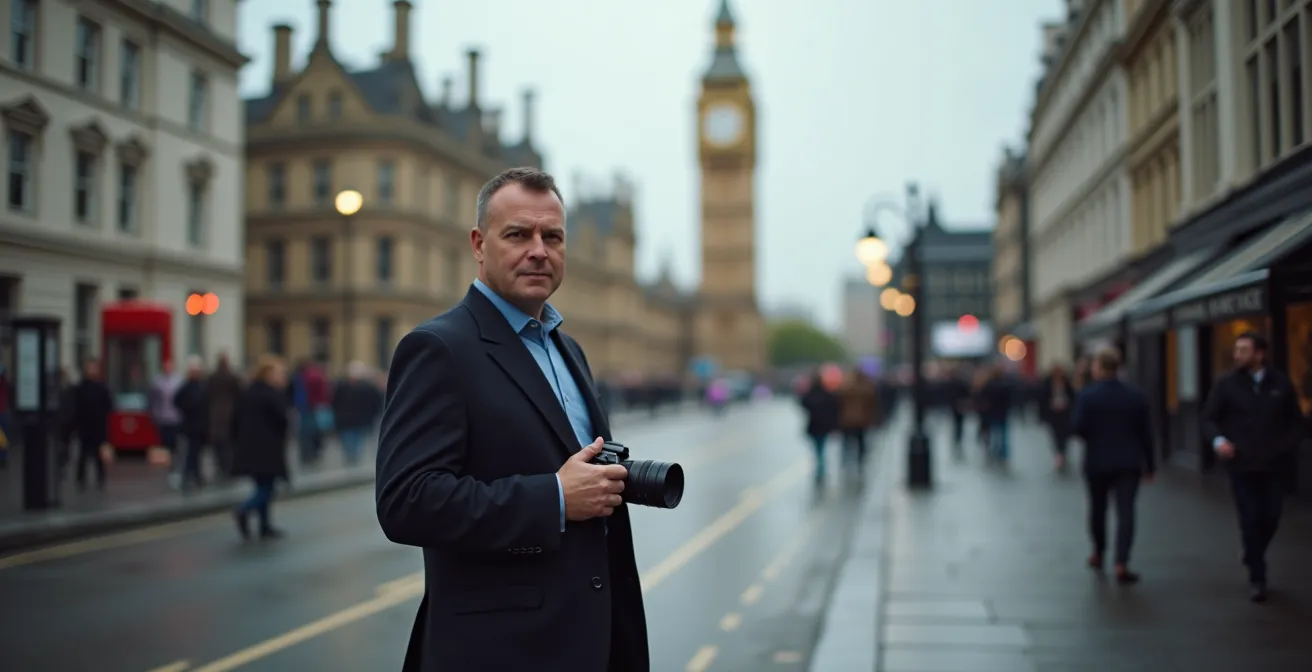
Confrontations with security or the public stem from a misunderstanding of one key legal concept: the ‘reasonable expectation of privacy’.
- In public spaces, your right to take photos for artistic or editorial use is protected, and you generally do not need permission.
- Private security’s only power is to ask you to leave their property; they cannot legally seize your camera or delete your images.
Recommendation: Instead of arguing, confidently understand and state the legal boundaries of privacy, property, and public order to de-escalate any situation.
You see the perfect shot. The light, the composition, a fleeting human moment. You raise your camera, and just as you capture it, a voice cuts through: “Excuse me, you can’t take pictures here.” It might be a security guard, a member of the public, or even a police officer. For many hobbyist photographers in the UK, this moment is filled with uncertainty, anxiety, and a chilling effect on their art. You’re told you’re breaking privacy laws, that GDPR forbids it, or that you need a permit. Most of this is, at best, a misunderstanding and, at worst, an intimidation tactic.
The common advice is often a simplistic list of “do’s and don’ts”. But these rules crumble when you’re under pressure and can’t explain *why* you have the right to be there. This is not about being aggressive; it’s about being informed. The true key to confident street photography isn’t just knowing the rules, but understanding the legal principles behind them. It’s about grasping the precise line the law draws between a public space and a private act, between artistic expression and commercial exploitation, and between a photographer and a genuine security threat.
This guide moves beyond simple lists. We will explore the legal boundaries that define your rights. We will examine the case law that underpins your freedom to shoot, dissect the limited powers of private security, clarify when equipment like a tripod actually becomes a legal issue, and provide you with the language to use when confronted. By understanding the ‘why’ behind the law, you can navigate these encounters not with conflict, but with calm, unshakeable authority.
This article provides a structured overview of your rights in the most common situations you’ll face. Each section addresses a specific challenge, from model releases to police encounters, to give you a comprehensive legal toolkit.
Contents: What Are Your Legal Rights as a Street Photographer in England and Wales?
- Do You Need a Release Form for Strangers in a Street Shot?
- Can Canary Wharf Security Make You Delete Your Photos?
- Obstruction or Art: When Does a Tripod Require a Council Permit?
- Editorial or Commercial: When Can You Sell a Photo of a Passerby?
- Section 43 Stop and Search: What to Do if Police Stop You for Photography?
- How to Write a Compliant Privacy Policy for Your Portfolio Site in 1 Hour?
- Park and Ride or City Centre: Which Saves More Stress in York?
- GDPR for Sole Traders: How to Avoid Fines Without Hiring a Lawyer?
Do You Need a Release Form for Strangers in a Street Shot?
This is the most fundamental question in street photography and the source of most public anxiety. The answer is rooted in a crucial legal concept: the reasonable expectation of privacy. In the UK, there is no general right to privacy in a public place. If a person is in a public street, participating in public life, they generally cannot expect their image not to be captured. For artistic or editorial purposes—such as a gallery exhibition, a photography book, or a news article—you do not need a model release form for people you photograph in public spaces, provided the image is not indecent.
However, this right is not absolute. The landmark European Court of Human Rights case, Peck v UK, provides essential clarity. In this case, a man was filmed on public CCTV while in a state of distress after a suicide attempt. The court ruled that broadcasting this footage was a violation of his privacy. The key takeaway is that even in a public place, the *nature* of the activity being photographed matters. An ordinary scene of someone walking down the street carries no expectation of privacy; a person in a moment of medical crisis or deep personal distress does. The context is everything. You cannot, for instance, use a long lens to photograph someone inside their home, even if you are standing on a public street, as this is a clear invasion of their private sphere.
It’s also important to consider the sensitive nature of photographing children. While the law for editorial use is the same, the ethical bar is much higher. Capturing a general scene in a park that includes children is one thing; a close-up, identifiable portrait of a single child is another and is best avoided without parental consent to prevent any misunderstanding. Ultimately, your legal right is strong for general street scenes, but it must be balanced with ethical judgment.
Can Canary Wharf Security Make You Delete Your Photos?
The Canary Wharf scenario is the classic example of a confrontation on a Privately Owned Public Space (POPS). These areas, which include many modern developments, shopping centres, and business districts, look and feel public but are legally private property. This distinction is the source of all power a security guard has over you. As a photographer, your primary legal right is to take photos from any public right of way. The moment you step onto a POPS, you are on private land, and the owner can set conditions for your entry, including a ban on photography.
However, the powers of private security are widely misunderstood, both by photographers and often by the guards themselves. A security guard’s power stems from trespass law. If you are on their property and they ask you to stop taking photos, you must comply. If you refuse, they can ask you to leave. If you refuse to leave, you are trespassing, and they can use reasonable force to remove you. That is where their authority ends. They have no legal power to demand you delete your images, view your photos, or seize your camera. Any attempt to do so would be an offence, potentially assault or criminal damage. As one legal guide for photographers notes, even police cannot demand deletion of photos without a warrant.
When confronted, the best approach is de-escalation. Don’t argue about your ‘right’ to be there. Instead, clarify their position with questions: ‘Am I being detained?’ (The answer is no). ‘Under what specific law are you asking me to delete my images?’ (They won’t be able to name one). Calmly state: “I understand this is private property, and I will respect your request to leave.” Then, pack up and move back onto the public pavement, where you are free to continue shooting.
The following table clarifies the critical differences in authority:
| Authority Type | Can Stop You | Can Seize Equipment | Can Delete Photos | Legal Powers |
|---|---|---|---|---|
| Private Security | Only ask you to leave | No – would be committing offence | No – cannot demand deletion | Trespass law only |
| PCSO | Limited circumstances | No | No | Very limited |
| Police Officer | Yes if reasonable suspicion | With arrest only | No without warrant | Section 43 Terrorism Act |
Obstruction or Art: When Does a Tripod Require a Council Permit?
While your right to take photographs in public is clear, the right to use certain equipment is more nuanced. The main legal issue with tripods is not photography itself, but obstruction of the highway. Any member of the public has the right to pass and repass along a public highway, and it is an offence to wilfully obstruct this right. A handheld camera causes no obstruction. A tripod, especially in a busy area, very well might.
Whether you need a permit is highly location-dependent and often hinges on the distinction between personal and commercial activity. For casual, personal photography, using a tripod briefly in a quiet area is unlikely to be an issue. However, if your setup is large, in place for a long time, or causing people to divert their path, a police officer could ask you to move or even arrest you for obstruction. The key is to be mindful and considerate. Alternative stabilisation methods, such as a monopod, a Platypod, or simply bracing against a wall, are far less likely to be seen as an obstruction or as “professional equipment” that attracts unwanted attention.
Certain landmark areas have their own specific rules, known as by-laws, which supersede general public highway rights. For example, using a tripod is generally prohibited in London’s Royal Parks without a permit for commercial work. Similarly, Trafalgar Square is protected by by-laws that require a permit for any commercial photography, and this extends to the sale of images taken there. Railway stations are another restricted zone where tripods and flash photography are typically forbidden on platforms for safety reasons. Before setting up for a long exposure in a well-known location, a quick search for the specific by-laws of that area is a wise investment of time.
The table below summarises the rules for several common location types:
| Location Type | Tripod Rules | Permit Required | Key Restrictions |
|---|---|---|---|
| London Royal Parks | Generally prohibited | Yes for commercial | Handheld only for casual |
| Public Streets | Cannot obstruct highway | Sometimes | Police can arrest for obstruction |
| Trafalgar Square | Protected by by-laws | Yes for commercial | Cannot sell images commercially |
| Railway Stations | Not permitted on platforms | Yes | Flash also prohibited |
Editorial or Commercial: When Can You Sell a Photo of a Passerby?
Once you’ve captured an image, the question of how you can use it legally becomes paramount. The answer hinges on a critical distinction: editorial versus commercial use. This line determines whether you can sell a photo of an unidentifiable stranger without their permission. In the UK, the law is more permissive than in many other countries, but the rules are strict.
Editorial use refers to using an image to inform, educate, or express an opinion, where the image illustrates a matter of public interest. This includes use in newspapers, magazines (print or online), blogs, and books. It also covers use as fine art, meaning you can exhibit your street photography in a gallery and sell prints as works of art. For all these editorial and artistic purposes, you do not need a model release for people captured in public spaces.
Commercial use, on the other hand, is when an image is used to advertise a product, service, or brand. This is about endorsement, expressed or implied. If a person’s image is used to help sell something—whether on a billboard, a company’s website, a product package, or a tourism brochure—it requires a signed model release. Without one, you are misappropriating their likeness for commercial gain, which can lead to legal action. As a practical matter, international companies and major stock libraries will not accept photos of identifiable people for commercial advertising without a release. Failing to obtain releases makes your images significantly harder to license commercially.
Consider this lifecycle: you take a photo on a Bristol street (legal). You exhibit it in a local gallery as art (legal). You upload it to a stock photography website under their “editorial” category for use in news articles (legal). A travel company then wants to license it for the front of their new brochure promoting Bristol. This final step crosses the line into commercial use and would require you to track down the subject and get their written permission via a model release.
Section 43 Stop and Search: What to Do if Police Stop You for Photography?
An encounter with a police officer can be more intimidating than one with private security, as they have genuine legal powers. However, those powers are specific and not unlimited. The official position of the UK police is clear. As the Metropolitan Police’s own guidance states, “Members of the public and the media do not need a permit to film or photograph in public places and police have no power to stop them filming or photographing incidents or police personnel.” Harassment or obstruction laws can apply, but the act of photography itself is not an offence.
Members of the public and the media do not need a permit to film or photograph in public places and police have no power to stop them filming or photographing incidents or police personnel.
– Metropolitan Police, Official Metropolitan Police guidance
The most likely power an officer might invoke if they have concerns is Section 43 of the Terrorism Act 2000. This allows an officer to stop and search a person if they have a ‘reasonable suspicion’ they may be a terrorist. Taking photos of a landmark could, in a worst-case scenario, be interpreted as hostile reconnaissance. While this power is real, its use against genuine photographers is rare and its threshold is high. An officer cannot stop you simply *because* you are taking photos; they must have a reasonable suspicion linked to terrorism.
If you are stopped by an officer, remain calm, polite, and professional. You are not obliged to answer questions about what you are doing, but cooperation can often de-escalate the situation faster. Crucially, you have the right to ask questions yourself. The first and most important question is: “Am I being detained, or am I free to go?” If you are free to go, you can leave. If you are being detained, ask: “Under what specific power are you stopping/searching me?” Make a note of the officer’s name, badge number, and station. As a guide on photographers’ rights suggests, it’s vital to take full advantage of your right to ask questions. Even if they search you under Section 43, they still have no power to make you delete your images or seize your equipment unless you are being arrested.
How to Write a Compliant Privacy Policy for Your Portfolio Site in 1 Hour?
Your legal responsibilities don’t end on the street; they extend to your online portfolio. When you publish photos of identifiable people, you are processing their personal data, and this activity falls under the UK General Data Protection Regulation (GDPR). While this can sound daunting, creating a compliant privacy policy for a simple portfolio site is straightforward if you understand the key principles.
The cornerstone of your policy is the artistic and journalistic exemption under UK GDPR. This exemption is vital as it allows for the processing of personal data for artistic purposes without needing to fulfil all of GDPR’s standard requirements (like gaining consent from every person in a photo). Your policy must clearly state that you are processing data under this exemption and for the legitimate interest of creating artistic work. However, this exemption does not give you a free pass. You must still be transparent and respect individuals’ rights.
A compliant policy must also include a clear and easily accessible method for someone to contact you to request the removal of their image (a takedown request). While they cannot force an immediate deletion without a court order, you are obliged to consider their request and respond. Finally, your policy needs to be transparent about any other data you collect, such as through website analytics or cookies, and provide information on how users can opt-out. Acknowledging that individuals may still have a reasonable expectation of privacy in some public contexts shows you are a responsible data controller.
Action Plan: 5 UK GDPR Must-Haves for Your Website’s Privacy Policy
- State Your Legal Basis: Explicitly mention you process personal data (images) for artistic purposes under the ‘artistic exemption’ provided by the UK Data Protection Act 2018.
- Provide a Takedown Method: Include a dedicated contact email or form for individuals to submit requests for their image to be reviewed for removal.
- Acknowledge Privacy Rights: Add a clause that you recognise individuals may have a reasonable expectation of privacy even in public spaces and that you handle all images with ethical consideration.
- Detail Cookie & Analytics Use: List any tracking technologies you use (e.g., Google Analytics), what they are for, and link to information on how users can opt out.
- Identify the Data Controller: Clearly state your name or your business name as the ‘data controller’ responsible for the website and provide contact details.
Park and Ride or City Centre: Which Saves More Stress in York?
The historic city of York provides a perfect microcosm of the legal landscape a street photographer must navigate in the UK. The rights you have can change drastically from one street to the next. Walking through The Shambles, a medieval public street, you are on a public right of way. Here, you are free to photograph the architecture, the crowds, and the general atmosphere for any editorial or artistic purpose. Your rights are at their strongest.
However, a short walk away is the Coppergate Centre. Despite being an open-air shopping area, it is private property. As soon as you enter its boundaries to take photos, the law of trespass applies. The management can ask you to stop or leave at their discretion. This contrast highlights the importance of being aware of your surroundings and understanding the transition from public to private land. Other key locations in York have their own specific policies. York Minster, for example, allows photography for personal use on its grounds but has restrictions inside. York Station is governed by Network Rail by-laws, which differ again from the public streets surrounding it.
This patchwork of rules is not unique to York; it’s the reality in every UK city. It demonstrates that the most stressful part of street photography is not the act itself, but the uncertainty of your position. Choosing a Park and Ride might save you the stress of city-centre driving, but only by understanding the distinction between public highways like The Shambles and private zones like a shopping centre can you save yourself the stress of a potential confrontation. It reinforces the core principle: your confidence comes from knowing precisely where you stand, both physically and legally.
Key Takeaways
- Your right to photograph in public for editorial/artistic use is protected, but does not extend to situations where a person has a ‘reasonable expectation of privacy’.
- Private security’s only legal power is to ask you to leave their property based on trespass law; they cannot lawfully seize your gear or delete images.
- The key legal issue with tripods is ‘obstruction of the highway’, not photography. Be mindful of public access to avoid issues.
GDPR for Sole Traders: How to Avoid Fines Without Hiring a Lawyer?
For a sole trader, the thought of GDPR compliance can be intimidating, but it boils down to a simple workflow of responsible data handling. While street photography in public places is fully legal in the UK, you are still a ‘data controller’ if your images contain identifiable people. This means you have a responsibility to handle that data with care, even under the artistic exemption. The Information Commissioner’s Office (ICO) is not looking to punish artists, but it does expect a baseline of professionalism.
A practical GDPR workflow starts at the moment of capture. While not legally required, keeping a simple log of the date and location of your shoots can help establish the context if a query ever arises. The next stage is storage. Personal data should be stored securely; for a photographer, this means using encrypted hard drives or secure cloud storage for your image files, especially your RAW files containing identifiable people. This protects the data from breaches.
When publishing, operate with respect for your subjects. While the artistic exemption is your legal basis, always consider the dignity of the person in the photograph. Finally, you must have a process for handling subject access or deletion requests. Under GDPR, an individual can ask what data you hold on them. You are required to respond to such requests within 30 days. Having a clear privacy policy on your website (as detailed in the previous section) is the best way to manage this process transparently. These simple steps—secure storage, respectful publishing, and a clear process for requests—form the bedrock of GDPR compliance for a sole trader, demonstrating due diligence without the need for expensive legal advice. Crucially, you must comply with the UK’s Data Protection Act provisions when using any system that captures personal data.
By internalising these legal boundaries and adopting a professional, respectful workflow, you transform from a potential target of harassment into a confident artist, secure in the knowledge of your rights and responsibilities.
Frequently Asked Questions About What Are Your Legal Rights as a Street Photographer in England and Wales?
Does GDPR apply to street photography websites?
Yes, GDPR is enforced in the UK by the ICO and protects individual data protection rights. It aims to maintain privacy and provide transparency on how data is used, which applies to portfolio websites featuring identifiable people.
Can people request removal of their image from my portfolio?
While no one can force you to delete a photo immediately without a court order, GDPR provides individuals with a ‘right to erasure’. You should have a clear process in your privacy policy for handling these requests and are obligated to consider them fairly, especially if the person has a strong case based on their right to privacy.
What’s the artistic exemption in UK GDPR?
The UK’s Data Protection Act 2018 contains exemptions for processing personal data for artistic or journalistic purposes. This is the primary legal basis that allows street photographers to capture and publish images of people without their direct consent. However, it must be balanced against individual privacy rights and does not exempt you from handling the data responsibly.