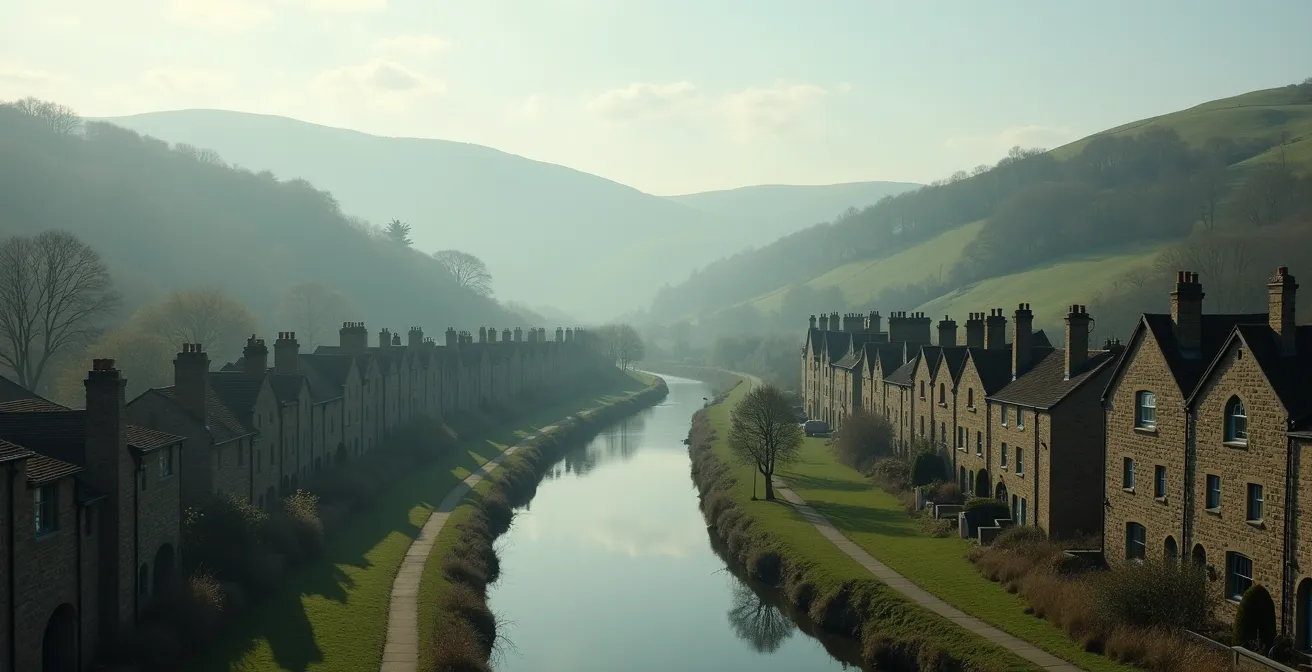
Thinking UK heritage is just castles and cathedrals? This guide reveals the industrial soul and intellectual power of Britain’s unsung UNESCO sites. We explore not just where to go, but how to connect with the living history that shaped the modern world—from the philanthropic vision of Saltaire to the raw experience of a Welsh coal mine, far from the familiar crowds.
When you picture a UK UNESCO World Heritage Site, your mind likely conjures the ancient, enigmatic circle of Stonehenge or the Roman elegance of Bath. These are icons for a reason, but they often come with a high price: queues, crowds, and a sense of viewing history from behind a velvet rope. This experience can leave a curious traveller feeling disconnected, as if observing a museum piece rather than stepping into a living story.
But beyond these headline acts lies a different kind of heritage, one that’s arguably more formative to modern Britain. It’s a heritage of ideas, industry, and ingenuity. It’s found in the grit of a coal mine, the ordered streets of a philanthropic village, and the wild, fossil-strewn beaches that rewrote our understanding of deep time. This is a tangible heritage, a history you can touch, walk through, and feel in your bones.
This guide is your intellectual detour. We will bypass the well-trodden paths to explore sites that tell the story of Britain’s industrial and social revolutions. We’ll uncover not just what these places are, but how to experience their ‘industrial soul’ authentically. You will learn how to see famous stones for free, where to legally hunt for your own piece of prehistoric life, and why a trip 300 feet underground can be more thrilling than any theme park ride. Prepare to see Britain’s heritage not as a static monument, but as a dynamic, lived landscape waiting to be explored.
This article provides a detailed exploration of these unique destinations. The following summary outlines the key sites and experiences covered, offering a roadmap for your next heritage adventure.
Contents: Beyond Stonehenge: A Guide to the UK’s Unsung UNESCO Sites
- Why Saltaire Village Is a Masterpiece of Victorian Philanthropy?
- How to See the Stones Without Paying the Visitor Centre Fee?
- Lyme Regis or Charmouth: Where Can You Legally Keep What You Find?
- Why Exploring the Blaenavon Mines Is Better Than a Theme Park?
- How Climate Change Is Threatening the Orkney Neolithic Sites?
- How to Reach the North Devon Biosphere Without a Car?
- Why Greece Wants Them Back and Why the UK Refuses?
- How to Explore the Brighton & Lewes Biosphere Without Harming It?
Why Saltaire Village Is a Masterpiece of Victorian Philanthropy?
Saltaire is not just a beautifully preserved Victorian village in West Yorkshire; it’s a monumental idea carved in stone and grit. Built between 1851 and 1876 by the textile magnate Sir Titus Salt, it was a radical social experiment. Salt, a devout Congregationalist, aimed to create an environment that would improve the moral, physical, and spiritual well-being of his workforce, a stark contrast to the squalid, disease-ridden slums of nearby Bradford. This wasn’t just about housing; it was a complete, self-contained community built in a harmonious Italianate style.
The scale of his vision was immense. By 1871, the village comprised over 800 dwellings housing 4,389 people, complete with a hospital, a school for 700 children, almshouses for the elderly, a park, and the grand Saltaire Institute with a library and concert hall. Unlike later philanthropic villages like Bournville or Port Sunlight, Saltaire was one of the earliest and most comprehensive examples. However, this benevolence came with strict social control; a key rule was teetotalism, with no public houses permitted in the village.
Today, the magnificent Salts Mill, once the thrumming heart of the world’s largest industrial building, has been reborn. It now houses a stunning permanent collection of works by local artist David Hockney, alongside independent shops and restaurants. To walk the grid-like streets, past the Grade I listed church and the meticulously designed workers’ cottages, is to step into a lived landscape shaped by one man’s powerful, if paternalistic, vision. It’s a profound lesson in how industrial might can be wielded not just for profit, but for social engineering.
How to See the Stones Without Paying the Visitor Centre Fee?
Stonehenge is a magnetic presence on the Salisbury Plain, but the official visitor experience, with its mandatory shuttle bus and hefty entrance fee, can feel sanitised and distant. For the traveller seeking a more personal and atmospheric connection to the ancient monument, there is a perfectly legal and wonderfully rewarding alternative. A public right of way allows you to approach the stone circle on foot, offering views that are arguably more dramatic and intimate than those from the official path, especially during the golden hours of sunrise and sunset.
The key is a public byway accessible from the village of Larkhill. By parking responsibly near the junction of Fargo Road and Willoughby Road, you can embark on a 15 to 20-minute walk across the historic landscape. This path brings you remarkably close to the stones, running parallel to the paid walkway but separated by only a simple rope fence. You are mere metres further away, a negligible distance that is more than compensated for by the freedom and lack of crowds. This route allows you to experience the stones in their natural context, feeling the scale of the landscape and the majesty of the monument without the filter of a curated attraction.
This approach transforms the visit from a simple tourist stop into a small pilgrimage. It’s an opportunity for heritage forensics, allowing you to observe how the light interacts with the sarsens and bluestones throughout the day and to photograph the circle from unique angles. Following this path is an act of reclaiming a more elemental experience of one of Britain’s most profound prehistoric sites.
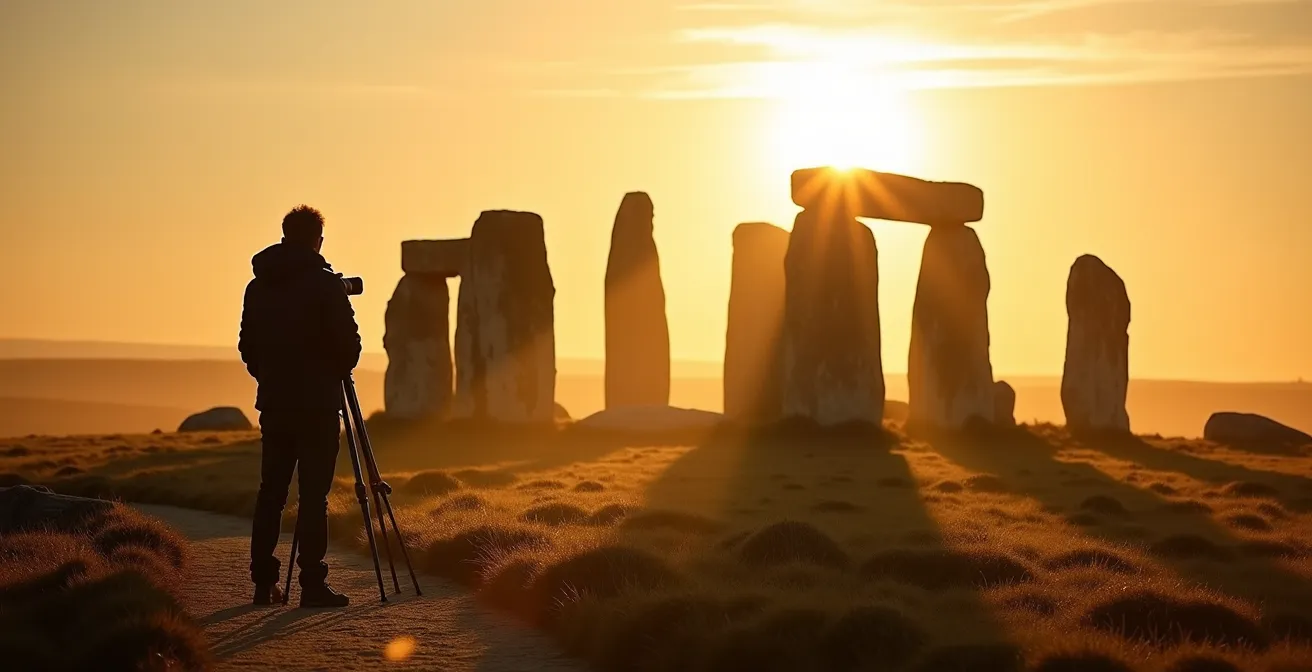
As you can see, this perspective offers an unparalleled opportunity for photography and quiet contemplation. The silhouette against the dawn sky puts the sheer scale and timelessness of the monument into sharp focus, a moment of connection that money simply cannot buy. It is the perfect way to appreciate this iconic landscape on your own terms.
Lyme Regis or Charmouth: Where Can You Legally Keep What You Find?
The Jurassic Coast, England’s first natural World Heritage Site, is a 95-mile-long treasure chest of geological history. For many visitors, the ultimate prize is to find a fossil of their own—a tangible link to a world of ichthyosaurs and ammonites. The two main hubs for this activity, Lyme Regis and Charmouth, each offer a different experience, and it’s crucial to understand the rules of engagement. The core principle is simple: you can keep what you find on the beach, but not what is embedded in the fragile cliffs.
As the West Dorset Fossil Collecting Code of Conduct, detailed in the Jurassic Coast Trust Guidelines, makes clear, responsible collecting is key. The advice is designed to protect both the finder and future scientific discoveries.
Surface fossils found on the beach are generally permissible to keep, but those embedded in cliffs should be reported – this is both for safety reasons and to preserve important scientific specimens.
– West Dorset Fossil Collecting Code of Conduct, Jurassic Coast Trust Guidelines
Choosing between the two towns depends on your goals. Lyme Regis is steeped in history, forever associated with the pioneering palaeontologist Mary Anning. It’s busier and more tourist-focused, with the excellent Lyme Regis Museum offering context and guided walks. Charmouth, by contrast, is the destination for the more serious collector. It is generally quieter, and its Heritage Coast Centre is staffed by professional fossil wardens who offer expert advice and lead dedicated hunts. The following table breaks down the key differences to help you plan your own piece of tangible heritage hunting.
| Aspect | Lyme Regis | Charmouth |
|---|---|---|
| Legal Collection | Beach fossils only (not cliff embedded) | Beach fossils only (not cliff embedded) |
| Best For | History buffs, Mary Anning heritage | Serious collectors, guided hunts |
| Key Facility | Lyme Regis Museum | Charmouth Heritage Coast Centre |
| Crowd Level | Busier, tourist hub | Quieter, dedicated collectors |
| Expert Support | Museum guides | Professional fossil wardens |
Why Exploring the Blaenavon Mines Is Better Than a Theme Park?
In a world of simulated experiences, the Blaenavon Industrial Landscape in South Wales offers something profoundly real: a journey into the dark, powerful heart of the Industrial Revolution. This is no ride; it’s a visceral encounter with the industrial soul of a nation. The centrepiece of this UNESCO site is the Big Pit National Coal Museum, a former working mine where visitors descend 300 feet (90 metres) underground into the original tunnels.
What elevates this experience from a mere tour to a deeply moving event is the human element. The guides are not actors; they are former miners, many of whom worked this very coalface. Their stories—of camaraderie in the darkness, the constant threat of danger, and the pride in their work—are unscripted, authentic, and utterly compelling. This is living history at its most potent.
The guides at Big Pit National Coal Museum are often former miners from the Welsh Valleys who worked in these very mines. Their unscripted personal stories – about near-misses, camaraderie, and the reality of working 300 feet underground – provide an authentic connection to industrial heritage that no theme park could replicate. The moment when they turn off all the lamps to demonstrate absolute darkness leaves visitors with a visceral understanding of mining conditions.
– Former Miner Guide Experience, Big Pit
The journey underground is just the beginning. The wider landscape includes the Blaenavon Ironworks, a beautifully preserved 18th-century site where new technologies pioneered the mass production of iron. You can walk the paths of a lived landscape that powered an empire. A theme park offers fleeting thrills, but Blaenavon provides something far more lasting: a genuine understanding of the human cost and colossal achievement of Britain’s industrial past. This is an intellectual and emotional journey that stays with you long after you return to the surface.

How Climate Change Is Threatening the Orkney Neolithic Sites?
The Heart of Neolithic Orkney is a collection of monuments so ancient they make Stonehenge seem modern. Sites like the 5,000-year-old village of Skara Brae and the chambered tomb of Maeshowe offer an unparalleled window into a sophisticated prehistoric culture. Yet this extraordinary legacy, which has survived for five millennia, now faces its greatest threat: modern climate change. The combination of rising sea levels and increased storm intensity is eating away at the Orcadian coastline, putting these irreplaceable sites at imminent risk.
The most vulnerable is Skara Brae, a remarkably preserved village that was buried by sand for thousands of years. Now exposed on the dramatic coast of the Bay of Skaill, its protective dunes are being eroded at an alarming rate. Monitoring by Historic Environment Scotland reveals that in some areas, the coastline is receding by several metres per decade, bringing the powerful Atlantic waves ever closer to the Neolithic structures. Increased rainfall also poses a problem, seeping into ancient tombs like Maeshowe and damaging the delicate internal masonry.
In response, a race against time is underway. Conservation is no longer a passive act but an active battle. The University of the Highlands and Islands is using cutting-edge 3D laser scanning to create precise digital records of the sites, preserving them for posterity before further damage occurs. New, more robust sea defences are being designed and implemented, and sophisticated drainage systems are being installed. Visiting these sites today is not just an act of tourism; it’s a poignant lesson in the fragility of our deepest heritage. The visitor fees directly contribute to these vital preservation efforts, making every tourist a partner in safeguarding this ancient wonder for future generations.
How to Reach the North Devon Biosphere Without a Car?
The North Devon Biosphere is a stunning mosaic of landscapes, from the wild expanse of Exmoor to the golden sands of Saunton and the unique Tarka Trail. Exploring this protected area sustainably is not just an ethical choice; it’s an opportunity to deepen your connection with the environment. Leaving the car behind transforms the journey from a means to an end into an integral part of the experience, offering perspectives and sensory details that are simply missed from behind a windscreen.
A network of public transport makes car-free exploration both feasible and enjoyable. The Tarka Line railway, running from Exeter to Barnstaple, is the gateway to the region. It’s a journey in itself, winding through lush river valleys and offering beautiful estuary views. From Barnstaple, an extensive network of buses connects you to the key coastal and inland locations. One of the highlights is the ‘Atlantic Coaster’ service, which often uses open-top double-decker buses on its route along the breathtaking coastline between Ilfracombe and Woolacombe.
This mode of travel encourages a slower, more observant pace. It’s an intellectual detour from the rush of modern life, allowing you to truly appreciate the transitions between landscapes. As noted by a local authority promoting sustainable tourism, the journey itself becomes a key part of the visit.
The journey itself becomes part of the experience – the Tarka Line offers stunning estuary views that car drivers miss completely, while the open-top deck of the Atlantic Coaster bus provides panoramic coastal vistas.
– Devon County Council, Sustainable Tourism Guide 2024
By using public transport, you not only reduce your carbon footprint but also directly support the local economy and the services that make these areas accessible for everyone. It’s a conscious choice to become a temporary resident of the landscape, rather than just a passive observer passing through.
Why Greece Wants Them Back and Why the UK Refuses?
The Parthenon Marbles, housed in the British Museum, are arguably the most famous and controversial museum artefacts in the world. Removed from the Acropolis in Athens by Lord Elgin in the early 19th century, their presence in London is a source of a long-standing and deeply emotional cultural dispute. Understanding this conflict requires an appreciation of two fundamentally different philosophies of how we should experience world heritage.
Greece’s argument is one of context and integrity. The sculptures are not standalone artworks but integral architectural components of a single, unique monument: the Parthenon. In the purpose-built Acropolis Museum in Athens, they can be displayed in their original orientation, with natural light and a direct view of the temple for which they were created. The empty spaces left for the missing pieces are a powerful, silent protest. The Greek position is that reuniting the collection would restore the monument’s wholeness and cultural meaning.
The British Museum’s counter-argument, as detailed in its public statements on contested objects, is rooted in the concept of the “universal museum.” It posits that placing the marbles in a global context, alongside other world cultures, allows a different kind of understanding and makes them accessible to a vast, international audience free of charge. The museum also argues it has a legal right to the sculptures and a duty to preserve them for all humanity. The debate is a fascinating clash of values: contextual integrity versus universal access, national identity versus global heritage. The table below summarises the core arguments.
| Aspect | British Museum (London) | Acropolis Museum (Athens) |
|---|---|---|
| Display Setting | Duveen Gallery, climate-controlled | Glass gallery with Parthenon view |
| Context Argument | Universal museum, global accessibility | Original architectural orientation maintained |
| Visible Evidence | Saw marks from Elgin removal, 1930s cleaning damage | Empty spaces awaiting marbles’ return |
| Annual Visitors | 6 million (free entry) | 1.5 million (paid entry) |
Visitor’s Checklist for Understanding the Controversy
- Look for visible saw marks on marble edges (evidence of 1816 removal process)
- Notice the controversial whitening from 1930s wire-brush cleaning
- Compare fragmented pieces with photos of complete friezes in Athens
- Read both museums’ interpretive panels on provenance and ownership
- Consider how lighting and display affect perception of the sculptures
Key Takeaways
- True heritage exploration goes beyond crowded landmarks to discover the ‘industrial soul’ and intellectual history of the UK.
- Authentic experiences, like descending into a Welsh coal mine with ex-miner guides, offer a deeper connection than simulated attractions.
- Responsible tourism is crucial, whether it’s understanding fossil collecting rules on the Jurassic Coast or using public transport to protect fragile biospheres.
How to Explore the Brighton & Lewes Biosphere Without Harming It?
The Brighton & Lewes Downs Biosphere, known as ‘The Living Coast’, is a precious landscape where the chalk hills of the South Downs meet the vibrant city of Brighton and the sea. This is not a wilderness reserve but a lived landscape, where millions of people live, work, and play alongside rare habitats like chalk grassland. Exploring it responsibly is not about restriction; it’s about a mindful engagement that ensures its survival for future generations.
The most fundamental principle is to ‘Leave No Trace’. The chalk grassland ecosystem is incredibly fragile. A single footstep off the marked paths can damage delicate wildflowers that have taken years to grow. During the spring and summer nesting season for ground-nesting birds like the skylark, keeping dogs on leads is not just a courtesy but a conservation necessity. It’s also vital to take all litter home, including organic waste like fruit peels, which can alter the delicate pH balance of the chalk soil. These small, individual actions collectively have a massive impact on preserving the biosphere’s health.
Beyond personal conduct, visitors can actively support the biosphere’s sustainability by patronising certified local businesses. The Living Coast project has a directory of partners, from bakeries and restaurants to wineries and accommodation, that are committed to conservation. Supporting a business like Silo, the UK’s first zero-waste restaurant in Brighton, or staying at the YHA South Downs with its Green Tourism Gold award, means your tourist spending directly contributes to the protection of the landscape you’ve come to enjoy. This creates a virtuous circle, proving that a thriving economy and a healthy ecosystem can go hand in hand.
By choosing these intellectual detours, you are not just seeing sights; you are engaging with the very ideas that built modern Britain. The next step is to plan your own journey into this tangible heritage, to see these landscapes not as a checklist, but as stories waiting for you to read them.