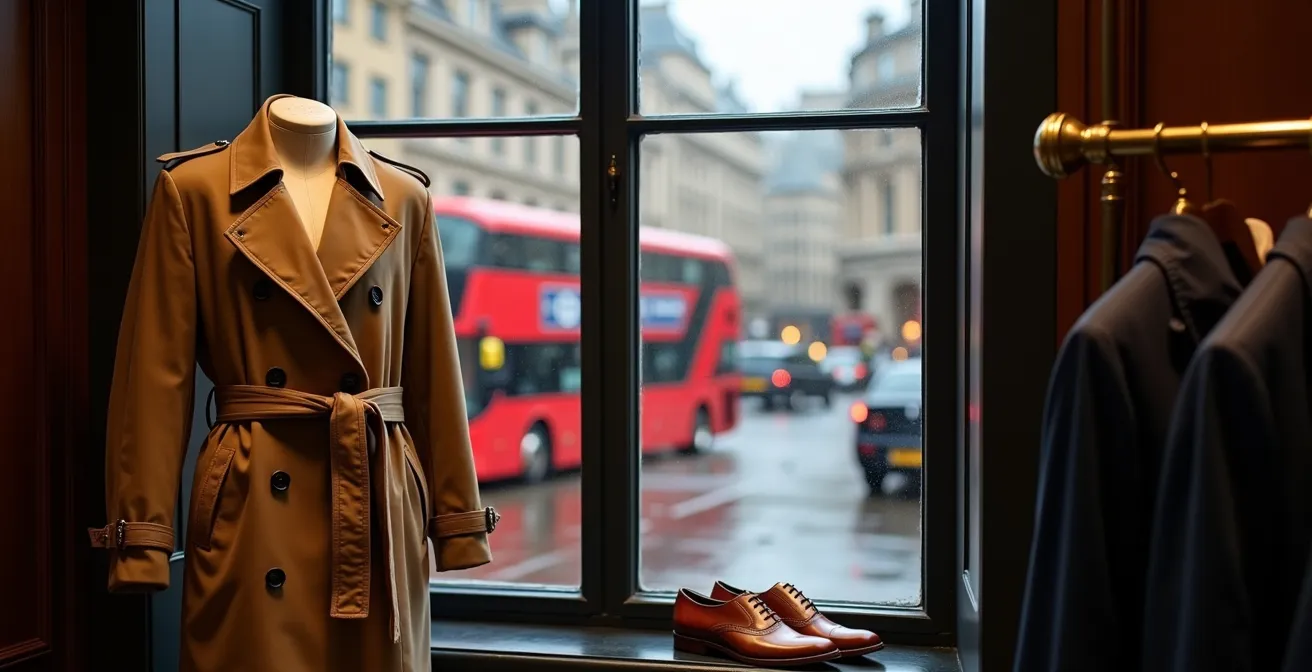
The true value of a £200 trench coat isn’t its price tag, but its dramatically lower ‘Cost Per Wear’ (CPW) in the face of relentless British rain.
- It withstands heavy downpours where ‘showerproof’ fast fashion fails, thanks to superior material integrity.
- Its construction allows for a maintenance lifecycle (cleaning, re-proofing) that extends its useful life for years, not just a season.
Recommendation: Calculate your investment not on the initial outlay, but on the cost divided by a decade of reliable, stylish wear.
There’s a moment every Briton knows well: the sudden, grey turn of the sky, the first fat drops of rain, and the dawning realisation that your stylish-but-cheap coat is about to betray you. The promise of being ‘showerproof’ evaporates into a damp, clinging disappointment. We’re often told that a quality trench coat is a ‘timeless classic’, a vague justification for a higher price tag. This advice, however, misses the point entirely from an investment perspective. It’s not about being a fashion staple; it’s about performance and durability in a climate that actively works to destroy your clothing.
The conversation around investment pieces often focuses on luxury brands and four-figure price tags, which is unrelatable for most. But what if the real sweet spot is the £200 mark? The key isn’t to think like a consumer chasing a trend, but like a professional buyer evaluating an asset. The crucial metric is Cost Per Wear (CPW). A £40 fast-fashion coat that lasts one soggy winter before losing its shape and water resistance has an infinitely higher real cost than a £200 coat you can wear reliably for a decade. This isn’t an expense; it’s a calculated investment in staying dry, looking professional, and owning something with genuine material integrity.
This guide deconstructs the £200 trench coat, moving beyond style to analyse the fabric science, maintenance lifecycle, and professional utility that make it the superior choice for the realities of British weather. We will explore why the technical specifications of a well-made garment offer a tangible return on investment that fast fashion simply cannot match.
This article provides a complete breakdown of the factors that determine a trench coat’s true value. The following summary outlines the key areas we will cover, from decoding fabric performance to strategic purchasing.
Summary: The Definitive Guide to Investing in a Weatherproof Trench Coat
- Why ‘Showerproof’ Is Useless in a Manchester Downpour?
- How to Re-proof Your Trench Coat Without Ruining the Breathability?
- Heritage Brand or High Street Premium: Is the Quality Gap Real?
- The Hemline Mistake That Makes You Look Shorter in Long Coats
- When to Buy Winter Coats to Get the Best Price Before Spring?
- Why Cotton Is Your Worst Enemy When Running in 5°C Drizzle?
- Etsy or Direct: How to Ensure the Maker Gets the Profit?
- Smart Casual Decoded: What to Wear to a UK Tech Interview vs a Law Firm?
Why ‘Showerproof’ Is Useless in a Manchester Downpour?
‘Showerproof’ is one of the most misleading terms in the British clothing market. It’s a low bar, designed to handle a light, fleeting drizzle. It is not designed for the persistent, soaking rain common across the UK. The technical term for this is the weather-performance threshold, the point at which a fabric stops resisting water and starts absorbing it. For most fast-fashion ‘showerproof’ coats, this threshold is crossed within minutes of a real downpour. In cities like Manchester, heavy rain is classified as 4 mm per hour or more, a rate that will overwhelm cheap coatings and loosely woven fabrics almost instantly.
The difference lies in material integrity. A true investment trench coat is typically made from long-staple cotton gabardine. The magic is in the incredibly tight weave of the fabric itself, which creates a natural barrier to water. Water droplets bead up on the surface and roll off, rather than soaking in. This is a mechanical property of the textile, not just a temporary chemical coating that wears off after a few wears or a single wash.

As this close-up shows, the hydrophobic properties of a quality fabric are visible to the naked eye. The water remains in spherical droplets, unable to penetrate the weave. In contrast, a cheap polyester coat relies on a thin DWR (Durable Water Repellent) finish. Once that finish is compromised by dirt, abrasion, or washing with standard detergent, the fabric underneath becomes saturated, heavy, and loses all its insulating properties. It stops being a coat and becomes a cold, wet liability. The £200 price point gets you into the realm of genuine material science, not just surface-level marketing.
How to Re-proof Your Trench Coat Without Ruining the Breathability?
One of the core components of a coat’s long-term value is its maintenance lifecycle. A cheap coat is a disposable item; a quality trench is an asset that can be maintained and restored. Re-proofing is a critical part of this process, designed to restore the water-repellent finish without compromising the fabric’s breathability—a crucial feature for comfort in damp, mild UK weather. Getting this wrong can seal the fabric, turning your breathable coat into a personal sauna.
The key is to use the right product for the material. Most investment trench coats are made of cotton or a polycotton blend, which requires a specific treatment. Avoid generic waterproofing sprays designed for tents or heavy-duty gear. Instead, look for wash-in or spray-on solutions formulated for technical cottons. It’s essential to first clean the garment with a specialised technical wash, as standard detergents leave behind hydrophilic (water-attracting) residues that prevent re-proofing agents from bonding to the fabric.
Comparing the market-leading products available in the UK shows clear differences in application and suitability. Your choice depends on your fabric and how much effort you’re willing to put in.
| Product | Application Method | Heat Required | Breathability Impact | Price Range |
|---|---|---|---|---|
| Nikwax TX Direct | Wash-in or Spray-on | No heat needed | Minimal impact if spray-on used | £8-12 |
| Grangers Performance Repel | Spray-on only | Air dry acceptable | Preserves breathability well | £10-15 |
| Nikwax Cotton Proof | Wash-in | No tumble dry needed | Specifically for cotton/polycotton | £9-13 |
As forum users discussing DIY re-proofing often report, preparation is everything. One user found that a Grangers spray-on treatment worked well, but its effect diminished after a couple of months, highlighting that professional services often use more durable industrial treatments. However, for a fraction of the cost, a correctly applied DIY treatment every year or two dramatically extends your coat’s life and performance, reinforcing its low Cost Per Wear.
Heritage Brand or High Street Premium: Is the Quality Gap Real?
When considering a £200 trench, the question of brand inevitably arises. Is it better to buy from a high-street premium label (like Reiss or Jigsaw) or hunt for a second-hand heritage brand (like Burberry or Aquascutum)? The reality is, at this price point, you are buying into a specific tier of quality, not a brand name. The “quality gap” is very real, but it’s between fast fashion and this £200+ tier, not necessarily between the brands within it.
A £200 coat from a reputable high-street brand is engineered to a standard. It will feature a tightly woven gabardine or similar technical cotton, quality seam taping in critical areas (like the shoulders), and robust hardware (buckles, buttons). These are the tangible markers of quality that contribute to a low Cost Per Wear. You are paying for the material science and construction, which will outperform a £50 coat in every meaningful way. The brand is secondary to these physical attributes.
The heritage brand conversation is more complex. A luxury trench coat offers diminishing returns in terms of pure weather performance. As one fashion journalist noted in a Berkshire Live column about the iconic brand:
A new Burberry will cost you a hefty £1,890, with second-hand options still costing hundreds of pounds on re-selling apps
– Fashion journalist, Berkshire Live fashion column
While the craftsmanship of a new Burberry is exceptional, it isn’t ten times more waterproof than a well-made £200 trench. With heritage brands, you are paying for the brand equity, the history, the specific cut, and the “Made in England” label. A second-hand heritage piece can be a fantastic investment if you find one in good condition, but for a guaranteed performance baseline, a new £200 coat from a trusted premium brand offers more predictable value.
The Hemline Mistake That Makes You Look Shorter in Long Coats
Beyond fabric and construction, the single most important factor for both style and practicality in a long coat is the hemline. Getting it wrong not only ruins your proportions, making you appear shorter and stumpier, but also creates practical problems in the wet British climate. A hem that is too long will drag on wet pavements, soak up dirty puddle water, and get damaged by the grit and salt used on roads in winter. A hem that is too short negates the primary benefit of a long coat: protecting your legs from rain and wind.
The ideal hemline on a trench or long coat for the average person should hit somewhere between the bottom of the kneecap and the top of the mid-calf. This length provides ample protection while still showing enough of the lower leg to maintain a sense of proportion. It’s also high enough to provide adequate “puddle clearance,” ensuring the fabric stays clean and dry. When wearing the coat over dresses or skirts, the coat’s hem should ideally be a few inches longer than the garment underneath for a clean, cohesive look.
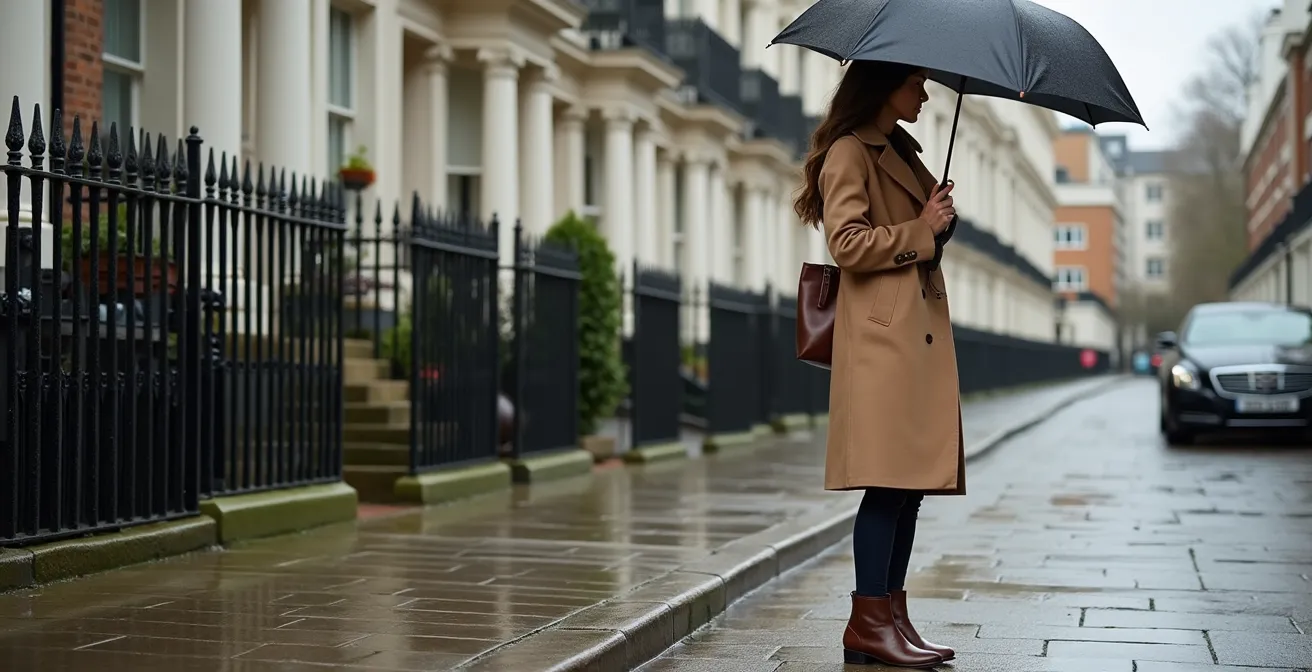
Don’t be afraid to invest in alterations. A budget of £15-£30 for a professional hemming at a local tailor or a chain like Timpson is a tiny additional cost that transforms a good coat into a perfect one. It’s a crucial final step in maximizing your investment, ensuring the coat not only performs well but also looks its best for years to come.
Your Action Plan: The Perfect Hemline Audit
- Measure with Intent: Stand in your most-worn winter boots. The hemline should hit your mid-calf or just below the knee for optimal proportion and protection.
- Check Puddle Clearance: Ensure the hem is a minimum of 15cm from the ground to avoid soaking up grime and damaging salt spray from wet streets.
- Layer and Compare: When worn with midi dresses or skirts, the coat’s hem should be 5-10cm longer than the dress hem to create a visually clean line.
- Budget for Tailoring: Allocate £15-£30 for professional hemming. This small investment guarantees a perfect fit that elevates the entire garment.
- Consider Seasonal Adjustments: A winter coat hem can be 2-3cm shorter than an autumn one to better accommodate the thicker soles of heavy-duty winter boots.
When to Buy Winter Coats to Get the Best Price Before Spring?
From a buyer’s perspective, timing the market is key to maximising value. While a quality trench coat is a year-round staple in the UK, purchasing one during specific retail windows can significantly reduce the initial outlay, making your Cost Per Wear calculation even more favourable. The worst time to buy is in September or October when demand is highest and prices are at full retail.
The first major opportunity is the post-Christmas sales period. UK retailers like John Lewis often begin their Boxing Day sales online as early as Christmas Eve, with discounts deepening through January. According to a detailed analysis of the John Lewis sales calendar, the “second markdown” phase in mid-January is often the sweet spot, offering an additional 10-20% off already reduced prices on premium outerwear. This is when a £250 trench might drop into the sub-£200 investment zone.
However, the absolute best prices are found in late February and early March. This is the final clearance period when retailers need to make space for incoming spring collections. The remaining winter stock, including classic trench coats, is often heavily discounted. While selection may be more limited in terms of sizes and colours, this is when you can find the deepest price cuts, often 60-70% off the original price. For instance, John Lewis typically offers discounts reaching up to 50% off during its main sale events, with final clearance offering even more. Patience is the strategic advantage here; buying your “winter” coat as spring begins is the smartest financial move.
Why Cotton Is Your Worst Enemy When Running in 5°C Drizzle?
While this article champions cotton gabardine, it’s crucial to understand that not all cotton is created equal. The statement “cotton is your worst enemy” is famous in the outdoor and athletic community for a reason, and it highlights the importance of fabric construction. Standard cotton, the kind used in t-shirts and hoodies, is hydrophilic—it loves water. When wet, it loses up to 90% of its insulating properties and clings to the skin, actively pulling heat away from your body. This is dangerous in cold, damp conditions.
This principle is directly applicable to outerwear. A cheap trench coat made from standard, loosely woven cotton will act like a sponge in a downpour. It will become saturated, heavy, and cold, offering zero protection. This is why the specific weave and treatment of gabardine are so critical. With a climate that delivers an average of 1046 mm of rainfall annually in Manchester, the difference between hydrophilic and hydrophobic cotton is not an academic point; it’s a daily reality.
Gabardine cotton is engineered to be the opposite of standard cotton. Its incredibly tight twill weave creates a surface so dense that water struggles to penetrate it. The long-staple fibres used are also naturally more water-resistant than the short-staple fibres in cheap cotton. This difference in performance when wet is stark.
| Property | Standard Cotton | Gabardine Cotton |
|---|---|---|
| Water Absorption Rate | Absorbs 25x its weight | Tight weave resists initial penetration |
| Drying Time | 4-6 hours | 2-3 hours |
| Breathability When Wet | Near zero | Maintains 40% breathability |
| Insulation When Wet | Loses 90% warmth | Retains 60% warmth |
This data proves that investing in a gabardine trench is an investment in functional textile technology. You are paying for a material that maintains its structure, a significant portion of its insulation, and its breathability even when faced with the persistent dampness of a British winter. It’s the engineering that justifies the cost.
Etsy or Direct: How to Ensure the Maker Gets the Profit?
Part of making a smart, long-term investment is considering the entire value chain. When you move away from fast fashion, you have the opportunity to support skilled makers and a more sustainable production ecosystem. The question is how to do it effectively. While marketplaces like Etsy can be a starting point for discovering independent brands, the best way to ensure the maximum profit goes to the person who made your coat is often to buy directly from them once you’ve found them.
True British craftsmanship comes with identifiable markers. Look for brands that are transparent about their production process. A genuine maker will proudly name their UK factory location, whether it’s in Manchester, London, or Northampton. They will be able to detail their supply chain, explaining where they source their gabardine or hardware. A label that simply says ‘Designed in the UK’ but is silent on manufacturing location is often a red flag for offshore, lower-quality production.
Supporting the ecosystem also goes beyond the initial purchase. It means investing in local services that maintain your garment. Instead of discarding the coat when it needs care, spend £20-£40 on a professional re-proofing service at a specialist cleaner every few years. Use independent tailors for alterations or repairs. This circular approach not only extends the life of your coat, lowering its Cost Per Wear to almost nothing over time, but it also channels money back into the local skilled economy. A ‘Made in UK’ or even ‘Made in Portugal’ label often indicates higher labour standards and quality control compared to far-east manufacturing, and these are qualities worth paying a premium for.
Key takeaways
- The ‘cost per wear’ metric is the most accurate way to evaluate a coat’s true value, prioritising longevity over initial price.
- ‘Showerproof’ is a marketing term; true performance in the UK requires a water-resistant fabric like tightly-woven gabardine that can be maintained.
- A quality trench is a professional asset, signalling preparedness and attention to detail in any UK business setting.
Smart Casual Decoded: What to Wear to a UK Tech Interview vs a Law Firm?
Beyond its technical performance, the £200 trench coat’s greatest asset is its incredible versatility, which further lowers its Cost Per Wear. It is the ultimate piece of professional signalling in the UK, capable of navigating the nuanced dress codes of different industries with ease. In a country where you can experience three seasons in one day, arriving at an interview dry, composed, and well-dressed is a powerful non-verbal cue that you are prepared and detail-oriented.
The trench coat acts as a sartorial bridge. For a tech or creative role interview in Shoreditch, it can be worn open over a merino wool jumper and dark jeans. It adds a layer of professionalism without appearing stuffy or corporate. The message is: “I’m creative, but I take this seriously.” For a finance interview in Canary Wharf or a law firm in the City, the same coat can be buttoned, belted, and worn over a formal shirt and trousers. It provides a sharp, clean silhouette that respects the formal environment while offering practical protection from the elements.
Case Study: The Professional First Impression Factor
A recent survey of UK hiring managers revealed that candidates who arrive prepared for the weather are perceived as having greater attention to detail and better judgment. One manager from a top City law firm commented that a candidate arriving in a drenched, cheap-looking coat “starts the interview on the back foot,” suggesting a lack of foresight. Conversely, a candidate in a quality trench coat, regardless of what’s underneath, is seen as “someone who understands the environment they operate in.” This demonstrates that the coat isn’t just clothing; it’s part of your professional toolkit.
This adaptability means you are investing in one piece of outerwear that can cover virtually every professional and social scenario in the UK. It eliminates the need for multiple, less-effective coats, simplifying your wardrobe and reinforcing the logic of buying one quality item over several mediocre ones. Evaluate your next outerwear purchase not by its price, but by its long-term cost per wear to make a truly smart investment.