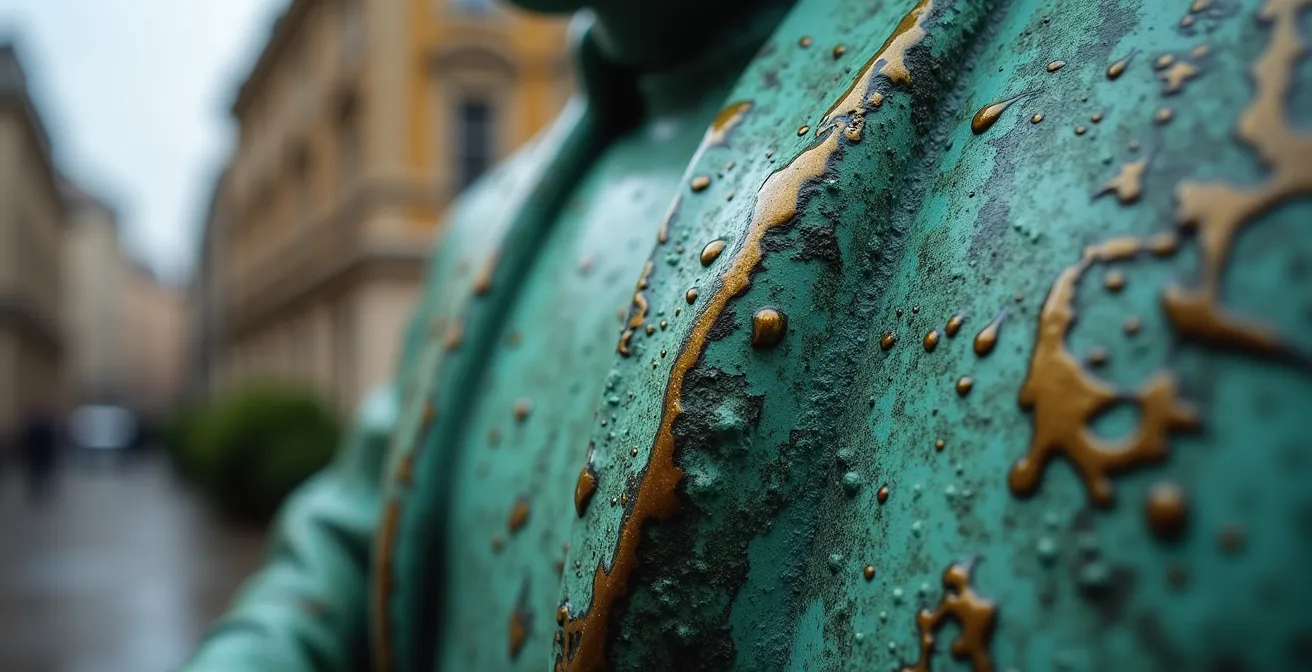
The green on a bronze statue is not just one thing; it’s a story of chemistry that can be either a protective shield or a destructive cancer for our public heritage.
- Environmental factors in the UK, like urban pollution and acid rain, dramatically accelerate chemical changes on bronze surfaces.
- A stable ‘noble’ patina is a desirable protective layer, while ‘bronze disease’ is an aggressive corrosion that requires immediate intervention.
Recommendation: Regular, gentle cleaning and protective waxing are crucial first-line defences, but diagnosing and treating serious issues should always be left to a professional conservator.
The green-tinged figures that watch over our city squares and parks are such a familiar part of the British landscape that we often take their appearance for granted. From London to Manchester, these silent witnesses acquire a distinctive verdigris coat, a process most people simply label as ‘oxidation’. We see it as an inevitable, even romantic, consequence of time and weather. However, from a conservator’s perspective, this surface transformation is a far more complex and critical narrative. It’s a dynamic chemical dialogue between the bronze alloy and its environment, one that can tell a story of graceful ageing or signal a catastrophic decay.
The common understanding is that rain and air cause the change, but this barely scratches the surface. The real story lies in distinguishing between different types of patina. Is the green a stable, protective shield that we call a ‘noble’ patina, or is it a sign of an aggressive, ‘vile’ corrosion that is actively eating away at the metal substrate? The difference is not merely aesthetic; it’s the difference between preservation and irreversible loss. Understanding this distinction is the first and most crucial step in the responsible stewardship of our public art heritage.
This guide will take you beyond the simple observation of a green surface. As a conservator, I will explain the specific environmental pressures our UK monuments face, from urban pollution to deliberate vandalism. We will break down the true costs associated with commissioning and restoring these works, explore the critical concept of ‘artist’s intent’ in their maintenance, and provide a practical guide to protective care. Ultimately, you will learn to see these statues not as static objects, but as complex systems that require informed care to survive for future generations.
In the following sections, we will delve into the specific chemistry of bronze degradation, the practical steps for assessment and maintenance, and the crucial role of the highly skilled professionals who preserve our shared history. This article provides a comprehensive overview for anyone—from council members to curious citizens—invested in the longevity of our public art.
Summary: Why Bronze Statues Turn Green and How to Maintain Them?
- Why Manchester’s Statues Degrade Faster Than Those in Rural Areas?
- Traffic Cones on Statues: Harmless Fun or Chemical Damage?
- Why Does a Life-Size Bronze Statue Cost £40,000?
- Moore or Hepworth: Who Changed the Landscape of British Sculpture?
- How to Wax Your Bronze Sculpture to Survive a British Winter?
- Why Soap Scum on Your Bath Means Your Pores Are Clogged?
- How to Find Open Studios to Watch Masters at Work?
- How to Support Endangered Crafts Like Clog Making Before They Vanish?
Why Manchester’s Statues Degrade Faster Than Those in Rural Areas?
The condition of a bronze statue is a direct reflection of its environment. A sculpture in a tranquil rural park in Dorset will age very differently from its counterpart in the heart of Manchester. The primary culprit is atmospheric pollution. Urban centres, particularly those with a rich industrial history like Manchester, concentrate airborne pollutants that act as aggressive chemical agents. The most significant of these are sulphur and nitrogen oxides, primarily from vehicle emissions and industrial processes. In fact, the public health impact is stark, with assessments linking air pollution to around 1,200 early deaths annually in Greater Manchester.
When these pollutants mix with moisture in the air—a frequent occurrence in the British climate—they form acidic solutions. This phenomenon, known as acid rain, dramatically accelerates the corrosion of bronze, which is an alloy primarily of copper and tin. Manchester holds a unique, if unfortunate, place in the history of this process. As early as 1852, scientist Robert Angus Smith conducted measurements that provided the first documented case of urban acid rain, showing that pollution from the industrial revolution dropped its pH from the usual ~5.5 to 3.5. This acidic deposition attacks the copper in the alloy, forming the characteristic green copper sulphates that we see staining the city’s monuments.
In contrast, rural air has far lower concentrations of these corrosive agents. The patina on a rural statue forms much more slowly and is more likely to be a stable layer of copper carbonates, derived from the natural carbon dioxide in the air. The intense, often streaky and uneven greening seen in cities is a clear signal of an ongoing, aggressive chemical assault that requires a more robust conservation strategy. The statue is not just ageing; it is reacting to a chemically hostile environment.
Traffic Cones on Statues: Harmless Fun or Chemical Damage?
The sight of a traffic cone perched atop a public monument, a recurring prank in cities like Glasgow and Manchester, is often seen as a piece of harmless fun. From a conservation standpoint, however, it represents a direct physical and chemical threat. Beyond the immediate risk of scratching or abrading the surface during placement and removal, the long-term contact between the cone’s material and the statue’s patina can cause significant, and sometimes irreversible, damage.
Traffic cones are typically made from PVC or similar plastics containing chemical additives called plasticisers, which keep the material flexible. When left in contact with a bronze surface, especially when exposed to cycles of sun and rain, these plasticisers can migrate out of the cone and into the microscopic pores of the patina. This can lead to disfiguring stains, often appearing as a ghostly outline or a discoloured patch that is incredibly difficult to remove without altering the surrounding patina. Furthermore, the trapped moisture underneath the cone creates a microenvironment that accelerates corrosion, leading to localised, uneven patina formation that disrupts the statue’s overall aesthetic integrity.

This form of casual vandalism highlights the vulnerability of outdoor bronze. Any foreign object left on a statue, from a sticker to a floral wreath, can trap moisture and leach chemicals. Responding to such incidents requires a careful and methodical approach to avoid causing further harm. Immediate removal of the object is key, but the subsequent assessment and cleaning must be done with an understanding of the material’s sensitivity.
Action Plan: Auditing a Bronze Statue’s Condition After an Incident
- Points of Contact: Document all areas where the foreign object touched the surface. Look for visible signals of damage such as new streaks, powdery spots, or discolouration.
- Collection: Inventory the existing condition by taking high-resolution photographs of the affected areas before any cleaning is attempted. Note any pre-existing issues.
- Coherence: Confront the current state with the statue’s intended appearance. Compare the damaged area to historical photographs to assess if the stable patina has been compromised.
- Memorability & Emotion: Distinguish between the statue’s natural, ‘noble’ patina and the new damage. Is the blemish a superficial stain or a sign of deeper chemical reaction?
- Integration Plan: Prioritise actions based on the assessment. This could range from a gentle wash with neutral detergents to scheduling a consultation with a professional metalwork conservator if staining persists.
Why Does a Life-Size Bronze Statue Cost £40,000?
The commissioning of a new public sculpture or the restoration of an existing one involves far more than just the cost of metal. A price tag of £40,000 for a life-size bronze statue may seem high, but it reflects a complex process involving artistry, specialised industrial craft, and significant logistical and regulatory hurdles. For councils and collectors, understanding this cost breakdown is essential for effective budgeting and project management. The process for creating a new work differs significantly from restoring a historic one, yet both are substantial investments.
For a new commission, costs begin with the artist’s design and consultation fees. The largest single expense is typically the foundry process: creating moulds, casting the molten bronze, and the highly skilled, labour-intensive work of chasing (finishing the metal surface) and applying the initial patina. The cost of the bronze alloy itself is also significant and fluctuates with global commodity markets. Finally, there are the costs of transportation and professional installation, which may require heavy machinery and structural engineering.
Restoration, on the other hand, carries its own unique expenses. It begins with a detailed conservation survey and material analysis to diagnose the problems. While the material costs for chemicals may be lower, the labour costs for specialist accredited conservators are high due to the precision and expertise required. Furthermore, working with historic, often listed, monuments involves navigating a complex web of permissions, such as obtaining Listed Building Consent, which adds significant administrative and reporting costs. The following table, based on guidance from heritage bodies like Historic England, illustrates the potential breakdown.
| Cost Component | New Bronze Commission | Historic Restoration |
|---|---|---|
| Initial Assessment | Artist consultation (£2,000-5,000) | Conservation survey & analysis (£3,000-8,000) |
| Materials | Bronze alloy (£8,000-12,000) | Patina chemicals & specialist materials (£2,000-4,000) |
| Labor | Foundry casting & finishing (£15,000-20,000) | Specialist conservator fees (£10,000-25,000) |
| Installation | Transport & mounting (£3,000-5,000) | Structural repairs & remounting (£5,000-15,000) |
| Compliance | Planning permission (£500-2,000) | Listed Building Consent & Heritage reports (£3,000-10,000) |
| Maintenance Fund | Optional endowment (£5,000+) | Mandatory conservation plan (£2,000-5,000) |
| Total Range | £35,000-50,000+ | £25,000-67,000+ |
Moore or Hepworth: Who Changed the Landscape of British Sculpture?
While art historians debate the relative influence of Henry Moore and Barbara Hepworth on modern British sculpture, for a conservator, their work raises a different but equally critical question: what did the artist want their sculpture to look like? This concept, known as ‘artist’s intent’, is a guiding principle in conservation. A sculptor does not simply create a form; they also make a deliberate choice about its surface. Some, like Moore, often favoured a dark, almost black, brooding patina on their bronzes. Others might have intended a brighter, more varied, or even a naturally developing green surface.
The challenge for conservation is to balance this original intent with the inevitable effects of the environment. Should a Moore sculpture be rigorously maintained to keep its dark finish, or should it be allowed to react to its surroundings and turn a bright green that the artist may never have envisioned? There is no single answer, and it’s an ongoing debate in the heritage sector. As one conservation perspective from Historic England puts it, this is a critical question: should a sculpture be allowed to turn bright green, or should it be maintained with the dark, brooding patina the artist originally favoured?
Artist’s intent is a critical conservation principle – should a Moore sculpture be allowed to turn bright green, or should it be maintained with the dark, brooding patina he originally favoured?
– Conservation perspective, Heritage conservation debate on artist intention
This challenge is amplified by the UK’s diverse environments. It is well understood in conservation that the rate of chemical change on a bronze surface is heavily location-dependent. For instance, research on environmental corrosion factors reveals that bronze surfaces in coastal environments, with their salt-laden air, can show patina formation up to three times faster than inland locations. A sculpture placed in St Ives, Cornwall, will have a vastly different ageing trajectory to an identical cast in an inland city. Respecting artist’s intent therefore requires not just a historical understanding, but a proactive, location-specific maintenance plan to manage the environmental forces at play.
How to Wax Your Bronze Sculpture to Survive a British Winter?
The single most effective protective measure an owner can take for an outdoor bronze sculpture is regular waxing. A correctly applied layer of wax acts as a sacrificial barrier, shielding the bronze and its patina from the primary cause of corrosion: water. During a typical British winter, with its relentless cycles of rain, frost, and damp, this barrier is essential. It prevents water from sitting on the surface and in crevices, where it can react with atmospheric pollutants to form corrosive acids.
Case Study: The Development of Renaissance Wax
The go-to product for museum professionals and conservators worldwide is Renaissance Wax, a product born from a specific conservation need. It was developed in the British Museum Research Laboratory in the late 1950s by Dr A.E.A. Werner. At the time, existing polishes based on natural waxes like beeswax and carnauba wax were found to be problematic, as they either contained acids or became acidic over time, potentially damaging the very objects they were meant to protect. In response, Dr. Werner formulated a new polish based on stable, refined microcrystalline waxes derived from crude oil. This formula proved to be chemically neutral, clear, and highly resistant to moisture, and is now a cornerstone of modern conservation practice for a vast range of materials, including bronze.
Applying wax is a straightforward process, but it requires care and precision. The goal is to apply a very thin, even coat. A thick, uneven application can trap dirt, discolour over time, and leave unsightly brush strokes. The process should be undertaken in dry, mild weather to allow the wax to cure properly. For outdoor sculptures in the UK, a twice-yearly application—once in late autumn to prepare for winter, and once in late spring—is a standard recommendation.
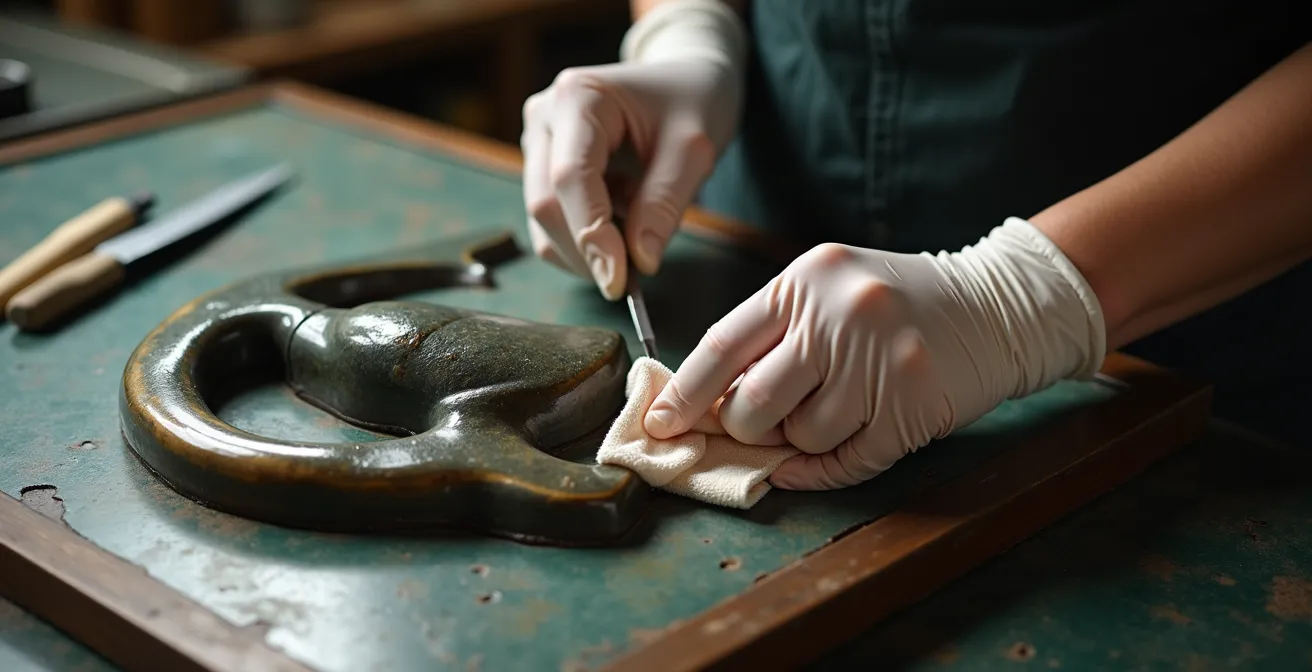
Here is a step-by-step guide based on professional practice:
- Preparation: First, gently clean the sculpture to remove any dust, cobwebs, or bird droppings. Use a soft brush and, if necessary, a cloth with a little warm water. Ensure the surface is completely dry before proceeding.
- Application: Using a clean, soft brush (a 1-inch brush is often suitable), apply a very thin layer of Renaissance Wax. Pay special attention to intricate details and areas where water is likely to collect, such as folds in drapery or under arms. Remember, less is more.
- Curing: Allow the wax to dry and haze over. This typically takes around 20-30 minutes, depending on the ambient temperature and humidity.
- Buffing: Once the wax is dry to the touch, use a clean, soft, lint-free cloth (like cotton or microfiber) to gently buff the surface to a subtle lustre. For detailed areas, a clean, soft shoe-brush can be effective.
- Ongoing Maintenance: Between waxing, it’s vital to remove tree resin and bird droppings as soon as they are noticed. These are highly acidic and can quickly damage both the wax layer and the patina beneath. A soft cloth and warm water are usually sufficient.
Why Soap Scum on Your Bath Means Your Pores Are Clogged?
It might seem an odd comparison, but the deposits that form on a bronze statue have something in common with the soap scum on your bath or the limescale in your kettle. In all cases, a layer is building up on a substrate. The crucial difference, however, lies in the nature of that layer: is it a harmless, superficial deposit, or is it a sign of an active process that is damaging the material underneath? For bronze, this is the vital distinction between a ‘noble’ patina and a destructive corrosion often called ‘bronze disease’.
A noble patina is the stable, uniform, and aesthetically pleasing green or brown layer that forms on bronze over many years. It is primarily composed of copper carbonates and sulphates that are chemically stable. Critically, this layer is adherent and non-porous, forming a protective shield that passivates the metal and slows down further corrosion. Like a good coat of paint on wood, it protects the substrate. This is the ‘good green’ that tells a story of graceful ageing.
In stark contrast is the ‘vile patina’, or bronze disease. This is not a patina at all, but a form of active, malignant corrosion. It manifests as bright green, powdery, or fuzzy spots on the surface. Chemically, it is caused by the presence of chlorides (often from salt in the air, de-icing salts, or pollution) reacting with the copper. Unlike a noble patina, this layer of copper chloride is unstable. It draws moisture from the atmosphere, creating a reaction that continues to eat into the bronze, producing more chlorides and creating pits in the metal—much like a cavity in a tooth. As Getty conservation research distinguishes, this chloride corrosion is identifiable by its powdery spots versus the uniform colour of a stable patina. The following table summarises the key differences.
| Characteristic | Noble Patina (Protective) | Bronze Disease (Destructive) |
|---|---|---|
| Appearance | Even, compact green or brown layer | Bright green, powdery pustules |
| Texture | Smooth, adherent surface | Flaky, loose powder |
| Chemical Composition | Stable copper carbonates/sulphates | Active copper chlorides |
| Effect on Bronze | Protects underlying metal | Actively eats into the metal, creating pits |
| Treatment Needed | Regular cleaning and wax maintenance | Urgent specialist conservation intervention |
How to Find Open Studios to Watch Masters at Work?
For those fascinated by the creation and care of bronze sculpture, the idea of watching a master at work is compelling. While artist open studios offer a glimpse into the creative process, the “masters” involved in preserving our public heritage are the conservator-restorers. These highly trained professionals work not in public-facing studios, but in specialised workshops and, most visibly, on-site at our monuments. Finding opportunities to see this meticulous craft in action or to engage with these experts requires a different approach.
The primary professional body for conservators in the UK is the Institute of Conservation (Icon). Their Conservation Register is the definitive resource for finding accredited specialists. For a member of the public, a council, or a private collector, this register is the first port of call to ensure you are commissioning a qualified professional. You can filter the register for ‘Metals’ and ‘Sculpture’ to find experts in bronze conservation near you.
Another avenue is to connect with the great British foundries that still practice the art of bronze casting. Establishments like Pangolin Editions in Gloucestershire or Morris Singer Foundry in Hampshire occasionally hold scheduled tours or open days. These events provide a unique opportunity to witness the ‘lost-wax’ process and understand the industrial craft that underpins all bronze sculpture. Finally, heritage organisations are increasingly offering behind-the-scenes glimpses into their conservation work. Here are some key ways to connect with these masters of conservation:
- Search the Institute of Conservation (Icon) register online for accredited metals specialists in your region.
- Contact major UK foundries like Pangolin Editions or Morris Singer to inquire about public tours or open days.
- Attend the annual student exhibitions at leading conservation training centres like West Dean College in Sussex to see the work of the next generation.
- For local monuments, book a consultation with your regional conservation officer at Historic England.
- Become a member of the National Trust or English Heritage, who often provide exclusive member events showcasing major conservation projects in progress.
Key Takeaways
- Not all green patinas are equal; a stable ‘noble’ patina protects the bronze, while ‘bronze disease’ actively destroys it.
- The UK’s urban pollution and damp climate create a uniquely challenging environment for outdoor bronze, accelerating corrosion.
- Professional conservation is a highly specialized craft, and proper maintenance requires more than simple cleaning; it involves diagnosis and targeted treatment.
How to Support Endangered Crafts Like Clog Making Before They Vanish?
When we think of endangered crafts, we often picture traditional skills like clog making or wheel-wrighting. However, there is another highly specialised craft, vital to our national heritage, that is facing a similar skills shortage: bronze conservation. The ability to correctly diagnose, treat, and preserve a monumental bronze sculpture is not something learned from a book. It is a ‘hands-on’ discipline passed down through rigorous apprenticeships and specialised academic programmes, combining chemistry, metallurgy, and fine art.
The scale of this skills gap is alarming. A professional analysis of heritage sector capacity shows that there are fewer than 50 accredited bronze conservators serving all of England’s vast collection of public and private heritage sites. This small pool of experts is responsible for thousands of monuments, from iconic national figures in Parliament Square to local war memorials. Without a pipeline of new talent and sustained support for existing professionals, the knowledge required to care for this heritage is at risk of disappearing.
Just as with traditional crafts, the principle of ‘use it or lose it’ applies. The most effective way to support this endangered skill is to create demand and provide funding for the work. For councils, collectors, and engaged citizens, this means moving from a reactive to a proactive mindset. Instead of waiting for a statue to be in a critical state of decay, we must invest in regular condition surveys and preventative maintenance plans. This not only preserves the artwork but also provides the consistent work that allows conservators and specialist foundries to maintain viable businesses and invest in training the next generation.
Here are practical ways to support the endangered craft of bronze conservation:
- Advocate for a Budget: Encourage your local council to allocate a dedicated annual budget for monument condition surveys and maintenance.
- Donate Directly: Contribute to specific statue conservation funds run by local councils or organisations like The National Trust.
- Support Training: Fund conservation training bursaries at institutions like West Dean College or City & Guilds of London Art School to help new students enter the field.
- Commission Wisely: When commissioning new works, choose traditional UK bronze foundries that run apprenticeship programmes to ensure skill transfer.
- Champion the Cause: Support the campaigns of the Heritage Crafts Association, which advocates for government funding and recognition for all endangered skills, including conservation.
To preserve our public heritage for future generations, the next step is to actively support the craft of conservation. Inquire with your local council about monument care, support heritage organisations, and champion the experts who are working to keep our history alive.