
The average London car costs thousands per year just sitting parked, making car clubs a financially superior alternative for most low-mileage urban drivers.
- Fixed ownership costs like depreciation, insurance, and parking permits create a silent financial drain on your budget.
- The Ultra Low Emission Zone (ULEZ) adds a significant financial risk and potential daily charges for non-compliant vehicles.
- Car clubs offer complete cost transparency, eliminating hidden expenses and converting a fixed liability into a flexible, on-demand expense.
Recommendation: Audit your total car expenses for one month. If the cost exceeds what you would spend on occasional car club use, it’s time to consider selling your car.
For many Londoners, owning a car feels like a necessity, a symbol of freedom in a bustling metropolis. Yet, the daily reality often involves circling for a parking spot, navigating congested streets, and watching a valuable asset sit idle for 95% of the time. The debate over ownership versus alternatives like car clubs often centres on convenience or environmental impact. These are valid points, but they miss the most critical factor for anyone driving less than 5,000 miles a year: the relentless, silent financial drain of a parked car.
Conventional wisdom tells us to weigh the monthly car payment against public transport costs. This approach is fundamentally flawed. It ignores the invisible expenses—depreciation, insurance, residential parking permits, MOTs, and repairs—that accumulate whether you drive one mile or one hundred. The question isn’t just whether a car club is cheaper for the journeys you make; it’s whether it can eliminate the significant costs you incur when you’re not driving at all.
This analysis moves beyond surface-level comparisons. We will dissect the true, all-in cost of London car ownership by treating your vehicle not as a convenience, but as a financial asset—or, more accurately, a depreciating liability. By quantifying the hidden costs and strategic risks like ULEZ penalties, we can provide a clear, data-driven answer to whether switching to a car club is the most financially astute decision for an urban resident.
This article provides a detailed financial breakdown, comparing the fixed, often hidden costs of car ownership in London with the variable, pay-as-you-go model of car clubs. Explore the sections below to build a complete picture.
Summary: A Financial Breakdown of London Car Ownership vs. Car Clubs
- Why Depreciation Makes Your Parked Car Cost £2000 a Year?
- How to Guarantee a Car for Christmas When Everyone Else Wants One?
- £10 Excess or £1000 Risk: Should You Pay the Extra Waiver Fee?
- The Charging Penalty That Hits You If You Return an EV Empty
- Why Car Club Bays Are the Best Parking Spots in Central London?
- How to Audit Your Monthly Direct Debits and Recover £500 a Year?
- Is Retrofitting Your Van for ULEZ Cheaper Than Selling It?
- How to Avoid Daily ULEZ Charges in London Without Buying a New Car?
Why Depreciation Makes Your Parked Car Cost £2000 a Year?
The most significant and least understood cost of car ownership is depreciation. Unlike a fuel receipt or an insurance bill, it’s a silent expense that drains value from your asset every single day, whether it moves or not. For a typical vehicle in London, this loss can easily exceed several thousand pounds annually. This figure is then compounded by other fixed costs that you cannot escape: insurance, tax, and resident parking permits, which can add hundreds or even thousands more to the yearly total. When you own a car, you are paying a premium for the *option* to drive, not for the driving itself.
This financial drain is amplified by regulatory risks. For instance, owning a non-compliant vehicle in the expanding Ultra Low Emission Zone can lead to staggering costs. An analysis highlights potential annual ULEZ charges of over £2,000 for those using their older car regularly. Even if you don’t drive frequently, the mere risk of incurring these charges devalues your asset and complicates the decision to use it. This transforms the car from a tool of convenience into a source of financial anxiety.
Visualising this £2,000-plus annual “sunk cost” in terms of what it could buy instead reveals the true opportunity cost of a parked car. This sum isn’t just a number on a spreadsheet; it represents significant lifestyle upgrades or financial goals that are being sacrificed. Instead of funding a depreciating asset, that money could be actively working for you:
- An annual Zone 1-4 Travelcard, covering all your public transport needs for a year.
- A significant contribution towards a shared ownership property deposit.
- A substantial investment into a tax-free ISA, allowing your money to grow.
- Hundreds of hours of driving time in a car club, paying only for the exact time you need.
Switching to a car club model fundamentally alters this equation. You are no longer paying for a vehicle to sit idle. Instead, you convert this large, fixed liability into a small, predictable, and entirely variable expense. You pay only for the mobility you use, freeing up thousands of pounds for more productive purposes. It’s a strategic shift from asset ownership to service utilisation—a far more efficient model for the low-mileage Londoner.
How to Guarantee a Car for Christmas When Everyone Else Wants One?
A common argument for car ownership is guaranteed availability. The belief is that owning a car means it’s always there when you need it, especially during high-demand periods like Christmas. However, this overlooks the realities of ownership: mechanical failures, the car being the wrong size for a specific trip (like collecting relatives from the airport), or it being blocked in. Ownership does not equal guaranteed utility, particularly when plans change.
Car clubs, often perceived as having limited availability during peak times, can actually offer a strategic advantage if approached with foresight. Unlike a private car, a car club fleet offers variety—from small city cars for quick trips to larger vehicles for family outings. The key is to treat booking a car club vehicle like any other festive planning activity, such as booking a train ticket or a restaurant table. Early and strategic planning is paramount.

As the visual suggests, securing a car for the festive season is about timing and strategy. By booking in advance, you not only guarantee a vehicle but also get your choice of model and location. This proactive approach turns a potential challenge into a distinct advantage, providing flexibility that a single privately-owned car cannot match. For those crucial trips—visiting family, airport runs, or navigating gift-laden shopping expeditions—a well-planned car club booking is often more reliable than relying on a single personal vehicle.
To ensure you have a vehicle ready for the holidays, a structured approach is essential. Follow a timeline to stay ahead of the demand surge:
- Book by late October or early November: This is the golden window for Christmas and New Year’s bookings to ensure the best availability.
- Consider multi-day discounts: Longer bookings often come with a lower daily rate, making them more economical for extended holiday use.
- Utilise one-way options: Services like Zipcar Flex are ideal for one-way journeys to major transport hubs like Heathrow or Gatwick, eliminating the need to pay for a parked car while you’re away.
- Have backup options: Be aware of other services like Enterprise Car Club or Hiyacar, which can serve as excellent alternatives if your first choice is unavailable.
- Compare with traditional rentals: For multi-day trips out of the city, sometimes a traditional rental from an airport location can be competitive. Do the maths.
£10 Excess or £1000 Risk: Should You Pay the Extra Waiver Fee?
One of the most compelling financial arguments for car clubs is the inclusion of insurance within the membership or booking fee. This eliminates a major, often complex, annual expense for car owners. However, a key detail that requires careful financial analysis is the insurance excess—the amount you’re liable for in the event of damage. Most car clubs have a standard excess that can be as high as £1,000, but offer a waiver to reduce it to a much lower figure, sometimes even to zero, for a small additional fee.
From a purely financial analyst’s perspective, this decision is a classic risk management calculation. Are you willing to accept a £1,000 potential liability to save a few pounds per trip or per month? Or is it more prudent to pay a small, fixed cost to cap your maximum financial exposure? For most drivers, especially in the unpredictable driving environment of London, paying the waiver is the more logical choice. It transforms an unknown, potentially high risk into a known, manageable operating cost.
This fee structure is part of the overall value proposition. To make an informed decision, it’s crucial to compare the all-in costs of different providers, including membership fees, hourly rates, and insurance terms. As a comparative analysis from Waltham Forest council shows, the models can vary significantly.
| Car Club | Annual Membership | Hourly Rate | Insurance Coverage |
|---|---|---|---|
| Zipcar | £59.50/year or £6/month | From £5/hour | Included in membership |
| Enterprise Car Club | £7/month | From £7.65/hour | Included in membership |
| Hiyacar | Free membership | From £4/hour | Booking fees charged separately |
The table illustrates that while some clubs may have lower upfront membership costs, the all-in price of a journey can differ. When factoring in the cost of a damage waiver, a slightly more expensive hourly rate might be offset by superior insurance coverage. The financially sound approach is to always opt for the waiver. It aligns with the core principle of using a car club: to replace the large, unpredictable costs of ownership with small, predictable, and controllable expenses.
The Charging Penalty That Hits You If You Return an EV Empty
The transition to electric vehicles (EVs) is a major advantage of modern car clubs. Fleets are increasingly electric, with providers like Zipcar operating one of the UK’s largest shared electric fleets. This allows members to drive the latest technology and avoid emissions charges without the colossal upfront investment of buying an EV. However, this benefit comes with a new layer of responsibility and potential penalties: charging.
Most car clubs have a strict policy regarding the battery level of EVs upon return. A vehicle must typically be left with a minimum state of charge (e.g., 25% or more) to ensure it’s usable for the next member. Failure to do so results in a penalty fee. This fee serves a dual purpose: it compensates the car club for the operational cost of taking the vehicle out of service to charge it, and it acts as a strong deterrent to leaving a car unusable.
For the user, this introduces a new calculation. The time spent charging must be factored into your booking duration. Furthermore, the cost of public charging needs to be weighed against the potential penalty fee. During a busy day, a 15-minute stop at a rapid charger is a small price to pay for peace of mind. Ignoring it could result in a fine that negates the savings of using an EV in the first place. A smart EV charging strategy is therefore not just about logistics, but about financial optimisation.
To avoid penalties and ensure a smooth experience, a disciplined approach to EV usage in a car club is essential:
- Plan charging stops: Before your journey, identify potential charging points like BP Pulse or Source London on your route using an app like Zap-Map or TfL’s charging map.
- Book extra time: Always add 20-30 minutes to your booking duration specifically for charging, especially if you anticipate finishing your journey with a low battery.
- Target rapid chargers: Utilise rapid chargers near your return location for a quick top-up at the end of your trip.
- Analyse the cost: In rare cases, if rapid charging costs are exceptionally high (e.g., peak-hour pricing) and the penalty fee is low, it might be cheaper to take the hit. This is an edge case but worth knowing.
- Be mindful in outer London: Charging infrastructure can be less dense in outer boroughs. Plan your journeys and charging stops with even more care when travelling further afield.
Why Car Club Bays Are the Best Parking Spots in Central London?
In the financial assessment of car ownership, parking is a major and often underestimated expense. A residential parking permit in a central London borough can cost hundreds of pounds per year. On top of that, paying for parking when visiting other parts of the city adds up quickly. However, the cost is not just monetary; it’s also measured in time and stress. The endless search for a vacant spot is a common frustration for every London driver.
This is where car clubs offer one of their most compelling, yet hardest-to-quantify, advantages: dedicated parking bays. These bays, reserved exclusively for car club vehicles, are often located in the most convenient and sought-after locations. Arriving at your destination and pulling straight into a guaranteed spot while other drivers circle the block is a luxury with immense practical value. This concept of “parking arbitrage” is a significant, non-monetary return on your car club membership.
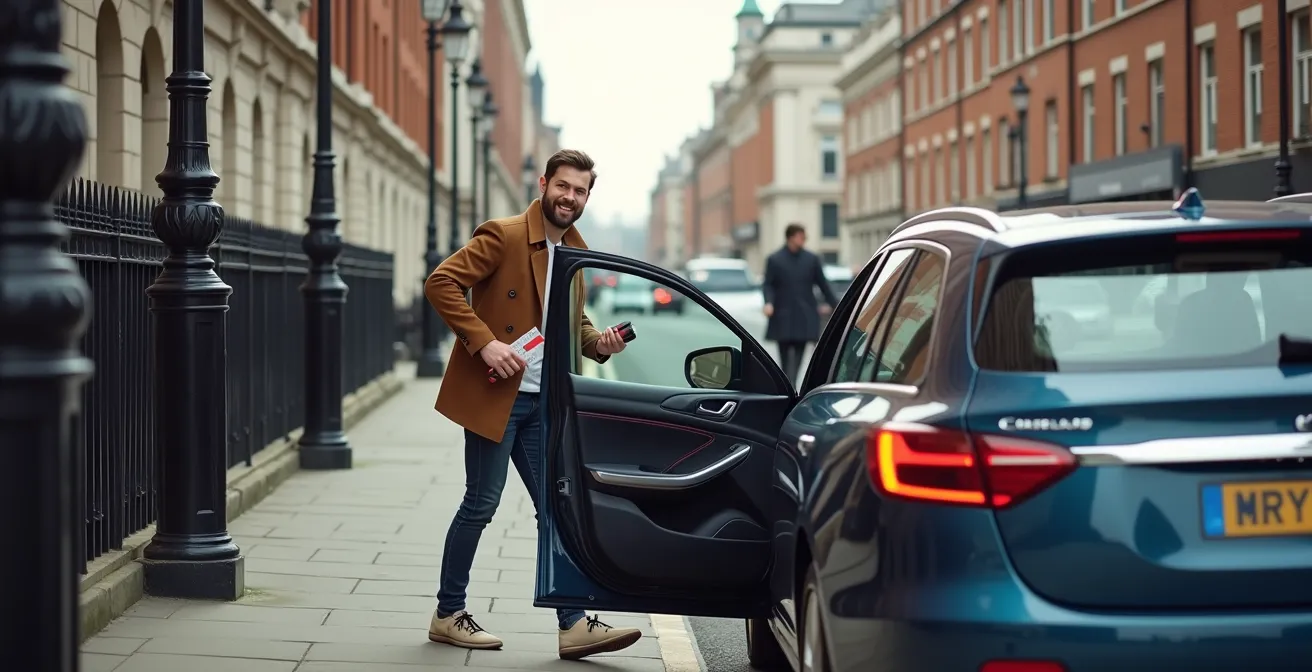
The existence of these prime parking spots is no accident. It’s a direct result of city policy aimed at reducing private car ownership. Councils actively support car clubs because they are a highly efficient use of road space. Research repeatedly shows that car clubs reduce the total number of vehicles on the road. For instance, comprehensive data from CoMoUK, cited by the London Assembly, demonstrates that one car club vehicle can replace between 15 and 32 private cars. This frees up vast amounts of kerbside space, reduces congestion, and improves air quality—goals that are central to TfL’s transport strategy.
For the user, this means your car club membership is effectively subsidised by a city-wide policy that grants you preferential parking. When you factor in the cost of a private parking space rental in central London—which can run into thousands per year—the value of these dedicated bays becomes crystal clear. It’s a benefit that doesn’t appear on an itemised bill but delivers tangible financial and practical returns every time you use the service.
How to Audit Your Monthly Direct Debits and Recover £500 a Year?
To make a truly informed financial decision, you must have a precise understanding of what you are currently spending. The total cost of car ownership is rarely a single, transparent figure. Instead, it is a collection of direct debits and recurring payments that are easy to lose track of. An honest audit of your bank statements is the first and most critical step in comparing ownership to a car club.
You might be surprised by the number of small, car-related expenses that add up over a year. Breakdown cover, automated toll payments, and even the standing charge on a little-used parking app all contribute to the silent financial drain. The goal of this audit is to compile a single, all-encompassing monthly cost of ownership. This number is your baseline. According to data from Zipcar, members consistently report monthly savings of around £300 compared to the costs of owning a car in London. Your personal audit will reveal if your own savings potential is in this ballpark.
This is not an estimate; it’s an exercise in financial archaeology. Go through your last six months of bank and credit card statements and categorise every single vehicle-related expense. This process will create the data you need for a true side-by-side comparison with the pay-as-you-go model of a car club.
Action Plan: Uncover Your True Annual Car Costs
- Insurance, Tax & MOT: Sum your annual costs for insurance, road tax, and your last MOT, then divide by 12 to get a monthly figure.
- Parking Permits: Find your annual residential parking permit cost and divide by 12. Add any regular parking costs (e.g., at work).
- Breakdown & Subscriptions: List all monthly direct debits for services like AA/RAC breakdown cover, Congestion Charge Auto Pay, or Dartford Crossing accounts.
- Financing & Depreciation: If you have a car loan, note the monthly payment. For depreciation, a rough estimate is 15-20% of the car’s value per year, divided by 12.
- Fuel & Maintenance: Calculate your average monthly fuel spend. Add in the cost of your last service and any repairs from the past year, then divide by 12 for a monthly average.
Once you have this total monthly cost, the comparison becomes simple. How many hours or days of car club use could you get for that same amount? For most Londoners driving less than 5,000 miles a year, the answer is often surprising and overwhelmingly in favour of giving up ownership.
Is Retrofitting Your Van for ULEZ Cheaper Than Selling It?
For sole traders and small business owners in London, the ULEZ expansion presents an even more acute financial challenge. A van is not a convenience; it is an essential tool for their livelihood. When a commercial vehicle is non-compliant, the owner faces a stark choice: pay the daily £12.50 charge, invest in an expensive retrofit, or scrap the vehicle and buy a new one.
Retrofitting a diesel van to meet Euro 6 standards can be a costly and complex process. While schemes exist, such as TfL’s scrappage scheme offering payments for non-compliant vans, these often don’t cover the full cost of a replacement vehicle. This leaves many business owners in a difficult position, forced to either take on debt to buy a new van or accept a significant loss on their existing asset.
The market dynamics reflect this pressure. Ahead of the ULEZ expansion, there was a dramatic surge in London-based listings for older, non-compliant vehicles. This flooded the market, causing values to plummet. A business owner trying to sell a non-compliant van was forced to accept a heavily discounted price, effectively crystallising a major financial loss. This situation highlights how regulatory changes can instantly turn a functional business asset into a significant liability.
Case Study: The ULEZ Effect on Commercial Vehicle Values
Before the full ULEZ expansion, analysis showed a 68% surge in online listings for cars over 15 years old originating from London postcodes. With approximately 700,000 vehicles in Greater London suddenly facing a potential daily charge of £12.50, owners of older commercial vehicles were among the hardest hit. This rush to sell created a buyer’s market, depressing the resale value of these assets and making it financially challenging for owners to trade up to a compliant model without incurring a substantial loss.
For many businesses that don’t require a van every single day, switching to a car club that includes vans in its fleet (like Zipcar) can be a powerful solution. It removes the entire ULEZ compliance burden, eliminates maintenance and insurance costs, and allows a business to scale its vehicle usage up or down based on actual demand. It’s a financially flexible model that mitigates the huge risks associated with owning a commercial vehicle in London today.
Key Takeaways
- The true cost of car ownership in London is dominated by silent, fixed expenses like depreciation and parking, which you pay even when the car is idle.
- Car clubs offer complete cost transparency and convert a fixed liability (an owned car) into a flexible, variable expense (pay-as-you-go mobility).
- Joining a car club is a powerful strategy to eliminate the financial risk and mental burden of ULEZ compliance, as fleets are fully compliant.
How to Avoid Daily ULEZ Charges in London Without Buying a New Car?
The expansion of the Ultra Low Emission Zone across all London boroughs has been a powerful catalyst for change. The primary goal is to improve air quality, and the policy has been effective in pushing drivers towards cleaner vehicles. Data from Transport for London shows that compliance is already high, with some reports stating that as many as 9 out of 10 cars seen driving in outer London meet the ULEZ standards. While this is a success for public health, it leaves the owners of the non-compliant 10% in a financially precarious position.
If you own one of these vehicles, you face a daily charge of £12.50 every time you drive. This can add up to thousands of pounds per year, making ownership untenable. The obvious solutions—buying a new compliant car or retrofitting your current one—involve significant capital expenditure. However, a third, far more financially efficient option exists: eliminating the problem entirely by selling the non-compliant vehicle and embracing a multi-modal transport strategy with a car club at its core.
This approach doesn’t mean giving up access to a car. It means using a car *smarter*. For daily commutes, public transport or an e-bike might be more efficient. For the weekly shop, a large project, or a weekend trip, you book a fully ULEZ-compliant car club vehicle. You get all the benefits of access to a car without any of the associated ownership costs or regulatory risks. The car club’s entire fleet is, by necessity, 100% compliant.
Adopting this strategy transforms you from a stressed car owner into a savvy urban navigator, using the right tool for every journey:
- Join a car club: This is the cornerstone of the strategy, giving you on-demand access to a ULEZ-compliant fleet.
- Combine transport modes: Use a Zipcar for a large supermarket run, but an e-bike or the Tube for your daily commute.
- Leverage public transport: Use Travelcards or contactless payments for regular, predictable journeys, reserving car club use for when a car is truly essential.
- Consider the scrappage scheme: If you are eligible, TfL’s scrappage scheme can provide up to £2,000 for a non-compliant car, which can be used to fund your new multi-modal transport lifestyle, including car club memberships and public transport passes.
Before you pay another month of insurance, another parking permit, or a single ULEZ charge, perform a full audit of your total cost of ownership. The resulting data will provide a clear, undeniable case for whether switching to a car club is the most logical next step for your finances and your peace of mind.